
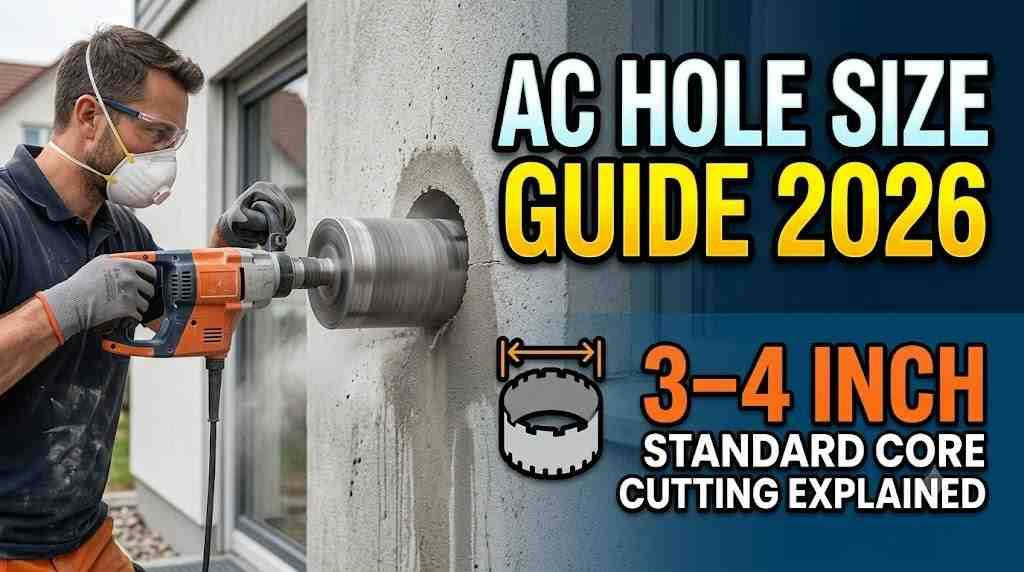
If you're installing a new split AC or window AC unit, one question comes up again and again: what is the correct AC hole size for the wall? Getting this wrong can lead to loose pipe fittings, water leakage, poor insulation, and even damage to your wall structure. In this guide, we break down the standard 3 inch and 4 inch AC hole sizes, why they matter, and how professional core cutting ensures a clean, precise, and damage-free installation every time.
At Core Cutting India, we specialize in precision core cutting for residential, commercial, and industrial AC installations across India. Whether you need a single hole for a home split AC or multiple holes for a commercial HVAC project, our expert team delivers accurate, dust-controlled, and structurally safe drilling. Need it done today? Call or WhatsApp us at 7009679903 for an instant quote.
Why AC Hole Size Matters
Every split AC unit requires a hole through the wall to pass the copper piping, drain pipe, and power cable that connect the indoor and outdoor units. If the hole is too small, the pipes get squeezed, restricting refrigerant flow and causing the compressor to work harder — which shortens the AC's lifespan. If the hole is too large, it leaves gaps that let in rainwater, dust, insects, and outside noise, and it weakens the insulation around the pipes.
This is exactly why the industry follows standardized hole sizes. Choosing the right size the first time saves you from costly rework, wall damage, and repeated core cutting charges later.
The Standard AC Hole Sizes: 3 Inch vs 4 Inch
3 Inch AC Hole Size
The 3-inch (75mm) hole is the most common size used for standard residential split AC units, typically ranging from 1 ton to 1.5 ton capacity. This size comfortably accommodates:
- Copper refrigerant pipes (both liquid and gas lines)
- The drain pipe
- The electrical wiring conduit/cable
A 3-inch hole is ideal for smaller rooms, bedrooms, and standard home installations where the piping bundle is compact.
4 Inch AC Hole Size
The 4-inch (100mm) hole is generally recommended for higher-tonnage ACs (2 ton and above), commercial split units, and installations where thicker insulated piping or additional cabling is required. The extra diameter gives enough clearance for:
- Larger diameter copper pipes used in bigger AC units
- Thicker foam/rubber pipe insulation
- Easier cable routing without compression
- Better sealing material application around the pipe bundle
Many technicians also prefer the 4-inch size for future-proofing, in case the AC unit is upgraded to a higher capacity later, since the same hole can be reused without additional wall damage.
Which Size Should You Choose?
| AC Capacity | Recommended Hole Size |
|---|---|
| 1 Ton Split AC | 3 inch |
| 1.5 Ton Split AC | 3 inch |
| 2 Ton Split AC | 4 inch |
| Commercial/Industrial AC | 4 inch or custom |
If you're unsure which size applies to your unit, our team at Core Cutting India can assess your AC model and wall type before drilling, ensuring the hole matches your exact piping requirement. This kind of on-site assessment is one of the biggest advantages of hiring professional core cutting services instead of relying on a general contractor with a hand drill.
Why Professional Core Cutting Is Better Than Manual Drilling
A lot of local electricians or AC technicians still use a hammer drill or chisel to create the wall opening. This often results in:
- Cracked plaster and uneven, jagged edges
- Oversized or undersized holes that don't match pipe diameter
- Dust and debris scattered across the room
- Structural micro-cracks in RCC (reinforced concrete) walls
Professional core cutting machines use a diamond-tipped hollow drill bit that cuts a perfectly round, clean hole in concrete, brick, or stone walls — with minimal vibration and dust when paired with water-cooled or vacuum dust-extraction systems. This is especially critical in RCC walls, where rebar-safe drilling avoids hitting structural reinforcement.
Our AC Core Cutting Process
- Site inspection – We check the wall thickness, material (brick, RCC, block), and AC unit specification.
- Marking – The exact hole position is marked based on indoor/outdoor unit alignment.
- Precision drilling – Diamond core bits (3 inch or 4 inch, as required) cut through the wall cleanly.
- Dust and debris control – Wet cutting or vacuum extraction keeps your space clean.
- Finishing – Edges are smoothed, and the hole is ready for pipe insertion and sealing.
This process typically takes 15–30 minutes per hole, depending on wall thickness and material.
Materials We Cut Through
Our core cutting equipment handles a wide range of wall materials commonly found across Indian homes and buildings, including RCC concrete, brick masonry, AAC blocks, and natural stone walls. Whatever your building type — apartment, independent house, office, or factory — our technicians carry the right tools and bit sizes for a clean cut.
Local AC Core Cutting Services You Can Trust
Core Cutting India provides on-demand AC hole cutting and core drilling services for homeowners, builders, interior designers, and HVAC contractors. Whether you're installing a single split AC in your bedroom or coordinating multiple installations across a commercial building, our team arrives with the right equipment, correctly sized diamond bits, and dust-control setup to get the job done without damaging your walls.
We serve residential societies, standalone homes, offices, retail spaces, and industrial units — bringing the same precision and care to every project, regardless of size.
Frequently Asked Questions (FAQ)
1. What is the standard AC hole size for a split AC? Most residential split ACs (1–1.5 ton) use a 3-inch hole, while 2-ton and larger units typically need a 4-inch hole.
2. Can I drill the AC hole myself? It's not recommended. Manual drilling often cracks the wall, creates uneven edges, and risks hitting electrical wiring or structural rebar. Professional core cutting ensures a clean, safe hole.
3. How long does AC core cutting take? A single hole usually takes 15–30 minutes, depending on wall thickness and material type (brick, RCC, or block).
4. Does core cutting create a lot of dust? With proper equipment like water-cooled or vacuum-extraction diamond drills, dust is significantly reduced compared to manual drilling or chiseling.
5. What if my wall is very thick (RCC)? Our diamond core bits are designed to cut through reinforced concrete walls safely, avoiding damage to embedded rebar wherever possible.
6. Is a 4-inch hole better than a 3-inch hole for all installations? Not necessarily. A 4-inch hole gives more clearance but isn't always needed for smaller AC units. Choosing the correct size for your specific AC capacity is more important than always going bigger.
7. Do you provide core cutting for commercial and industrial AC projects? Yes, we handle both residential and large-scale commercial/industrial core cutting projects across various wall types and thicknesses.
8. How do I book a core cutting service? Simply call or WhatsApp us at 7009679903, or email [email protected]. You can also visit our website at corecuttingindia.com to explore our full range of core cutting and drilling services.
Get Your AC Hole Cut Right, the First Time
Don't risk wall damage, leakage, or a poorly fitted AC unit with amateur drilling. Trust the precision of professional core cutting for your 3-inch or 4-inch AC hole requirement.
📞 Call or WhatsApp now: 7009679903 📧 Email: [email protected] 🌐 Visit: corecuttingindia.com to check our other core cutting and wall drilling services, including concrete core cutting and wall drilling solutions for homes, offices, and industrial sites.
Get in touch today for a fast, clean, and precise AC hole cutting service — anywhere you need it.