
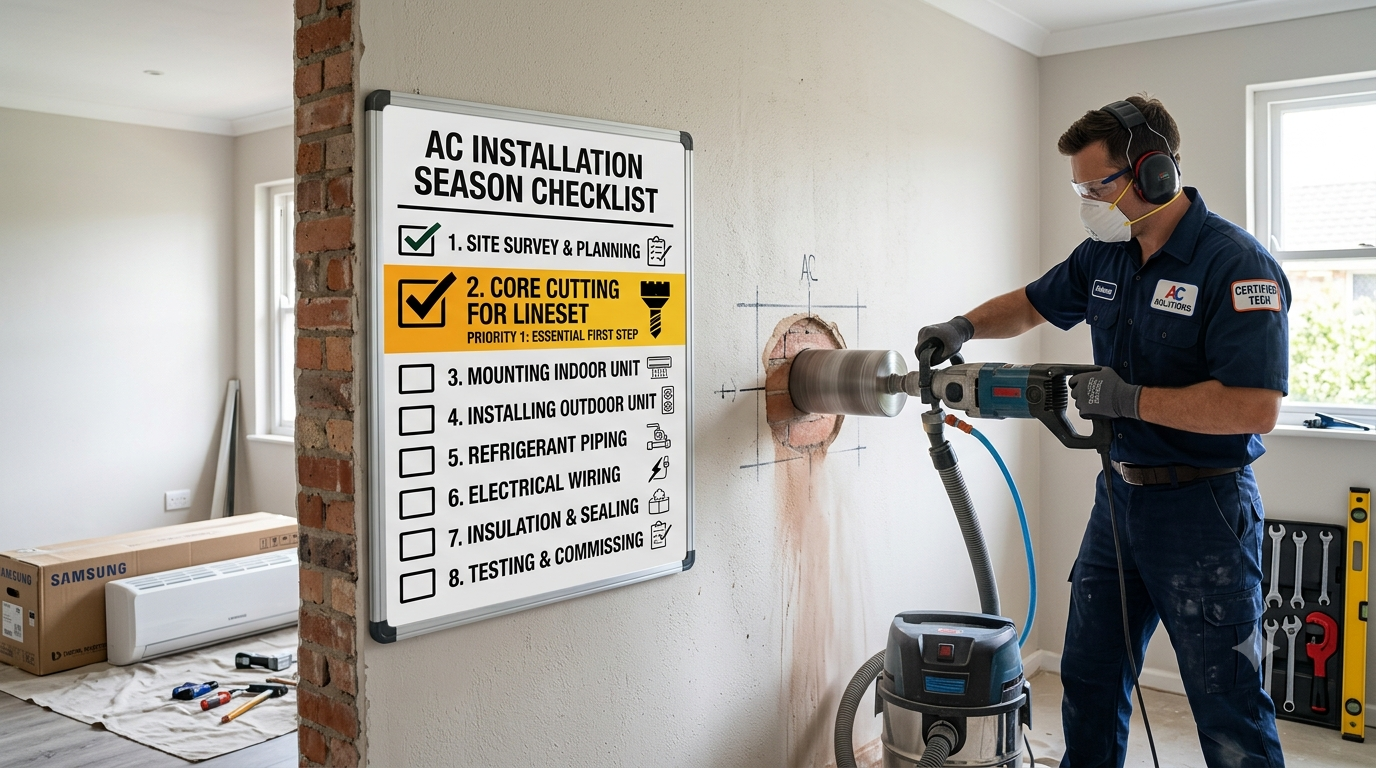
As the summer sun hits its stride across India, from the scorching heatwaves of Delhi-NCR to the humid coastal weather of Mumbai and Chennai, air conditioning shifts from a luxury to an absolute essential. Every year between March and July, HVAC technicians and electrical contract teams across the country operate around the clock to meet the surging demand for new split AC installations and structural renovations.
However, amidst the excitement of unboxing a high-efficiency inverter air conditioner, homeowners and property developers often overlook a critical step: how the refrigerant copper pipes, drainage hose, and wiring actually pass through your solid concrete walls or brick masonry.
Traditionally, local installers rely on heavy hammer drills, chisels, or manual sledgehammers to punch holes through RCC (Reinforced Cement Concrete) beams, brick walls, and exterior facades. This crude approach frequently leads to structural micro-cracks, unsightly plastered patches, water leakage during the monsoon, and permanent aesthetic damage.
To ensure your air conditioner operates efficiently without compromising your building’s structural integrity, core cutting must be the absolute first item on your AC installation checklist.
In this comprehensive guide, we unpack the mechanics of diamond core cutting, detail a step-by-step installation checklist tailored for Indian residential and commercial structures, and explain why partnering with specialists like Core Cutting India ([email protected]) guarantees a seamless installation.
What is Core Cutting and Why Does It Matter?
Before diving into the checklist, it is essential to understand what core cutting actually is and how it differs from traditional drilling methods.
Core cutting is a specialized engineering technique that uses heavy-duty, diamond-tipped cylindrical drill bits to cut smooth, precise circular openings through concrete, RCC structures, stone, brickwork, and asphalt without generating heavy structural vibrations.
Traditional Hammer Drilling                    Diamond Core Cutting
---------------------------                    --------------------
[Impact & Vibration]                          [Rotary Diamond Edge]
       │                                              │
       ▼                                              ▼
• Jagged, uneven holes                        • Perfectly smooth cylinder
• Structural micro-fractures                  • Zero structural vibration
• Water seepage risk                          • Tight, weather-sealed fit
• High noise & dust clutter                   • Dust-controlled wet cutting
When installing a split AC, an opening ranging from 2 inches to 4 inches (50 mm to 100 mm) in diameter is required to route:
-
Liquid and suction copper lines (refrigerant pipes)
-
Insulation sleeves
-
Condensate water drain pipe
-
Interconnecting electrical cable
When this hole is made using crude manual methods, the surrounding wall is subjected to extreme impact stress. Diamond core cutting, by contrast, cleanly slices through steel rebar and dense concrete like butter, leaving a perfectly round, smooth sleeve ready for immediate pipe passage.
The Ultimate AC Installation Season Checklist
Whether you are fitting out a high-rise apartment in Bengaluru, a villa in Hyderabad, or an office space in Gurgaon, follow this prioritized checklist before the summer rush begins.
┌─────────────────────────────────────────────────────────────┐
│               AC INSTALLATION PHASED CHECKLIST             │
├─────────────────────────────────────────────────────────────┤
│  PHASE 1: PRE-INSTALLATION & STRUCTURAL PLANNING            │
│  ├── 1. Tonnage & Load Assessment                            │
│  ├── 2. Wall Marking & Core Location Selection               │
│  └── 3. Electrical Load & Wiring Verification               │
├─────────────────────────────────────────────────────────────┤
│  PHASE 2: CORE CUTTING & SLEEVE PREPARATION (FIRST STEP)   │
│  ├── 4. Professional Core Drilling ([email protected])│
│  ├── 5. Downward Angle Check (10°-15° Slope for Drainage)   │
│  └── 6. PVC Wall Sleeve Insertion                            │
├─────────────────────────────────────────────────────────────┤
│  PHASE 3: AC UNIT MOUNTING & CONNECTIONS                    │
│  ├── 7. Indoor Unit (IDU) Plate Leveling                    │
│  ├── 8. Outdoor Unit (ODU) Stand Anchoring                   │
│  └── 9. Refrigerant Piping & Vacuuming                      │
├─────────────────────────────────────────────────────────────┤
│  PHASE 4: SEALING & COMMISSIONING                           │
│  ├── 10. Weatherproof Hole Sealing (PU Foam / Silicone)     │
│  └── 11. Condensate Drainage Test                           │
└─────────────────────────────────────────────────────────────┘
Phase 1: Pre-Installation & Structural Planning
1. Heat Load and Tonnage Calculation
Do not choose an AC unit based solely on room square footage. In Indian conditions, factor in:
-
Sun exposure: Top floors and west-facing rooms in cities like Ahmedabad require higher tonnage (e.g., 1.5 Ton to 2.0 Ton).
-
Occupancy & Appliances: Kitchens or home offices with multiple computers create higher thermal loads.
-
Ceiling Height: Standard 9–10 ft ceilings vs. double-height spaces.
2. Wall Inspection & Core Hole Placement
Identify where the indoor unit (IDU) and outdoor unit (ODU) will be mounted.
-
Avoid Structural Beams/Columns: Never cut through load-bearing structural columns without structural engineering approval.
-
Piping Distance: Keep the pipe run between the indoor and outdoor units as short as possible (ideally within 3 to 5 meters) to maintain cooling efficiency and reduce compressor strain.
3. Electrical Load and Stabilizer Verification
Ensure your home's electrical panel can handle the starting and running amperage of the new units. Verify that dedicated MCBs (Miniature Circuit Breakers) and appropriate copper wiring gauges (2.5 sq. mm or 4 sq. mm) are installed.
Phase 2: Core Cutting Execution (Why It Must Come First)
4. Perform Professional Core Cutting BEFORE Unboxing the AC
This is where most homeowners make a major mistake: they let the AC technician unbox the indoor unit, mount the backplate, and then start hammering away at the wall. This fills the delicate internal blower, filters, and evaporator coils of your brand-new AC with abrasive cement dust!
Execute core cutting first:
-
Call professional operators like Core Cutting India ([email protected]).
-
Cleanly cut the designated 2.5-inch or 3-inch hole through brick, block, or RCC.
-
Collect slurry and dust using dedicated wet-vacuum attachments to protect indoor floor tiles and wallpaper.
5. Maintain a Downward Slope (10° to 15°)
Condensate water flows out of the indoor unit purely through gravity. The core hole must be drilled at a slight downward angle toward the exterior wall.
If a hole is drilled straight or tilted slightly upward—a common mistake when using manual chisels—water will pool inside the drain pan, leading to indoor water dripping, mold growth, and ruined wall paint.
6. Insert a Rigid PVC Wall Sleeve
Once the clean cylindrical hole is bored, insert a rigid PVC conduit pipe inside the core opening. This sleeve protects the fragile copper insulation and electrical cabling from rubbing against raw cement edges over time.
Phase 3: Unit Mounting & Refrigerant Line Setup
7. Indoor Backplate Mounting
Ensure the indoor unit mounting plate is installed completely level using a spirit level tool. A tilted indoor unit causes uneven condensate drainage and fan motor vibration.
8. Outdoor Unit (ODU) Placement
-
Place the outdoor unit in a well-ventilated space (balcony, terrace, or cantilever bracket).
-
Install rubber anti-vibration pads under the ODU feet to prevent humming noises from transferring through the building structure.
9. Copper Line Flaring and Vacuum Evacuation
-
Ensure high-grade, thick-walled copper tubing is used (especially for modern R-32 and R-410A high-pressure refrigerants).
-
Crucial Step: The technician must use a vacuum pump for at least 15–20 minutes to purge air and moisture from the lines before opening the refrigerant valves. Moisture inside the lines causes ice blockage and acid formation, leading to premature compressor failure.
Phase 4: Weatherproofing & Final Commissioning
10. Gap Sealing with PU Foam or Weatherproof Silicone
Once the piping bundle is routed through the sleeve, seal the exterior and interior gaps surrounding the pipes. Use expanding Polyurethane (PU) foam or neutral silicone sealant to prevent rainwater ingress, insects, dust, and warm air draft entry into your air-conditioned room.
11. Drain Test & Commissioning
Pour a cup of water directly into the indoor unit’s drain pan before turning the unit on to verify smooth, leak-free drainage outside. Check supply air temperature drops (should be 8°C to 12°C lower than room ambient air).
Deep Dive: Why Core Cutting Should ALWAYS Come First
To understand why leading interior designers, architects, and MEP (Mechanical, Electrical, Plumbing) consultants across India insist on core cutting prior to AC installation, let us examine the mechanical and structural reasons.
               TRADITIONAL DRILLING vs. DIAMOND CORE CUTTING
┌──────────────────────────────┬──────────────────────────────┬──────────────────────────────┐
│ PARAMETER                    │ TRADITIONAL HAMMER / CHISEL  │ DIAMOND CORE CUTTING         │
├──────────────────────────────┼──────────────────────────────┼──────────────────────────────┤
│ Hole Finish                  │ Jagged, uneven, oversized    │ Perfectly smooth cylinder    │
│ Structural Impact            │ High vibration micro-cracks  │ Zero structural impact       │
│ Steel Rebar Handling         │ Hits rebar, stalls or bends  │ Slices rebar cleanly         │
│ Noise & Dust                 │ Extreme noise, flying debris │ Low noise, water dust-control│
│ Water Leakage Risk           │ High (cracks trap moisture)  │ Minimal (sealed fit)         │
│ Finishing Work Needed        │ Extensive plastering & paint │ Zero masonry repairs         │
└──────────────────────────────┴──────────────────────────────┴──────────────────────────────┘
1. Protection Against Structural Micro-Fractures
Indian residential construction heavily utilizes RCC framing—a combination of concrete and steel reinforcement bars (rebar). When a heavy hammer drill or chisel strikes concrete, it sends high-frequency shockwaves through the slab and beam matrix.
These shockwaves create micro-fractures within the concrete. Over time, especially during monsoon seasons in cities like Mumbai, Kochi, or Kolkata, rainwater seeps into these micro-cracks. The water reacts with internal rebar, causing rust expansion, concrete spalling, and costly structural damage.
Diamond core bits operate on a smooth rotational cutting principle rather than impact hammering. They slice through stone, concrete, and steel rebar cleanly without transmitting shockwaves to the surrounding wall.
2. Neatness and Architectural Integrity
When you spend lakhs on premium interior design, textured wall paints, or imported wallpapers, having a massive, jagged hole patched up with uneven white cement ruins the aesthetics of your living room.
Core cutting creates a clean, factory-finish circular opening. The face of the wall remains immaculate, eliminating the need for plaster repairs, masonry work, or touch-up repainting after the AC team finishes.
3. Dust Protection for Sensitive HVAC Equipment
Traditional drilling generates fine silica dust that settles everywhere. If the AC unit is already mounted on the wall when traditional drilling occurs, this abrasive silica dust accumulates on:
-
The evaporator coil fin pack
-
The blower wheel fan assembly
-
The electronic PCB control module
Silica dust combined with humidity forms a sticky paste on the internal cooling fins, reducing airflow efficiency by up to 25% right out of the box. Core cutting utilizes water lubrication (wet cutting) or local dust collection, capturing concrete slurry at the source and keeping your living room and new appliance dust-free.
4. Precision Fit for Pipe Insulation
Split AC copper tubes are wrapped in Elastomeric Nitrile Rubber insulation to prevent thermal loss and sweat condensation.
When copper pipes are shoved through an uneven, jagged, hand-chiseled hole, sharp concrete edges rip through the foam insulation layer. Exposed copper tubing then sweats inside the wall cavity, causing internal dampness, wall fungus, and peeling paint behind the indoor unit. A smooth, core-cut hole slides the insulated pipe bundle through without damaging the sleeve.
Real-World Indian Scenarios: Lessons from the Field
To appreciate the impact of proper core cutting, consider these typical installation challenges encountered in Indian properties:
Case Study A: The High-Rise Luxury Apartment in Gurgaon
-
The Problem: A homeowner on the 18th floor of a premium apartment complex bought three 5-star inverter split ACs. The local installer attempted to chisel through the 9-inch exterior concrete sheer wall. After 3 hours of deafening noise, complaints from neighbors, and a bent steel rebar, the installer produced a messy, oblong 5-inch hole that broke the interior plaster wall.
-
The Solution: The owner called a specialized team at Core Cutting India ([email protected]). Using a high-precision diamond core rig anchored to the wall, the team completed the remaining two 3-inch penetrations through dense RCC within 25 minutes per hole, leaving completely smooth openings without disturbing the neighbors or damaging the exterior brick cladding.
Case Study B: Monsoon Leakage in a Coastal Villa in Chennai
-
The Problem: A villa owner in Chennai experienced recurring water dripping inside their master bedroom every time heavy rains hit during the North-East monsoon. An inspection revealed that the installer had hammered a hole at an upward angle from inside to outside. Driven by wind, rainwater collected in the oversized, jagged cavity and flowed directly down into the bedroom.
-
The Solution: The technician sealed the damaged area with high-strength non-shrink grout. A fresh 3-inch diamond core hole was drilled nearby with a dedicated 12-degree downward slope toward the exterior, fitted with a PVC sleeve, and sealed with weather-resistant sealant. The leakage stopped permanently.
Key Mistakes to Avoid During AC Wall Penetration
-
Cutting Main Load-Bearing Rebar Recklessly: While core drills can cut through steel rebar, cutting through primary structural steel in a critical beam or column without an engineer's consent can compromise building safety. Always position core holes through non-structural wall panels, brick infills, or pre-approved shear wall zones.
-
Forgetting the PVC Sleeve: Never run bare insulated copper pipes directly against raw concrete or brick cutouts. Always insist on a PVC conduit sleeve.
-
Improper Hole Size:
-
Standard 1.0 to 1.5 Ton Split AC: 2.5-inch (63 mm) core bit is ideal.
-
Multi-split or VRF systems with multiple pipe runs / heavy insulation: 3-inch to 4-inch (75 mm to 100 mm) core bit required.
-
A hole that is too tight crushes the insulation; a hole that is too wide is difficult to weather-seal.
-
-
Skipping the Slope: Ensure the core drill rig is set at a slight downward tilt before the operator starts drilling.
Why Choose Core Cutting India?
When preparing your property for the summer AC installation season, working with experienced structural penetration specialists makes all the difference.
At Core Cutting India, we specialize in providing heavy-duty, dust-controlled core drilling services tailored for residential apartments, commercial complexes, industrial plants, and villa projects across India.
Our Services Include:
-
Precision AC Core Cutting: Clean 2-inch to 6-inch wall and slab openings for split ACs, VRV/VRF systems, and ductless units.
-
RCC Structural Core Drilling: Advanced diamond bit drilling through high-grade reinforced concrete, beams, and sheer walls.
-
Plumbing & Electrical Penetrations: Smooth circular cuts for drain lines, conduits, and ventilation ducts.
-
Stitch Drilling & Concrete Sawing: Customized concrete removal for larger MEP openings.
Get in touch with the experts before your AC installation:
📧 Email Us: [email protected]
🌐 Website: Contact Core Cutting India today for hassle-free, structural-safe core drilling services at competitive rates.
Target-Related Searches
To help you research further, here are the top search queries homeowners and contractors use when planning AC wall penetrations:
-
AC core cutting cost in India per hole
-
Split AC wall hole drilling machine diamond bit
-
Core cutting service for air conditioner in residential apartments
-
How to prevent water leakage from AC wall hole
-
Core cutting vs local hammer drilling for split AC
-
RCC beam core cutting safety guidelines for HVAC
-
Best size of core cutting bit for 1.5 ton split AC
-
Dustless core drilling service near me for AC installation
People Also Ask (PAA) Questions
Q1: What is the ideal size for an AC core cutting hole?
Answer: For a standard 1.0 Ton to 2.0 Ton residential split air conditioner, a 2.5-inch (63 mm) to 3-inch (75 mm) diameter core hole is ideal. This provides sufficient clearance for two copper tubes (suction and liquid lines), foam insulation, the interconnecting electrical cable, and the flexible condensate drain pipe without pinching the insulation.
Q2: Can core cutting damage the main structure or RCC beams of my house?
Answer: When done by experts using diamond core bits, core cutting creates zero vibration, which prevents micro-cracks in surrounding concrete. However, you should avoid cutting main load-bearing structural columns or primary reinforcement bars without consulting a structural engineer. Core holes should ideally be placed through brick masonry, AAC block walls, or non-structural sheer wall locations designated for utilities.
Q3: Why does water leak inside the room after installing a split AC?
Answer: Indoor water leakage is most commonly caused by an improperly sloped wall hole. If the hole drilled through the wall is level or tilts upward toward the outside, condensate water cannot drain freely by gravity and flows back into the room. Drilling the core hole with a 10° to 15° downward exterior slope prevents this issue completely.
Q4: How long does it take to core cut a wall for an AC installation?
Answer: On a standard 9-inch brick or AAC block wall, diamond core cutting takes roughly 15 to 20 minutes. For heavy RCC (Reinforced Cement Concrete) walls with steel rebar, the process typically takes 30 to 45 minutes depending on concrete density and rebar thickness.
Q5: How much does AC core cutting cost in India?
Answer: Professional AC core cutting rates in India typically range from ₹500 to ₹1,500 per hole, depending on the wall thickness, material (brick wall vs. heavy RCC slab), floor height, and location. Contact [email protected] for customized project quotes.
Final Thoughts: Invest in Core Cutting for Peace of Mind
An air conditioner is a long-term investment meant to keep your home comfortable for a decade or more. Don't let a crude hammer-and-chisel approach ruin your expensive interior walls, damage your new appliance with silica dust, or create permanent water seepage issues.
By prioritizing professional diamond core cutting as the first step on your AC installation checklist, you ensure a clean, precise, structural-safe opening that preserves your property’s beauty and structural strength.
Planning your AC installation this season? Reach out to the specialists at Core Cutting India at [email protected] to schedule your precision core drilling service today!