
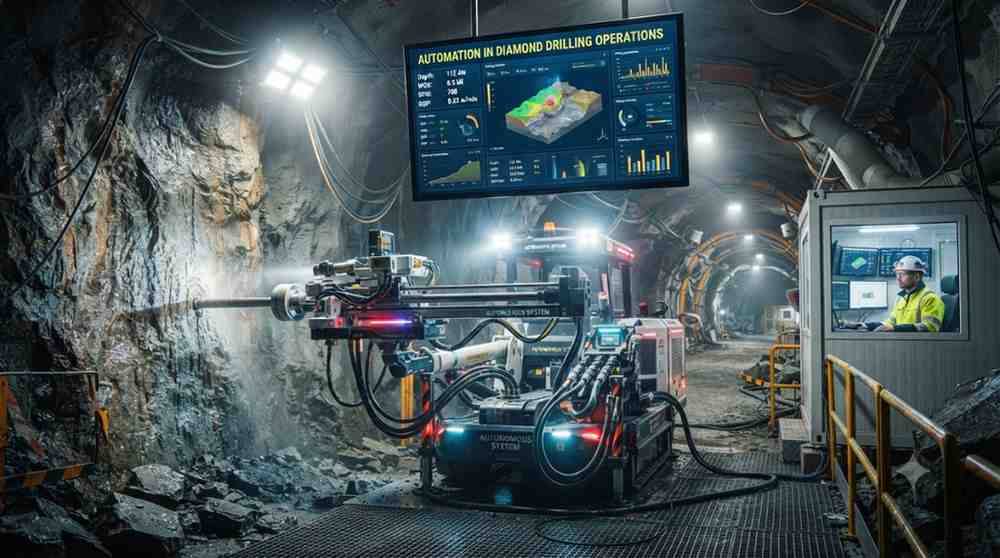
Diamond drilling has long been the backbone of mineral exploration, geotechnical investigation, and construction core sampling. It is prized for the precision and quality of the core samples it retrieves, giving geologists and engineers reliable subsurface data to make critical decisions. Yet, for decades, diamond drilling has also been a labor-intensive process — dependent on skilled crews working in physically demanding, often hazardous conditions.
Today, that picture is changing rapidly. Automation is reshaping diamond drilling operations across the globe, bringing new levels of safety, consistency, and productivity to an industry that has traditionally relied on manual expertise. At Core Cutting India ([email protected]), we've seen firsthand how automated systems are helping drilling contractors and exploration companies achieve more with less risk and lower operational costs.
In this blog, we take a deep dive into what automation means for diamond drilling, the technologies driving this transformation, the benefits and challenges involved, and what the future holds for this evolving sector.
Understanding Diamond Drilling and Why It Matters
Diamond drilling uses a rotating drill bit embedded with industrial-grade diamonds to cut through rock and extract cylindrical core samples. These samples provide invaluable geological information — mineral content, rock structure, density, and more — which is essential for mining exploration, civil engineering projects, and resource assessment.
Because of the precision required, diamond drilling has traditionally depended on experienced drillers who manually control rod handling, monitor drilling parameters, and manage core retrieval. While this hands-on approach has served the industry well, it comes with inherent limitations: fatigue-related errors, exposure to physical hazards, inconsistent drilling parameters between operators, and higher long-term labor costs.
This is precisely where automation steps in — not to replace human expertise, but to augment it with intelligent systems that reduce risk and improve consistency.
What Does Automation in Diamond Drilling Actually Look Like?
Automation in diamond drilling operations refers to the use of mechanized, computerized, and sensor-driven systems to perform or assist with tasks that were previously done manually. This spans a wide spectrum — from partial automation of specific tasks like rod handling, to fully autonomous drilling rigs capable of operating with minimal human intervention.
Key components of automated diamond drilling systems include:
1. Automated Rod Handling Systems
One of the most physically demanding and injury-prone tasks in diamond drilling is manual rod handling — lifting, aligning, and connecting drill rods as the hole deepens. Automated rod handling systems use robotic arms and hydraulic mechanisms to add and remove rods without requiring workers to be in the direct line of rotating machinery. This drastically reduces the risk of crush injuries and repetitive strain, while also speeding up round-trip times.
2. Real-Time Data Monitoring and Sensor Integration
Modern automated drilling rigs are equipped with sensors that continuously track parameters such as rotation speed, thrust, torque, water flow, and penetration rate. This data is transmitted in real time to onsite or remote monitoring dashboards, allowing drillers and supervisors to make immediate, informed adjustments. Real-time monitoring also creates a digital record of every metre drilled, which is invaluable for quality control and reporting.
3. Remote and Semi-Autonomous Rig Operation
Some of the most advanced diamond drilling rigs now allow operators to control drilling functions remotely, from a control cabin located a safe distance away from the rig floor. This is particularly valuable in hazardous or remote exploration sites, such as steep terrain, underground mines, or environmentally sensitive areas, where minimizing on-site personnel is a priority.
4. AI-Driven Drilling Optimization
Artificial intelligence and machine learning are beginning to play a role in optimizing drilling parameters in real time. By analyzing historical and live drilling data, AI systems can recommend or automatically adjust settings to maximize penetration rate while minimizing bit wear and equipment strain — something that traditionally relied heavily on driller intuition and experience.
5. Automated Core Handling and Logging
Beyond the drilling process itself, automation is also transforming how core samples are handled after retrieval. Automated core trays, digital core photography systems, and AI-assisted core logging software are reducing manual handling errors and speeding up the geological logging process significantly.
Key Benefits of Automation in Diamond Drilling Operations
Improved Worker Safety
Perhaps the most significant advantage of automation is the dramatic improvement in workplace safety. By removing workers from high-risk zones near rotating machinery and heavy rod strings, automated systems significantly reduce the likelihood of serious injuries — one of the longstanding challenges in the drilling industry.
Greater Precision and Consistency
Automated systems apply consistent force, speed, and technique regardless of operator fatigue or experience level. This consistency translates into more reliable core recovery rates and higher-quality samples, which directly benefits geological interpretation.
Increased Productivity
Automated rod handling and optimized drilling parameters reduce non-productive time between drilling runs. Faster round trips, fewer equipment failures, and optimized penetration rates all contribute to more metres drilled per shift.
Reduced Operational Costs
While the upfront investment in automated equipment can be significant, the long-term savings are considerable. Reduced downtime, lower injury-related costs, less equipment damage from human error, and improved drilling efficiency all contribute to a lower overall cost per metre drilled.
Better Data for Decision-Making
Automated systems generate continuous, accurate data logs that support better-informed decisions — both during the drilling process and in post-project analysis. This level of data granularity was simply not achievable with manual logging methods.
Enhanced Environmental and Site Control
Automation allows drilling operations to be conducted with a smaller physical footprint and reduced site disturbance, particularly important for projects in ecologically sensitive or logistically constrained areas.
Challenges in Adopting Automation
Despite its clear advantages, automation adoption in diamond drilling is not without challenges.
High Initial Investment: Automated rigs and associated technology require significant capital investment, which can be a barrier for smaller drilling contractors.
Training and Skill Gaps: Operating and maintaining automated systems requires a different skill set than traditional manual drilling. Companies must invest in training their workforce to manage, troubleshoot, and optimize these new systems.
Integration with Existing Fleets: Many drilling companies operate a mix of older manual rigs and newer automated equipment. Integrating data systems and workflows across this mixed fleet can be operationally complex.
Remote Site Connectivity: Since automation often depends on real-time data transmission, drilling sites in remote locations with poor connectivity can face challenges in fully leveraging automated monitoring and remote-control capabilities.
Maintenance Complexity: Automated systems involve more sophisticated electronics, sensors, and software, which require specialized maintenance support compared to traditional mechanical drilling rigs.
Despite these hurdles, the long-term safety and productivity gains are driving steady adoption across the industry, particularly among larger exploration and mining companies with the resources to invest in next-generation equipment.
The Role of Skilled Partners in a Changing Industry
As automation reshapes diamond drilling, the value of experienced equipment and tooling partners becomes even more important. Reliable, high-precision drilling consumables — core bits, reaming shells, casing, and drilling accessories — remain essential to the success of any drilling operation, automated or manual.
At Core Cutting India ([email protected]), we understand that automation is only as effective as the equipment supporting it. Precision-engineered drilling tools ensure that automated systems perform at their full potential, delivering the consistent, high-quality results that modern exploration and construction projects demand.
The Future of Automation in Diamond Drilling
Looking ahead, several trends are likely to shape the next phase of automation in diamond drilling operations:
Fully Autonomous Drilling Rigs: Similar to developments in surface mining, fully autonomous diamond drilling rigs capable of operating with minimal human oversight are likely to become more common, particularly in large-scale exploration projects.
Predictive Maintenance: AI-driven predictive maintenance systems will increasingly be used to anticipate equipment failures before they occur, reducing unplanned downtime.
Integration with Digital Twin Technology: Digital twin models of drilling sites and equipment will allow companies to simulate and optimize drilling plans before physical operations begin.
Greater Use of Robotics: Robotic systems will likely expand beyond rod handling into areas like automated core retrieval, sample preparation, and even site setup.
Sustainability-Driven Automation: As environmental regulations tighten, automated systems that reduce water usage, energy consumption, and site disturbance will become increasingly valuable.
Conclusion
Automation in diamond drilling operations represents a fundamental shift in how exploration and core drilling projects are conducted. From automated rod handling and real-time data monitoring to AI-driven optimization and remote rig control, these technologies are making drilling operations safer, more efficient, and more precise than ever before.
While challenges around cost, training, and integration remain, the long-term benefits — improved safety, higher productivity, and better data quality — make automation an increasingly essential part of modern drilling operations.
As the industry continues to evolve, having access to reliable, high-quality drilling equipment and expert support remains critical. Core Cutting India ([email protected]) is committed to supporting drilling contractors and exploration companies as they navigate this transition, providing the precision tooling and technical expertise needed to make the most of automated drilling technology.
For more information on diamond drilling equipment, tooling, and automation-ready solutions, get in touch with Core Cutting India at [email protected].