
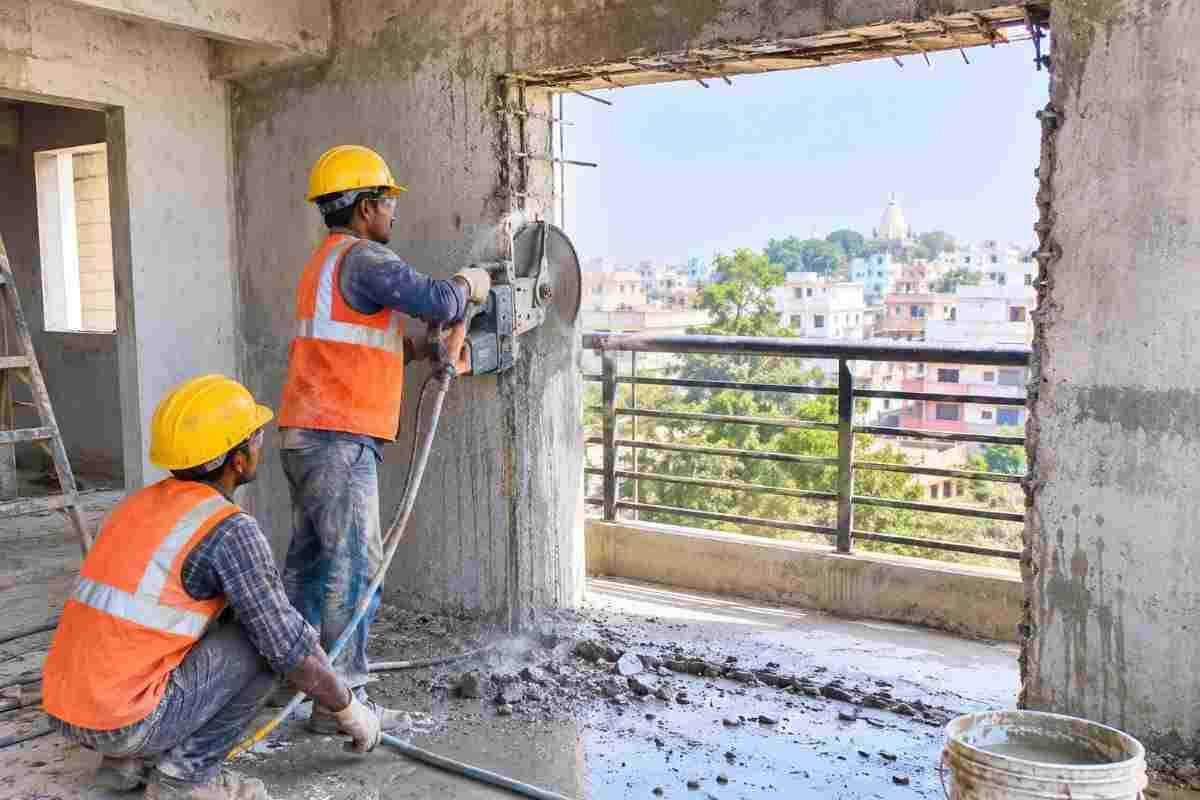
Gaya is changing. Apartment complexes are rising around Bodh Gaya Road, near Civil Lines and across the newer residential belts. Along with this growth, homeowners are rethinking how they use their space. One of the most common requests is simple: “I want a door opening to my balcony.”
A balcony door can transform a dark, closed room into a bright, breezy living space. But in an RCC (Reinforced Cement Concrete) apartment, you can’t just break the wall with a hammer. The wrong method can crack slabs, damage neighbouring flats and compromise the building’s structure.
This guide explains how professional balcony door opening cutting in RCC apartment walls in Gaya works, why it matters, what it involves and how to choose the right contractor. It is brought to you by Core Cutting India, specialists in precision concrete cutting.
Why Do Homeowners in Gaya Want Balcony Door Openings?
Many apartments in Gaya were designed with a window facing the balcony rather than a door. Over time, residents realise that this limits light, ventilation and usability. Common reasons for converting a window or solid wall section into a door include:
- Better access to the balcony. A proper door lets you use the balcony for sitting, gardening or drying clothes without climbing through a window.
- More natural light and airflow. A wide opening improves cross-ventilation, which matters during Gaya’s hot summers.
- Improved property value. Apartments with direct balcony access usually feel more spacious and modern.
- Interior redesign. Renovations often involve merging rooms with balconies or changing the layout entirely.
- Emergency access. A second exit point adds a layer of safety.
Whatever your reason, the method you choose to create the opening will decide whether the result is clean and safe or messy and risky.
Why Traditional Breaking Methods Are a Bad Idea
Many local masons still use chisels, hammers or electric breakers to open RCC walls. It looks cheaper, but the hidden costs are significant:
- Heavy vibration. Impact tools send shock waves through the structure, which can crack plaster, tiles and even beams in nearby rooms or flats.
- Rough, uneven edges. Breaking leaves jagged edges that need heavy patching and plastering.
- Damage to reinforcement. Uncontrolled breaking can bend or expose steel bars incorrectly.
- Excessive noise and dust. In a society or apartment complex, this irritates neighbours and may lead to complaints or even stoppage of work.
- Slow and unpredictable. Breaking takes longer, produces more debris and is difficult to control.
Modern concrete cutting solves these problems by cutting the wall rather than breaking it.
What Is RCC Wall Cutting?
RCC wall cutting uses diamond-impregnated tools to slice through concrete and steel reinforcement cleanly and accurately. Because the tools grind rather than hammer, they generate minimal vibration. Water is used for cooling and dust suppression, so the work is cleaner too.
The main techniques used for door openings are:
1. Wall Saw Cutting
A wall saw is mounted on a rail fixed to the wall. A circular diamond blade cuts through the concrete in straight, precise lines. It is ideal for door and window openings because the cuts are smooth and the dimensions are exact. The cut-out section can be removed in manageable pieces.
2. Wire Saw Cutting
A diamond wire loops around the section to be removed and is pulled through the concrete by a motor. This is useful for thick walls, awkward locations or places where a wall saw cannot reach. It is slower to set up but powerful for heavy-duty jobs.
3. Core Drilling
Core drilling makes round holes using a hollow diamond bit. For balcony door openings, cores are often drilled at the corners of the opening to give clean, square cut-ends and to let the saw blade overrun safely. Core drilling is also used for pipes, cables and ducts.
4. Hand-Held Ring Saw / Flush Cutting
For corners and places where larger machines can’t reach, compact tools provide the finishing cuts.
At Core Cutting India, these methods are chosen according to wall thickness, location, access and the building’s condition, so every job gets the right tool.
The Most Important Question: Is the Wall Load-Bearing?
Before any cutting begins, you need to answer a critical question: Is this wall load-bearing, or is it a partition?
In RCC framed buildings, loads are mainly carried by columns, beams and slabs, while walls often serve as partitions (infill). In such cases, a door opening is usually feasible with proper lintel support. But in some apartments, especially older ones or those with shear walls, the wall may carry load or contribute to lateral stability. Cutting such walls without engineering review can be dangerous.
Always get a structural engineer’s opinion first. The engineer will check:
- Whether the wall is structural or non-structural
- The size and position of the proposed opening
- The need for a lintel, additional reinforcement or a frame around the opening
- Any restrictions from the building’s design drawings
- Whether permission is needed from the housing society or builder
Skipping this step is the single biggest mistake homeowners make. A professional cutting company will always ask about it and will not start work on a structurally unclear wall.
Step-by-Step Process for Balcony Door Opening Cutting
Here is how a professional job typically unfolds.
Step 1: Site Inspection and Consultation
The team visits your flat, examines the wall, checks thickness and reinforcement (where possible), assesses access for equipment and discusses your requirements, including door size, position and finish.
Step 2: Structural Clearance
The engineer’s approval, along with any society NOC, is obtained. If a lintel or strengthening is required, it is planned before cutting begins.
Step 3: Marking the Opening
The exact outline of the door is marked on both sides of the wall. Accurate marking saves time and avoids costly errors. Allowance is made for the door frame, plaster and flooring levels.
Step 4: Protection and Preparation
Floors, furniture, windows and adjoining surfaces are covered. Water supply and drainage for slurry are arranged. Power requirements are checked.
Step 5: Core Drilling at Corners
Holes are drilled at the corners of the marked opening. This prevents over-cutting and gives sharp, clean corners.
Step 6: Wall Saw or Wire Saw Cutting
The rail-mounted saw makes the main cuts along the marked lines. The blade passes through concrete and rebar smoothly, with water cooling the cut and trapping dust.
Step 7: Removal of the Cut Section
The cut concrete block is divided into manageable pieces, secured and lifted out safely. Because the cut is clean, there is no random falling debris.
Step 8: Slurry Cleaning and Finishing
Slurry is collected and cleared. Edges are checked, any exposed rebar is treated and the opening is prepared for lintel work, framing and plastering.
Step 9: Final Inspection
The team confirms dimensions, alignment and edge quality before handing over the opening for the next stage: door frame installation, plastering and finishing.
Benefits of Professional Cutting Over Breaking
| Factor | Professional Diamond Cutting | Manual Breaking |
|---|---|---|
| Vibration | Very low | High |
| Edge quality | Smooth, straight | Rough, uneven |
| Dust | Controlled with water | Heavy |
| Noise | Moderate | Very high |
| Risk to structure | Minimal | Significant |
| Finishing work | Less | Extensive |
| Neighbour disturbance | Low | High |
For apartment owners in Gaya, where buildings are close together and shared walls are common, low vibration and controlled dust are not just conveniences. They are necessities.
Challenges Specific to Apartments in Gaya
Limited Access
Many apartments are on upper floors with narrow staircases. Professional teams use compact, portable equipment and plan the removal of cut sections carefully to avoid damage.
Society Rules
Most housing societies have working-hour restrictions and require prior permission for structural alterations. A reliable contractor will help you plan work within allowed timings.
Water and Slurry Management
Wet cutting needs water and a way to collect slurry. Good teams use containment and vacuum methods to keep your floors and your neighbours’ balconies clean.
Old vs. New Construction
Older buildings may have lower-grade concrete or unusual reinforcement layouts. Newer ones may have thicker, denser reinforcement. Both are handled well by diamond tools, but the plan must be adapted to the structure.
Climate Considerations
Gaya experiences hot summers and monsoon rains. After cutting, the new opening must be properly framed and sealed to prevent water ingress, particularly on balcony-facing walls.
Safety Measures You Should Expect
A trustworthy contractor will follow strict safety practices, including:
- Using trained operators and proper personal protective equipment
- Securing the cut-out section before it is released
- Keeping people away from the cutting and removal zone
- Controlling electrical connections around water
- Protecting the premises and adjoining areas
- Cleaning up thoroughly after completion
Do not hesitate to ask a contractor how they handle these issues. Their answers will show their experience and professionalism.
What Affects the Cost of Balcony Door Opening Cutting?
Pricing differs from site to site, so there is no universal rate. The main factors are:
- Wall thickness. Thicker walls need more cutting time and blade wear.
- Size of the opening. Larger openings mean more cutting length.
- Reinforcement density. More steel means slower cutting.
- Floor level and access. Upper floors and difficult access may need additional labour.
- Location of work. Tight spaces may need special equipment.
- Debris removal. Hauling cut pieces and slurry out of the building affects cost.
- Timeline. Urgent jobs may be priced differently.
The best approach is to request a site visit and a written quotation. Avoid contractors who quote a price by phone without seeing the wall, as such estimates often change later.
How to Choose the Right Contractor in Gaya
Because this is structural work, choosing the right contractor matters. Look for:
- Experience with RCC cutting. Ask about similar apartment projects.
- Proper equipment. Wall saws, wire saws and core drills should be in good working condition.
- Clear communication. They should explain the process, risks and timeline honestly.
- Respect for structural advice. A good contractor insists on engineering clearance rather than skipping it.
- Clean working practices. Ask how they manage dust, slurry and noise.
- Transparent quotation. The scope, charges and exclusions should be clear.
- Reliable support. Someone should be reachable if you have questions during or after the job.
Core Cutting India is built around these principles. The team focuses on precise, controlled cutting with minimal disturbance to your home and neighbours.
After the Cutting: Finishing Your Balcony Door
Cutting is only the first stage. To complete your balcony door properly, plan for:
- Lintel or support beam, if recommended by your engineer
- Door frame installation, in wood, aluminium, uPVC or steel
- Plastering and finishing around the opening
- Waterproofing and sealing, especially on the balcony side
- Threshold and flooring alignment, so water doesn’t flow into the room
- Painting and final touch-ups
Coordinating these stages with your carpenter, mason and designer ensures a smooth result.
Common Mistakes to Avoid
- Cutting before getting structural approval. This is the most serious error.
- Hiring based only on the lowest price. Poor workmanship often costs more in repairs.
- Ignoring society permissions. This can lead to penalties or work stoppage.
- Not planning door dimensions properly. Measure the frame and clearances before marking.
- Skipping waterproofing. Balcony-facing openings are exposed to rain.
- Letting untrained workers use heavy tools. Always use experienced operators.
Frequently Asked Questions (People Also Ask)
Can I cut a door opening in an RCC wall in my apartment?
Often yes, but only after a structural engineer confirms the wall is safe to cut and your society or builder permits it. Non-load-bearing partition walls are generally easier to modify than structural walls.
Is cutting an RCC wall dangerous?
It can be if done without planning or by untrained people. With structural approval, proper equipment and experienced operators, diamond cutting is a controlled and safe method.
How long does it take to cut a balcony door opening?
A standard door opening can often be cut in a few hours to a day, depending on wall thickness, reinforcement and access. Preparation and cleanup add some time.
Will wall cutting damage my neighbours’ flats?
Diamond cutting produces far less vibration than breaking with hammers or breakers, so the risk is much lower. Good contractors also take precautions to protect adjoining areas.
What is the difference between wall sawing and wire sawing?
A wall saw uses a circular blade on a rail for straight cuts in walls and slabs. A wire saw uses a diamond-coated wire loop, which suits thick or hard-to-reach sections.
Do I need permission from my housing society?
In most cases, yes. Structural alterations typically need approval, and societies often set timing rules for noisy work.
Can a window be converted into a door?
Yes, in many cases. The existing window opening can be extended downward to form a door, subject to structural clearance and proper lintel design.
How do I find RCC cutting services near me in Gaya?
Look for specialists with proven experience, proper equipment and transparent pricing. You can contact Core Cutting India at +91 70096 79903 to arrange a site visit.
Why Choose Core Cutting India for Your Balcony Door Opening?
When your home is involved, you want a team that treats it with care. Core Cutting India offers:
- Precision cutting with modern diamond equipment
- Low vibration and controlled dust suited to apartment living
- Experienced operators who understand RCC structures
- Clear guidance on structural and permission requirements
- Neat, clean results that make finishing easier
- Responsive support from enquiry to completion
Whether you need a single balcony door or multiple openings, the approach is the same: plan carefully, cut cleanly and leave your home ready for the next stage.
Conclusion
A balcony door opening can add light, space and value to an apartment in Gaya, but only when it is done properly. RCC walls demand respect: structural checks, the right cutting method, trained operators and careful finishing. Shortcuts such as hammering through the wall may save a little money upfront, but they risk cracks, damage and disputes later.
Professional diamond cutting is the smarter path. It protects your building, your neighbours and your investment, and it gives you a clean, accurate opening that is ready for a beautiful new door.
If you are planning balcony door opening cutting in your RCC apartment wall in Gaya, get expert advice before you begin.
📞 Contact Core Cutting India Today
Phone: +91 70096 79903
Website: https://corecuttingindia.com/
Call now to book a site inspection and get a clear, no-pressure quotation for your project.