
Introduction
Surat, one of Gujarat's fastest-growing industrial and textile hubs, sits along the banks of the Tapi River. While this location has fueled the city's commercial success, it has also created a unique set of underground water challenges for property owners. Basements across residential complexes, commercial buildings, and industrial units in Surat frequently battle seepage, dampness, and structural water damage — problems that standard construction practices often fail to address. This is where basement concrete modification becomes essential, and why understanding the water management challenges specific to Surat's geography is critical before starting any renovation or waterproofing project.
At Core Cutting India ([email protected]), we specialize in precision concrete cutting, coring, and structural modification services designed to solve exactly these problems. This blog explores why Surat basements are especially vulnerable to water issues, how concrete modification techniques help, and what property owners should know before hiring a contractor.
Why Surat Basements Are Prone to Water Problems
1. High Water Table and River Proximity
Surat's location near the Tapi River means the natural water table in many parts of the city sits relatively close to the surface. During monsoon season, this water table rises further, putting hydrostatic pressure on basement walls and floors. Even basements built with modern waterproofing membranes can develop cracks and seepage points over time as this pressure pushes water through the smallest structural weaknesses.
2. Heavy Monsoon Rainfall
Surat receives significant rainfall between June and September, and the city's drainage infrastructure, while improving, still struggles during peak monsoon periods. Surface water runoff can pool around building foundations, increasing the risk of water infiltration into basements that lack proper external drainage systems.
3. Rapid Urban Construction
As Surat has expanded rapidly, many buildings — particularly older commercial and residential structures — were not designed with modern basement waterproofing standards in mind. Builders often prioritized speed and cost over long-term water management planning, leaving many basements vulnerable to seepage, efflorescence, and eventual structural deterioration.
4. Soil Composition
The alluvial soil common in Surat's river basin areas has high water retention properties. This soil type expands when saturated, exerting additional pressure on basement walls and foundations, which can widen existing cracks or create new points of water entry.
5. Poor Original Waterproofing or Aging Infrastructure
Many buildings in Surat's older commercial districts were constructed decades ago, when waterproofing technology and building codes were far less advanced than they are today. As waterproof coatings degrade and concrete ages, basements that were once dry begin to show signs of moisture intrusion.
What Is Basement Concrete Modification?
Basement concrete modification refers to the process of cutting, coring, demolishing, or reshaping existing concrete structures to install, repair, or upgrade water management systems. Unlike surface-level waterproofing (such as applying sealants or coatings), concrete modification addresses the structural pathways water uses to enter a basement.
Common modification techniques include:
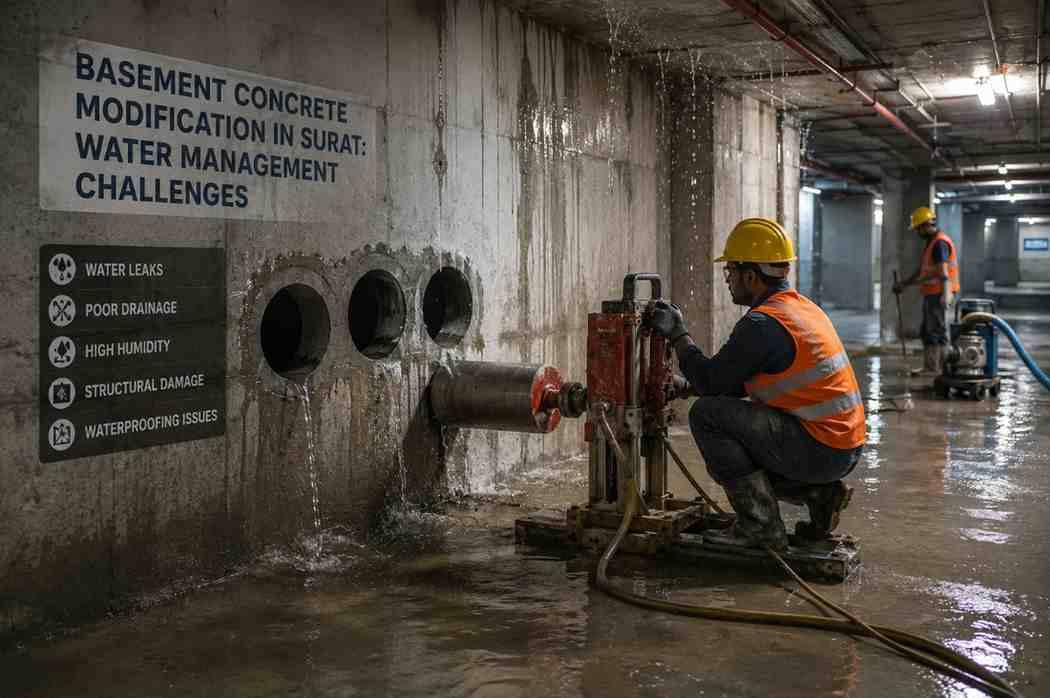
- Concrete coring – drilling precise circular holes through walls or floors to install drainage pipes, sump pumps, or utility lines
- Wall sawing – cutting straight, controlled lines through concrete walls to create new drainage channels or access points
- Floor slab cutting – removing sections of basement flooring to install French drains, sump pits, or interior drainage systems
- Demolition and re-pour – removing severely damaged concrete sections and replacing them with properly waterproofed material
- Joint and crack cutting – widening and cleaning cracks so they can be properly sealed with waterproof epoxy or polyurethane injections
Each of these techniques requires precision equipment and experienced technicians, because improper cutting can weaken structural integrity or create new water entry points instead of solving the problem.
Core Water Management Challenges in Basement Renovation
Hydrostatic Pressure Management
One of the biggest challenges in basement water management is controlling hydrostatic pressure — the force exerted by groundwater against basement walls and floors. If this pressure isn't relieved through proper drainage, it will eventually force water through even well-sealed concrete. Interior drainage systems, installed through precise floor cutting, allow this pressure to be redirected safely away from the building rather than through it.
Installing Interior Drainage Systems
Many older Surat basements were never built with drainage channels. Retrofitting a basement with an interior French drain system requires cutting a channel around the perimeter of the basement floor, just inside the foundation walls. This channel collects water that seeps through walls or the wall-floor joint and directs it to a sump pump, which then discharges the water away from the building. This process demands accurate, dust-controlled concrete cutting to avoid damaging existing utilities or structural elements.
Sump Pit Installation
A sump pit is a collection basin, usually installed at the lowest point of a basement floor, where water is gathered and pumped out. Creating a sump pit requires cutting through the concrete slab and often into the soil beneath it. Precision is essential here — an improperly sized or positioned pit can fail to manage water flow effectively, leading to continued flooding risk.
Managing Existing Utility Lines
Basements in commercial and industrial buildings often contain a maze of plumbing, electrical conduits, and gas lines embedded within or beneath concrete floors and walls. Any modification work must account for these utilities. This is why professional core cutting services use scanning technology (such as ground-penetrating radar or rebar detectors) before cutting, ensuring no critical infrastructure is damaged during the water management upgrade.
Balancing Structural Integrity with Modification
Every cut made into a basement wall or floor has the potential to affect the building's structural load distribution. Water management modifications must be planned in coordination with structural considerations — cutting too much, too close to load-bearing points, or without proper reinforcement can compromise the building's stability. This is a key reason why DIY or unqualified contractor work on basement concrete is risky, and why experienced firms follow structural assessments before any cutting begins.
Dealing with Recurring Efflorescence and Mold
Even after water entry points are addressed, basements that have experienced long-term moisture exposure often develop efflorescence (white mineral deposits) and mold growth. Concrete modification projects frequently include removing and treating affected sections of concrete, not just sealing the surface, to fully resolve the underlying moisture problem.
The Process: How Professional Basement Concrete Modification Works
- Site Assessment and Water Source Diagnosis – Before any cutting begins, technicians assess where water is entering the basement — through walls, floor joints, cracks, or hydrostatic pressure from below.
- Utility Scanning – Ground-penetrating radar and other scanning tools locate embedded pipes, cables, and rebar to avoid damage during cutting.
- Precision Cutting and Coring – Using diamond-tipped saws and core drills, technicians cut drainage channels, sump pits, or access points with minimal dust, noise, and vibration.
- Drainage System Installation – Perforated pipes, gravel beds, and sump pumps are installed within the cut channels to manage water flow.
- Sealing and Waterproofing – Once systems are installed, remaining concrete surfaces are treated with waterproof coatings or membranes to reinforce protection.
- Testing and Verification – The system is tested under simulated water conditions to confirm it effectively redirects water away from the basement.
Why Professional Expertise Matters
Basement concrete modification is not a task suited to general contractors without specialized cutting equipment. The risks of improper execution include:
- Structural weakening from uncontrolled cutting
- Damage to embedded utilities, leading to costly repairs
- Incomplete water management systems that fail during heavy monsoon seasons
- Excessive dust and debris affecting indoor air quality
- Voided warranties on waterproofing materials due to improper installation
Companies like Core Cutting India bring specialized diamond cutting equipment, trained technicians, and structural know-how to ensure that water management upgrades are both effective and safe for the building's long-term integrity.
Choosing the Right Concrete Cutting Partner in Surat
When selecting a contractor for basement concrete modification and water management work in Surat, property owners should consider:
- Experience with local soil and water table conditions – Surat's unique geography requires location-specific expertise
- Availability of modern cutting equipment – diamond wall saws, core drills, and dust-control systems
- Structural assessment capability – ensuring modifications don't compromise building safety
- Track record with commercial and residential projects – varied project experience indicates adaptability
- Post-installation support – warranties and maintenance guidance for long-term water management performance
Conclusion
Basement water problems in Surat are not a matter of if but often when, given the city's high water table, monsoon intensity, and soil composition. Addressing these challenges effectively requires more than surface-level fixes — it requires precise, professional concrete modification that tackles the root causes of water intrusion. From interior drainage systems and sump pit installation to careful wall coring and structural-safe cutting, the right approach can transform a chronically damp basement into a dry, usable space for years to come.
If you're dealing with basement water seepage, flooding, or planning a renovation that requires professional concrete cutting and coring, Core Cutting India is ready to help. Our team combines local expertise in Surat's unique water management challenges with precision cutting technology to deliver lasting solutions.
Contact us today at [email protected] to schedule a basement assessment and get expert guidance on the right concrete modification solution for your property.