
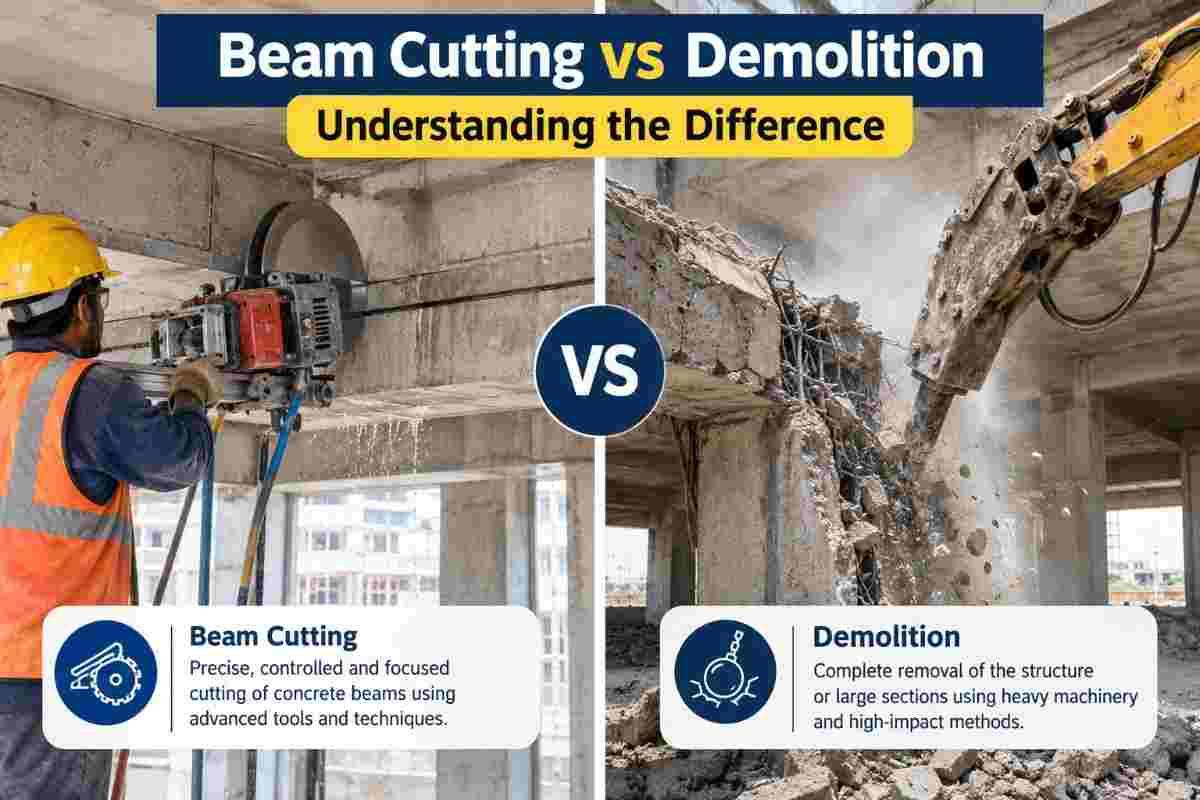
If you own, manage or renovate a building in India, you will sooner or later face a structural question. Do you need to remove a section of a beam, or tear down part of the structure? People often use “beam cutting” and “demolition” as if they mean the same thing. They don’t. Choosing the wrong one can cost you time, money and, in the worst case, structural safety.
At Core Cutting India, we see this confusion on many projects. Clients ask for “demolition” when a precise cut would do, or assume cutting is always safer when the structure actually needs to come down. This guide explains what each method involves, how they differ, and how to decide which one your project needs.
What Is Beam Cutting?
Beam cutting is the precise, controlled removal of a section of a beam, or the separation of a beam from the rest of a structure. It uses specialised diamond-tipped tools such as wall saws, wire saws, ring saws and hand saws. The goal is to remove only what is necessary while leaving the surrounding structure intact.
Beams carry loads from slabs and walls into columns and foundations, so cutting one is never casual work. A proper job involves planning, load assessment, temporary support (propping or shoring) and often a structural engineer’s sign-off. The cut itself is clean, with smooth edges, little vibration and minimal damage to adjacent elements.
Common Reasons for Beam Cutting
- Creating openings for ducts, pipes, cables or staircases
- Modifying layouts during renovation or change of use
- Removing damaged sections of a beam for repair or replacement
- Making room for elevators or equipment in existing buildings
- Separating structural members for phased dismantling
- Installing or retrofitting services in older buildings
Beam cutting is a form of selective intervention. You are editing the structure, not erasing it.
What Is Demolition?
Demolition is the partial or complete removal of a structure or its major components. It ranges from knocking down a single wall to dismantling an entire building. Common methods include:
- Mechanical demolition using excavators with breakers or crushers
- Hydraulic breakers and hand-held jackhammers for smaller jobs
- Controlled demolition in phases, from the top floor down
- Implosion, which is rare and used for large, isolated structures
- Hydrodemolition, which uses high-pressure water to remove concrete
Demolition is broader and often more forceful. The aim is to remove material, not to preserve the surroundings. Even “selective demolition”, where only certain elements are removed, tends to produce more vibration, noise, dust and debris than precision cutting.
Common Reasons for Demolition
- A building is structurally unsafe or beyond economic repair
- A site is being cleared for redevelopment
- A structure has reached the end of its life
- Major parts of a building need to go, such as entire floors or wings
- Illegal or unsafe construction must be removed
Beam Cutting vs Demolition: The Core Differences
At a glance, the two are very different approaches to the same broad goal of changing or removing built structure.
| Factor | Beam Cutting | Demolition |
|---|---|---|
| Purpose | Remove or modify a specific section | Remove part or all of a structure |
| Precision | Very high, cuts to exact lines | Lower, more material removed by force |
| Vibration | Minimal | Moderate to high |
| Noise and dust | Low (wet cutting controls dust) | High |
| Impact on adjacent structure | Minimal | Can be significant |
| Debris | Clean, manageable pieces | Large volumes of rubble |
| Speed | Slower per element, but exact | Faster for large-scale removal |
| Best for | Renovation, retrofitting, openings | Clearing, rebuilding, unsafe structures |
| Structural planning needed | Essential (load transfer, propping) | Essential (sequence and stability) |
1. Precision and Control
Beam cutting is about accuracy. A diamond wire saw can cut through heavily reinforced concrete beams of almost any thickness, following a marked line to within millimetres. Demolition tools work by impact or crushing, so the edges are rough and the damage often extends beyond the intended area, including micro-cracking in the concrete you want to keep.
2. Vibration and Structural Stress
Breakers and hammers send shock waves through the structure. In an occupied building, a hospital, a data centre or a heritage property, that vibration can crack plaster, loosen fittings or harm sensitive equipment. Diamond cutting is nearly vibration-free, which is why it is the standard choice where neighbouring spaces must stay in use.
3. Noise, Dust and Site Disruption
Wet diamond cutting keeps dust down and produces far less noise than percussive demolition. For work in malls, offices, factories or residential societies with strict working hours, that difference decides whether a project is workable at all.
4. Scale
Demolition is the practical answer when a lot of material must go. Using precision cutting to take down a whole building would be slow and expensive. Equally, using a wrecking approach to remove one 500 mm beam section from a working floor would be reckless.
5. Debris Handling
Cutting yields large, clean blocks that can be lifted out in a controlled way, which matters on upper floors or in tight sites where debris removal is hard. Demolition produces rubble that has to be sorted, loaded and transported, adding to cost and logistics.
When Should You Choose Beam Cutting?
Beam cutting is usually the better choice when:
- The rest of the structure must stay in service. Occupied buildings, factories and commercial spaces cannot tolerate heavy vibration.
- Precision matters. Openings, notches and sectional removals need clean, exact edges.
- You are renovating or retrofitting. Layout changes in older buildings rely on precise cuts.
- Adjacent elements must be protected. Neighbouring columns, slabs and finishes are valuable and costly to repair.
- Noise and dust must be limited. Hospitals, schools and residential projects often have strict limits.
When Is Demolition the Right Call?
Demolition makes sense when:
- The structure is unsafe or deteriorated beyond repair. Spending money on precision work for a failing building is wasteful.
- The site is being cleared. If everything is coming down anyway, speed and economy favour demolition.
- A large portion needs removal. Entire floors or wings are better handled with mechanical methods.
- Rebuilding is cheaper than modifying. Sometimes the existing frame cannot meet new load or code requirements.
Many projects use both. A contractor may demolish a large section mechanically, then switch to diamond cutting for the final, delicate edges near the retained structure. This hybrid approach combines speed where it is safe with precision where it counts.
Structural Engineering: Why Planning Comes First
Whichever method you choose, the structure must be understood before any cutting begins. A beam is not just a piece of concrete. It is part of a load path. Remove or weaken it without a plan, and loads redistribute in ways that can overstress other members.
Good practice includes:
- Structural assessment of the beam, its reinforcement and the loads it carries
- Review of drawings, or on-site investigation (scanning, rebound testing) where drawings are missing, which is common in older Indian buildings
- Temporary supports such as props or shoring to carry loads during and after the cut
- A defined cutting sequence so the beam is released safely and the cut piece is controlled
- Permanent strengthening where the beam is reduced, such as added steel sections or jacketing
- Compliance with local regulations and municipal approvals where required
At Core Cutting India, structural coordination is part of how we approach every job, because a clean cut is only a good result if the building stays safe afterwards.
Techniques and Equipment Used in Beam Cutting
Different beams and site conditions call for different tools:
- Wire saw cutting: A diamond-impregnated wire loops around the beam and cuts through it. It suits large, thick or hard-to-reach members and cuts regardless of reinforcement density.
- Wall saw cutting: A track-mounted saw with a large diamond blade makes straight, deep cuts. It is common for openings and sections in beams and walls.
- Ring saw cutting: A compact ring-shaped blade reaches deeper than a standard blade, useful where space is limited.
- Core drilling: Overlapping holes can relieve a section or assist larger cuts, particularly at corners.
- Hand saw cutting: Light hand-held diamond saws handle smaller sections and detail work.
Water is used throughout to cool the blade and suppress dust, and slurry is collected so the site stays clean.
Safety and Environmental Considerations
Beam cutting is generally safer for workers and surroundings because the process is controlled and the cut sections are secured before release. Dust is managed with water, and slurry can be contained and disposed of responsibly. Because it avoids heavy impact, it lowers the risk of unintended damage and secondary cracking.
Demolition carries greater risks, including falling debris, dust inhalation, noise exposure and the chance of unplanned collapse if the sequence is wrong. It needs exclusion zones, dust suppression, protective barriers and careful waste management. Much demolition waste can be recycled as aggregate, which helps sustainability, but the volumes involved require organised handling.
Both methods demand trained operators, proper protective equipment and clear site safety plans. Cutting corners here, in any sense, is never worth it.
Cost Comparison: What to Expect
Cost depends on the size of the job, access, beam thickness, reinforcement, location within the building and local conditions.
- Beam cutting costs more per unit of material removed, because it uses specialised equipment and skilled operators. But it saves money elsewhere: less damage to repair, less debris to haul, less disruption to occupants.
- Demolition is usually cheaper per cubic metre for large-scale removal, but the hidden costs can add up, including repair of collateral damage, dust and noise mitigation, and longer clean-up.
The right way to compare is total project cost, not just the price of the cutting or breaking itself. For small, targeted modifications, cutting often wins on total cost. For large removals, demolition usually does.
Common Mistakes to Avoid
- Using the terms interchangeably when briefing a contractor. Be specific about what must go and what must stay.
- Skipping structural review. Even a “small” beam cut can affect load distribution.
- Choosing on price alone. The cheapest quote may rely on methods that damage what you want to keep.
- Ignoring site constraints. Working hours, vibration limits and access shape which method is viable.
- Not planning debris removal. Large cut sections need lifting and transport arrangements in advance.
How to Choose the Right Contractor
Look for a contractor who:
- Offers both cutting and demolition-related expertise, so the advice isn’t biased toward one method
- Uses modern diamond cutting equipment and maintains it properly
- Works with structural engineers or can coordinate with yours
- Has a documented safety record and trained crews
- Provides a clear method statement, timeline and scope before work begins
- Has experience with your type of structure, whether RCC, pre-stressed or older masonry-frame buildings
Frequently Asked Questions
What is the difference between beam cutting and demolition?
Beam cutting precisely removes or modifies a section of a beam using diamond tools, while the rest of the structure is preserved. Demolition removes part or all of a structure, usually with more forceful methods and less precision.
Is beam cutting safe for a building?
Yes, when planned correctly. It requires a structural assessment, temporary supports and strengthening where needed. Done without those, any beam modification can be unsafe.
Can a load-bearing beam be cut?
It can, but only after an engineer confirms how loads will be carried afterwards. Temporary shoring and permanent reinforcement are usually required.
Is beam cutting cheaper than demolition?
Not always. Cutting costs more per unit removed but often costs less overall on small, precise jobs because it avoids damage and heavy clean-up. For large-scale removal, demolition is generally cheaper.
Does beam cutting create dust and noise?
Far less than demolition. Wet cutting controls dust, and diamond tools run much quieter than impact breakers.
Can beam cutting be done in an occupied building?
Yes. Its low vibration and controlled process make it the preferred option for hospitals, offices, malls and homes that remain in use.
How long does beam cutting take?
It depends on beam size, reinforcement and access. A single beam section may take a few hours to a few days including setup and support.
Which is better for renovation: cutting or demolition?
Usually cutting, because renovation depends on preserving most of the existing structure while changing specific parts.
Conclusion: Cutting Is Editing, Demolition Is Removing
The simplest way to remember the difference is this. Beam cutting edits a structure; demolition removes it. One is surgical, the other is broad. Both have their place, and the best projects often combine them.
If you are planning a renovation, retrofit or structural change, start by defining exactly what must go and what must stay. Then involve a structural engineer and an experienced contractor before choosing the method. That order of decisions protects your building, your budget and the people who use it.
Planning a project and unsure which approach fits? The team at Core Cutting India can assess your requirements and recommend the safest, most economical method. Visit https://corecuttingindia.com/ to request a consultation.