
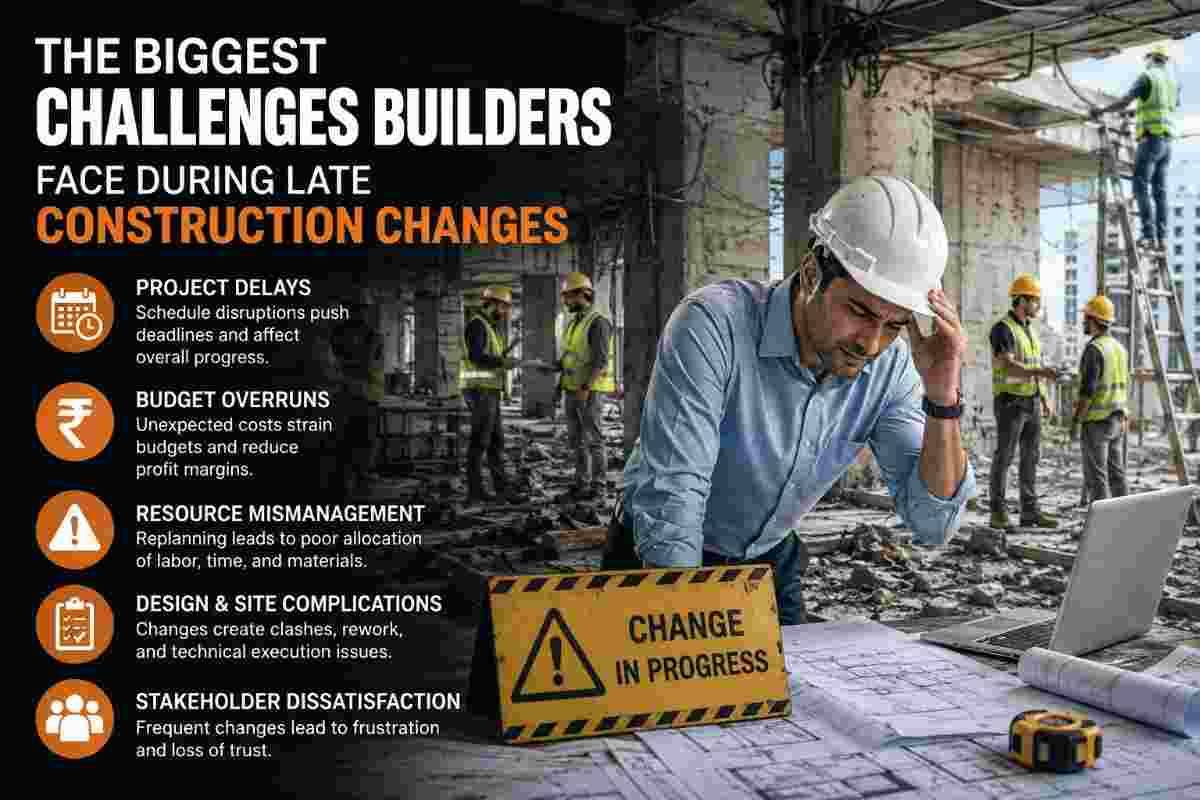
Construction projects rarely go exactly as planned. Somewhere between the foundation pour and the final coat of paint, a client rethinks a layout, an architect spots a design flaw, or a regulatory body demands a compliance update. These are what the industry calls late construction changes — modifications requested after a project is already underway, sometimes even after structural work is complete.
For builders, contractors, and project managers, late changes are one of the most stressful parts of any job. They disrupt sequencing, strain budgets, and often require specialized intervention like structural core cutting or concrete drilling to make new openings for doors, windows, ducts, or utility lines. At Core Cutting India, we work with builders across residential, commercial, and industrial projects who are navigating exactly this kind of last-minute disruption. This blog breaks down the biggest challenges builders face during late construction changes — and how smart planning and the right specialist partners can minimize the damage.
1. Structural Safety Risks
The single biggest concern with any late change is structural integrity. Once concrete has cured and load-bearing elements are in place, altering the structure is no longer as simple as erasing a line on a blueprint. Adding a new doorway, enlarging a window, or cutting an opening for ductwork means physically removing material from a wall, slab, or beam that was designed to carry specific loads.
Done carelessly, this can weaken the structure, cause cracking, or in severe cases, lead to partial collapse. This is precisely why professional core cutting and concrete cutting services exist — they use diamond-tipped tools and precision equipment to make clean, controlled cuts without generating the vibration or stress fractures that come from traditional breaking methods like jackhammering. Builders who attempt late structural changes without engineering assessment and specialized cutting equipment are taking on significant liability.
2. Budget Overruns
Late changes almost always cost more than the same change would have cost if planned from the start. Materials may need to be re-ordered, previously completed work may need to be undone, and specialized subcontractors — like core cutting or drilling teams — often need to be brought in on short notice, sometimes at a premium for expedited scheduling.
Change orders also tend to trigger a domino effect: modifying one wall might require rerouting electrical conduit, which then affects the ceiling plan, which then affects the HVAC layout. Builders frequently underestimate how many downstream costs a single late change can generate, and clients are often unprepared for how quickly those costs add up.
3. Timeline Delays and Schedule Disruption
Construction schedules are built around sequence dependencies — framing before drywall, plumbing before flooring, and so on. A late change forces builders to break that sequence, often requiring teams to backtrack to an earlier phase of work. This is particularly disruptive when structural modifications are involved, since cutting, drilling, or coring concrete requires its own scheduling, equipment mobilization, dust and debris control, and curing or reinforcement time afterward.
Even a seemingly small request — like relocating a doorway by two feet — can add days or weeks to a project if it requires structural assessment, permit amendments, and coordination between multiple trades.
4. Permitting and Regulatory Compliance
Any change that affects the structural, electrical, plumbing, or fire-safety systems of a building typically needs to be reflected in updated permits and drawings. Builders making late changes without notifying regulatory authorities risk failed inspections, stop-work orders, or costly rework later on.
This is especially true for structural alterations. Cutting into load-bearing walls or slabs for a late-stage design change often requires a structural engineer's sign-off before work begins, along with updated architectural drawings. Skipping this step to save time is one of the most common — and most expensive — mistakes builders make.
5. Coordination Between Multiple Trades
A late change is rarely isolated to one trade. A request to add a bathroom on an upper floor, for instance, touches plumbing, electrical, structural, waterproofing, and flooring — all of which need to be resequenced and coordinated. Builders have to communicate the change to every affected subcontractor, adjust the master schedule, and ensure nobody proceeds with outdated plans.
Miscommunication at this stage is one of the leading causes of rework. A framing crew that isn't informed about a wall relocation, or an electrician who wires a switch box before the wall opening is finalized, creates costly errors that could have been avoided with better change-management processes.
6. Precision and Quality Control
When changes happen late, there's less room for error — and less time to fix mistakes. Structural modifications in particular demand precision. Cutting an opening slightly off-dimension, or damaging embedded rebar or utility lines while cutting through concrete, can create both safety hazards and additional repair costs.
This is where the difference between traditional demolition methods and specialized core cutting and concrete sawing techniques becomes clear. Precision core drilling allows for exact, clean openings — whether it's a small hole for a pipe or a large opening for a new doorway — with minimal collateral damage to surrounding structure. This precision is especially critical in occupied buildings, where over-cutting or excessive vibration can affect neighboring units or finished spaces.
7. Managing Dust, Noise, and Site Disruption
Late-stage structural work, especially in occupied or near-complete buildings, brings unique challenges around dust, noise, and vibration control. Unlike early-stage construction where a site is often unoccupied and open, late changes frequently happen when finishes are already in place, other trades are actively working, or — in renovation and retrofit projects — when the building is still in use.
Modern diamond core cutting and wall sawing methods are specifically designed to minimize dust and vibration compared to traditional breaking or hammering, which matters enormously when builders need to protect finished work nearby or maintain a livable, workable environment during the change.
8. Client Expectation Management
Clients requesting late changes often don't fully grasp the ripple effects those changes create. A homeowner who asks to "just move the window a little" may not realize this involves structural assessment, cutting, reinforcement, replastering, and repainting — along with the associated cost and time impact.
Builders are frequently caught in the middle: trying to accommodate a client's evolving vision while protecting the project's budget, timeline, and safety standards. Clear, documented communication about the true scope of a late change — including cost estimates and revised timelines — is essential to avoid disputes later.
9. Access and Equipment Constraints
Late changes in already-built structures often mean working in confined spaces — a finished basement, a tight utility shaft, or an occupied floor with limited access. This limits which tools and methods can be used. Heavy demolition equipment may simply not fit or may cause unacceptable disruption.
Specialized core cutting equipment is built for exactly these conditions: compact enough to operate in confined areas, powerful enough for structural concrete and masonry, and precise enough to avoid damaging adjacent finished work. Builders who bring in the right equipment and specialists for the job — rather than relying on generic demolition crews — save significant time and reduce risk.
10. Documentation and As-Built Accuracy
Every late change needs to be reflected in updated as-built drawings. This is frequently overlooked, especially under time pressure, but it creates serious problems down the line — for future renovations, for facility management, and for regulatory compliance. Builders who fail to document late changes accurately leave a knowledge gap that can cause confusion, safety risks, or compliance failures years later.
How Builders Can Minimize the Impact of Late Changes
While late changes can never be fully eliminated, builders can reduce their impact with a few key practices:
- Bring in structural engineers early whenever a change involves load-bearing elements, before any cutting or demolition begins.
- Use specialized core cutting and concrete cutting services for precision, safety, and minimal disruption instead of relying on manual demolition.
- Update permits and drawings promptly to stay compliant and avoid inspection failures.
- Communicate clearly with every trade affected by the change, and document the revised sequence.
- Set realistic expectations with clients about the cost and time impact of any late-stage request.
- Partner with experienced subcontractors who understand how to work efficiently within occupied or near-complete sites.
Why Builders Trust Core Cutting India for Late-Stage Structural Work
When a late change requires cutting into concrete, masonry, or reinforced structures, precision and safety are non-negotiable. Core Cutting India specializes in diamond core drilling, wall sawing, and precision concrete cutting services designed specifically for situations like these — new door and window openings, utility penetrations, structural modifications, and renovation work in occupied or nearly finished buildings.
Our team works closely with builders and contractors to assess structural implications, plan cuts that minimize disruption, and execute the work with the accuracy that late-stage construction demands. Whether it's a small residential renovation or a large commercial retrofit, having the right cutting partner can be the difference between a smooth change order and a costly setback.
Frequently Asked Questions (People Also Ask)
1. What are late construction changes? Late construction changes are modifications to a building's design, layout, or systems that are requested after construction has already begun — sometimes after structural work, plumbing, or electrical systems are already in place.
2. Why do late changes in construction cost more? Late changes often require undoing completed work, re-ordering materials, bringing in specialized subcontractors on short notice, and resequencing multiple trades — all of which add cost beyond what the same change would have cost if planned from the start.
3. Is it safe to cut concrete walls after construction is complete? Yes, when done by trained professionals using proper equipment like diamond core drills and wall saws, and after a structural engineer has assessed the load-bearing implications. Improper cutting or demolition, however, can compromise structural integrity.
4. How long does a late structural change typically add to a project? It varies widely depending on complexity, but even simple changes can add several days to weeks, especially if they require permit amendments, structural engineering review, or coordination across multiple trades.
5. What is core cutting used for in construction? Core cutting is a precision method of drilling or sawing through concrete, masonry, or reinforced structures to create clean openings for doors, windows, pipes, cables, HVAC ducts, or structural modifications, with minimal vibration and damage to surrounding areas.
6. Do late changes always require new permits? Not always, but any change affecting structural, electrical, plumbing, or fire-safety systems typically requires updated permits and revised drawings to remain compliant with local building codes.
7. Can late changes be made without disrupting the rest of the site? With the right planning and specialized tools — such as low-vibration core cutting equipment — disruption can be significantly minimized, even in occupied or near-complete buildings.
Final Thoughts
Late construction changes are an inevitable part of building — but they don't have to derail a project. The key lies in recognizing the risks early: structural safety, budget creep, timeline slippage, permitting gaps, and coordination breakdowns. Builders who plan for these challenges, communicate clearly with clients and trades, and partner with specialists for precision work like structural cutting are far better positioned to handle late changes without compromising quality or safety.
If your project needs precise, safe, and efficient concrete or core cutting for a late-stage design change, Core Cutting India is ready to help you get it done right.