
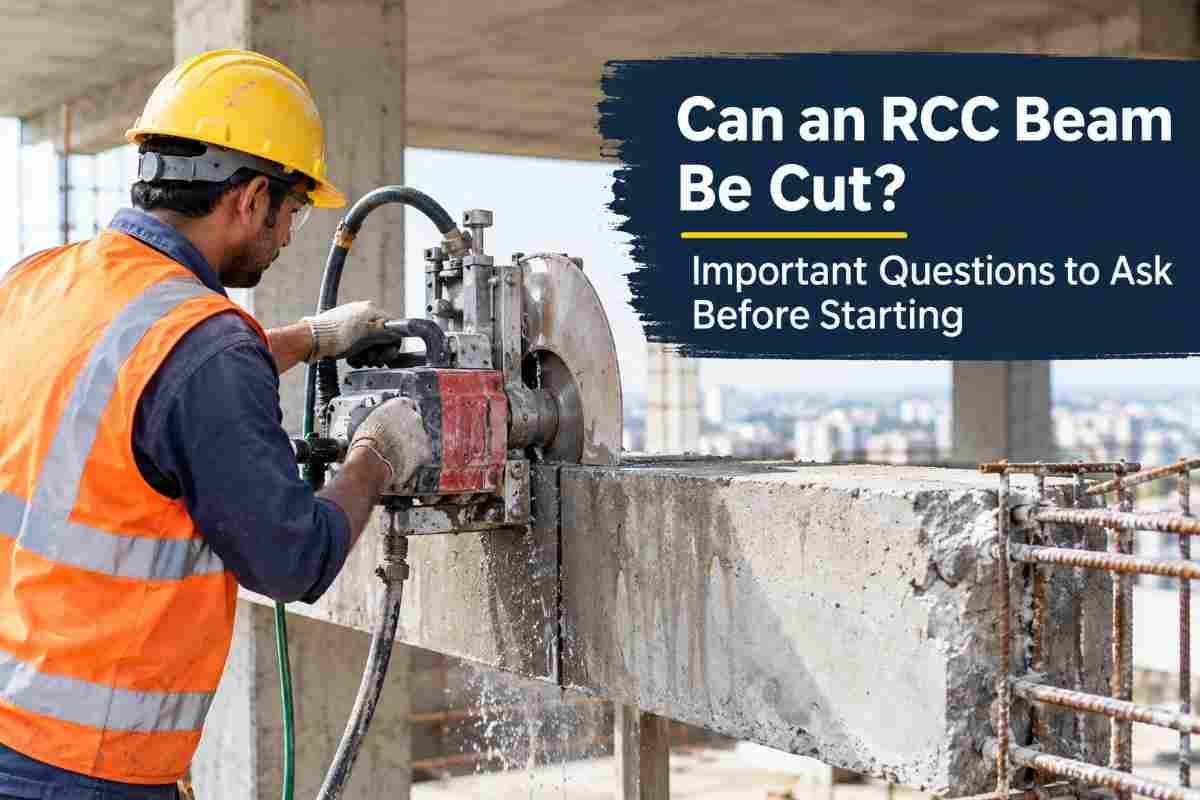
Renovating a home, converting an office or adding a staircase or lift often leads to the same worry: a reinforced cement concrete (RCC) beam is in the way. The first question is usually, “Can an RCC beam be cut?”
Technically, yes. Modern concrete cutting equipment can cut through almost any RCC element with precision. But whether it should be cut is a different question, and the answer depends on the beam’s structural role, the loads it carries and the engineering support you put around the work.
This guide explains what happens when you cut an RCC beam, the risks, the methods, and the questions to ask before work begins. It’s written for homeowners, builders, facility managers and contractors who want to avoid costly, dangerous mistakes.
Understanding the Role of an RCC Beam
Before asking whether a beam can be cut, you need to know what it does. An RCC beam is a horizontal structural member made of concrete and steel reinforcement. Concrete is strong in compression but weak in tension, so steel bars (rebar) carry the tensile forces.
A beam collects loads from slabs, walls and floors above, then transfers them to columns and then to the foundation. Together, beams, columns, slabs and footings form the skeleton of your building.
Cutting a beam interrupts this load path. If the beam is carrying significant load and nothing replaces its function, the result can be cracking, excessive deflection, or in the worst case partial or total collapse.
So, Can an RCC Beam Be Cut?
Yes, but only under controlled conditions. Beam cutting is common in:
- Renovation and remodelling, such as opening up spaces or relocating walls
- Installing lifts, staircases or ducts
- Demolishing damaged or deteriorated sections
- Creating openings for plumbing, HVAC and electrical services
- Retrofitting and seismic strengthening
- Industrial layout changes
In many of these cases the beam is not simply removed. It is cut and then supported, strengthened, re-routed or replaced. What matters is that a qualified structural engineer approves the plan first.
A beam should never be cut on guesswork, on a contractor’s verbal assurance, or because it “looks unnecessary.”
Types of RCC Beams and Why They Matter
Not all beams are equal, and the type affects how risky cutting will be.
Primary (main) beams carry heavy loads from slabs and secondary beams to columns. Cutting these is the highest-risk operation and normally needs full temporary support and engineered strengthening.
Secondary beams transfer load to primary beams. They are slightly less critical but still structural.
Plinth beams sit at plinth level and tie walls and columns together. They add stability and help resist differential settlement.
Lintel beams span openings such as doors and windows and carry the masonry above.
Tie beams and grade beams link columns or foundations and help resist lateral forces, which makes them particularly important in earthquake-prone zones.
Cantilever beams project beyond their support, for example under balconies. Cutting these without expert design is extremely dangerous.
Knowing the type tells you whether the beam is a candidate for cutting, strengthening or replacement.
Important Questions to Ask Before Cutting an RCC Beam
This is the most important part of the process. Work through these questions with your engineer and cutting contractor before any blade touches concrete.
1. Is the beam structural or non-structural?
Some beams, such as certain intermediate ones or beams in old non-load-bearing partitions, may carry little load. But you cannot judge this by eye. Only a structural engineer reviewing the drawings, or inspecting the building on site, can say for certain.
2. Do structural drawings exist for the building?
Original drawings show beam sizes, reinforcement details, spacing of stirrups and load assumptions. If they are missing, especially in older buildings, you may need a structural audit, non-destructive testing and sometimes rebar scanning to understand what is inside the concrete.
3. What loads does the beam carry?
Consider slabs above, walls resting on the beam, additional floors, water tanks, machinery and future expansion. A beam under a terrace with a heavy water tank behaves very differently from one that carries only a light partition.
4. What is the age and condition of the structure?
Older buildings may have lower-grade concrete, corroded rebar or hidden cracks. Cutting can expose or worsen weaknesses that were previously invisible. A condition survey, including rebound hammer and ultrasonic pulse velocity tests, helps assess this.
5. Is a structural engineer involved?
This is non-negotiable. The engineer should provide a written method statement covering the cutting sequence, temporary support design and permanent strengthening, such as steel jacketing, additional beams, props, or concrete or steel framing around the opening.
6. What temporary support is required?
Before cutting, the load must be taken by props, shoring or needle beams. The type, spacing and positioning depend on the load. Inadequate shoring is one of the most common causes of accidents in structural modification.
7. Are permissions and approvals required?
Depending on your city and the nature of the change, you may need approval from the municipal authority, a housing society or a building owner. Structural alterations without permission can lead to penalties, insurance problems and difficulty selling the property.
8. What cutting method is most suitable?
Different methods suit different situations (see the next section). The right one depends on beam size, access, noise limits, dust control and the level of precision required.
9. How will rebar be handled?
Reinforcement steel is cut along with the concrete. Your engineer should specify which bars can be cut, which must be preserved and how any cut bars will be reconnected or anchored.
10. What are the safety and environmental controls?
Concrete cutting generates slurry, dust, noise and vibration. Ask about water management, dust suppression, slurry disposal, PPE, area barricading and how nearby occupants will be protected.
11. Who is doing the work, and how experienced are they?
Check the contractor’s track record, equipment, trained operators and safety practices. Ask for references from similar structural cutting projects. An experienced team such as the one at Core Cutting India works with engineers’ specifications and uses the right equipment for each job, rather than treating cutting as a rough demolition task.
12. What is the cost and timeline?
Cost depends on beam depth, reinforcement density, access, method and the support work involved. Get a detailed quotation that separates cutting, support, disposal and any strengthening work.
Common Methods of Cutting an RCC Beam
Wall Saw Cutting
A wall saw is mounted on a track and uses a diamond blade to make straight, clean cuts through thick concrete. It is widely used for beams, walls and slabs where accuracy matters. It produces minimal vibration and a smooth finish, which protects the surrounding structure.
Wire Saw Cutting
A diamond wire saw is ideal for very large or irregularly shaped members and for places where a circular blade cannot reach. It is common in heavy industrial and bridge work, and it can cut through very thick sections.
Core Drilling
A diamond core drill makes round holes, often used for pipes, ducts and cables, or to create relief holes as part of a larger cutting plan. When holes must pass through a beam, they need engineer approval on size and location, because large or poorly placed holes can weaken the member significantly.
Hand-Held Ring Saw and Chain Saw Cutting
These are useful in tight spaces or where larger machines can’t fit. They are suited to smaller sections and finishing work.
Breaker and Chipping Methods
Jackhammers and breakers are sometimes used for demolition. However, they create heavy vibration, dust and noise, and can cause micro-cracking in the surrounding structure. For beams that remain part of a live structure, sawing is generally preferred over breaking.
Risks of Cutting an RCC Beam Without Proper Planning
Understanding the risks shows why preparation matters.
Structural failure: Removing or weakening a load-bearing beam without alternative support can cause sagging, cracking or collapse.
Cracks in slabs and walls: Load redistribution can cause new cracks in connected elements, even when the beam itself seems fine.
Cutting through critical reinforcement: Without scanning, you might unknowingly cut main tension bars or stirrups, reducing capacity dramatically.
Damage to utilities: Concealed electrical conduits, water lines and gas pipes may be embedded in or near the beam.
Safety hazards to workers and occupants: Falling concrete, unstable props and slurry spills can all lead to injury.
Legal and insurance trouble: Unauthorised structural changes may invalidate insurance cover and create liability if anything goes wrong.
Pre-Cutting Checks That Make the Job Safer
A responsible project usually includes the following steps:
- Structural assessment by a qualified engineer
- Review of drawings and, where needed, a site survey
- Rebar and utility scanning, for example with GPR (ground-penetrating radar) or a cover meter
- Design of temporary supports and permanent strengthening
- Method statement and risk assessment
- Marking of the cut lines on the beam
- Setting up water supply, slurry collection and dust control
- Barricading and signage around the work area
- Sequenced cutting, with monitoring for deflection and cracking
- Post-cutting strengthening and inspection
Skipping any of these steps increases the risk, and the savings are small compared with the potential cost of repairs or accidents.
What Happens After the Beam Is Cut?
Cutting is often only half the job. Depending on the engineer’s design, the follow-up work may include:
- Installing steel plates, angles or I-sections to carry the load
- Casting a new reinforced beam or a column to redirect loads
- Applying fibre-reinforced polymer (FRP) wraps or jacketing to strengthen the remaining section
- Using epoxy grouting to seal cracks
- Applying structural repair mortars and anti-corrosion coatings to exposed rebar
- Removing temporary props only after the new supports reach design strength
Only when the engineer confirms the structure is stable should the props be removed and the area returned to use.
Can You Cut Part of a Beam Instead of the Whole Thing?
Sometimes. Instead of removing a full beam, projects may need:
- A notch for a duct or pipe
- An opening (web penetration) for services
- A partial-depth cut for a recess or connection
Each of these reduces the beam’s capacity to some degree. The size, shape and position of the opening matter greatly. Openings near supports, in the tension zone at the bottom, or too close to each other can be dangerous. As a rule, any penetration through a beam should be designed and checked by the structural engineer, never decided on site.
DIY Cutting: A Bad Idea
Beam cutting is not a do-it-yourself task. Even if you can hire a saw or grinder, the risks are significant:
- You may not know which part of the beam carries tension
- Improvised props can fail without warning
- Hand tools produce uneven, rough cuts that need extra repair
- Dust and slurry management are rarely adequate
- Mistakes affect the entire building, not just one room
Professional concrete cutting teams have trained operators, calibrated equipment and safety systems that significantly reduce these risks.
Choosing a Professional RCC Cutting Service
When shortlisting a contractor, look for these qualities:
Experience: Proven work on beams, slabs, walls and large industrial structures.
Right equipment: Wall saws, wire saws, core drills and ring saws in good condition, with a range of diamond blades.
Engineer coordination: Willingness to work with your structural consultant and follow their method statement.
Safety culture: PPE, risk assessments, trained operators and incident-free records.
Clean work practices: Slurry management, dust control and minimal disruption.
Transparent pricing: A clear, itemised quote without hidden charges.
Insurance and compliance: Appropriate cover for workers and third-party risk.
Core Cutting India offers specialised concrete cutting services across multiple applications, and you can learn more or request a consultation at https://corecuttingindia.com/.
Frequently Asked Questions
Can I cut an RCC beam in my house?
Yes, in some cases. It depends on the beam’s structural role, load and condition. You need a structural engineer’s approval and a proper method with temporary supports.
Is it safe to cut an RCC beam?
It can be safe when planned and executed correctly, with engineering design, support, proper equipment and trained operators. It is unsafe if done casually.
What happens if you cut a load-bearing beam?
Without replacement support, the load redistributes unpredictably, causing cracks, deflection or collapse.
Can a beam be cut without weakening the structure?
Only if the load is properly transferred and strengthening is provided. Any cut reduces local capacity, so compensation is usually necessary.
How much does RCC beam cutting cost?
Cost varies with beam size, reinforcement, method, site access and support requirements. Request a site-specific quotation.
Which method is best for cutting RCC beams?
Wall saw and wire saw cutting are preferred for precision and minimal vibration. Core drilling suits holes, and ring saws suit tight spaces.
Do I need permission to cut a beam?
Often yes, especially for structural changes. Check with your local authority, society or building owner.
Can you drill holes through an RCC beam?
Small holes may be allowed in specific zones, but size and location must be approved by the engineer.
Final Thoughts
So, can an RCC beam be cut? Yes, but the real answer is “only with the right plan.” A beam is more than a piece of concrete. It is part of a system that keeps your building stable, and cutting it affects the whole system.
Before you begin, confirm the beam’s role, involve a structural engineer, prepare temporary supports, choose the correct cutting method and hire an experienced team. Doing so protects your building, your budget and, most importantly, the people who use the space.
If you’re planning a beam cutting, core drilling or any other concrete cutting project, talk to the professionals at Core Cutting India for guidance and precise execution.