
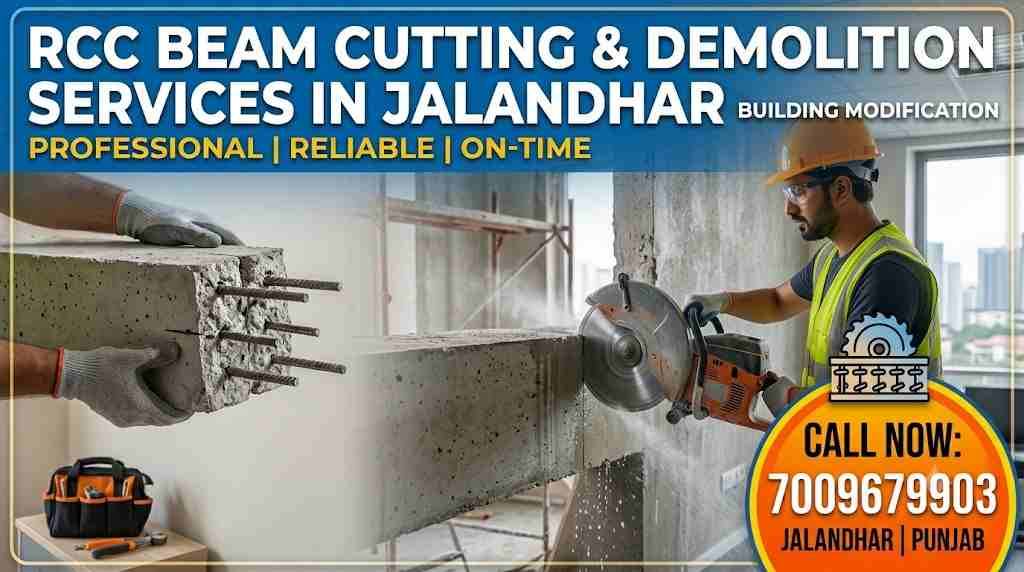
RCC beam cutting contractors in Jalandhar use diamond wire saws, wall saws and core drilling machines to cut, trim or remove reinforced concrete beams with controlled, low-vibration precision. Because a beam carries load, the cut must be planned with a structural engineer, supported with temporary props, and executed in a measured sequence. Done properly, it lets you reshape a building without damaging what you want to keep.
Planning a modification? 📞 Call or WhatsApp 7009679903 for a site-based answer.
A Beam Is Not a Wall: Why This Job Is Different
Most people who call a contractor about "cutting concrete" are thinking about a wall or a slab. A beam is another matter entirely.
A beam is the horizontal member that collects the weight of floors, walls and loads above and carries it to columns. Its steel is positioned with purpose: heavy bars at the bottom to resist stretching, bars at the top near supports, and stirrups along its length to resist shear. Cut it carelessly and you are not just making a hole; you are interrupting a load path.
That is why searching for RCC beam cutting contractors in Jalandhar should not be a hunt for the cheapest quote. It should be a search for a team that understands the difference between cutting a beam and cutting around one.
Why People in Jalandhar Modify Beams
Jalandhar's building stock is changing fast. Older homes built decades ago in Model Town, Basti Danishmanda and around Nakodar Road are being rebuilt or reconfigured, while commercial stretches near BMC Chowk, Adda Hoshiarpur and Kapurthala Road keep evolving. Typical reasons for touching a beam include:
- Opening up floor plans. Removing a projecting beam to create a larger hall, showroom or open kitchen.
- Adding a staircase or lift. Cutting a slab edge and trimming a beam to create the void.
- Changing use. Converting a residential floor into a clinic, office or coaching centre.
- Fixing design clashes. Making space for ducts, pipes or HVAC services that cross a beam.
- Removing damaged concrete. Cutting out cracked or deteriorated portions for repair.
- Demolishing in sections. Taking down part of a structure cleanly rather than bringing the whole thing down.
Each of these has a different risk profile, which is why the first conversation matters more than the first cut.
Cutting, Penetrating, Trimming, Removing: Know Which One You Need
Contractors and clients often use the same words for very different tasks. Clarifying this early saves time and money.
| What you want | What it means | Typical method | Engineer input |
|---|---|---|---|
| Small penetration | A round hole for a pipe or duct through a beam | Core drilling | Essential. Location and size are restricted |
| Notch or trim | Removing a small portion of a beam's edge | Hand saw, wall saw | Essential |
| Partial removal | Cutting out a length of beam | Wall saw, wire saw | Essential, with propping design |
| Full removal | Taking out an entire beam | Wire saw, wall saw | Essential, usually with new support |
| Sectional demolition | Cutting a damaged section out of a structure | Wire saw in planned sections | Essential |
Notice the last column. Every row says the same thing, and that is deliberate.
The Right Tools for Beam Work
Diamond Wire Saw
A loop of wire threaded with diamond beads runs around the beam and pulls through it. It is the most flexible method for thick, heavy or awkward sections because the wire can wrap around the element from any direction. The beam can be cut into manageable blocks, lowered or lifted out, and handled safely.
Wall Saw
A rail-mounted hydraulic saw makes long, precise straight cuts. It is excellent where a flat face is accessible and a perfectly square edge matters.
Core Drilling
When all you need is a hole for a service line, a diamond core bit gives a clean, round opening with minimal disturbance. For beams, hole position and diameter are limited by structural rules, so check with your engineer before marking anything. Our core cutting service in Jalandhar page explains typical hole sizes and uses.
Hand Saw
Compact and portable, a handheld diamond saw is used for tight spaces, finishing cuts and small adjustments.
All of these work wet. Water cools the diamond segments, controls dust and carries slurry away, which keeps the job cleaner and the cut accurate.
Why Diamond Cutting Beats Breaking
Beam work is where traditional breaking methods look most risky.
- Vibration travels. Impact breakers send shock through the entire frame, loosening joints and cracking plaster in adjoining rooms.
- Reinforcement gets damaged. Hammering can bend or loosen rebar you were counting on to remain intact.
- Edges are rough. Ragged surfaces need heavy repair before new work can bond.
- Control is limited. It is hard to stop at an exact line.
Diamond cutting grinds through the concrete and steel in a line you choose. The remaining structure stays quiet, and the finished face is ready for strengthening or finishing. If you want the wider picture of the technology, see our overview of diamond concrete cutting in Jalandhar.
The Safe Way to Modify a Beam: A Practical Sequence
Here is how a responsible beam modification generally proceeds. Your engineer and contractor may adjust it for your building, but the logic stays the same.
Step 1: Understand the structure. Review the drawings if available, or assess the building as it stands: its age, load, condition and framing system.
Step 2: Get a structural opinion. A qualified structural engineer decides whether the beam can be cut, trimmed or removed, and what must happen first.
Step 3: Design the support. Temporary props or shoring carry the load while the beam is altered. Where a beam is being removed permanently, a replacement member such as a steel section or a new RCC beam may be required.
Step 4: Scan and mark. Reinforcement and embedded services are located, and cut lines are marked and approved.
Step 5: Install protection. Props go in, surrounding areas are protected, and water and slurry arrangements are made.
Step 6: Cut in sequence. The beam is cut in planned stages, with weight controlled at each step.
Step 7: Remove and clean. Cut pieces are lifted or lowered safely, and the area is cleaned.
Step 8: Strengthen and finish. New supports, jacketing or repairs are completed before props come out.
If a contractor offers to cut a beam without talking about propping or engineering, treat that as a warning sign.
Myths About Beam Cutting
Myth: "If the beam looks thick, it's fine to cut a little." Thickness alone says nothing about where its tension steel sits or how much load it carries.
Myth: "A hole through a beam is the same as a hole through a wall." Holes in beams are restricted by size and position. A hole in the wrong zone can reduce shear capacity.
Myth: "If the building has stood for years, it has spare strength." Older buildings may have been designed to different standards, and concrete may have aged. Assume nothing.
Myth: "Removing a beam is cheaper than supporting it." Removal without proper replacement is often far more expensive when cracks or deflection appear later.
Myth: "Any labour contractor with a grinder can do this." Precision beam work depends on the right machines, trained operators and engineering coordination.
What to Look For in an RCC Beam Cutting Contractor
When you compare RCC beam cutting contractors in Jalandhar, check these points:
- Do they ask about the structure first? A good contractor asks about the beam, the loads and your goal before quoting.
- Do they involve or respect structural engineers? They should work comfortably with your engineer's instructions.
- Do they use proper diamond equipment? Wire saws, wall saws and core machines, not improvised tools.
- Do they discuss propping and sequence? This shows they understand the risk.
- Is the quote clear? Scope, method and what is included should be written out.
- Do they take site protection seriously? Water control, dust, floor protection and safety measures matter.
- Can they show relevant work? Photos or references of similar jobs build confidence.
- Are they easy to reach? Fast, honest communication is a good indicator of how the job will go.
What Affects the Cost of Beam Cutting?
There is no single flat price because every beam is different. The main factors are:
- Beam depth, width and length to be cut
- Reinforcement density and bar diameter
- Method used (wire saw, wall saw, core drilling)
- Number of cuts and sections
- Height, access and working space
- Propping and shoring requirements
- Debris handling and removal
- Urgency and site conditions
To get a rough idea before you call, use our concrete cutting rate calculator. For a precise quote, send photos and measurements on WhatsApp.
Real-World Scenarios
Scenario 1: The open-plan living room. A homeowner wants to remove a beam that splits the drawing room. The engineer checks the load, designs a steel replacement, supports are installed, and the beam is cut in sections by wire saw. The result is one clean, open room without cracks in neighbouring walls.
Scenario 2: The ducted AC. A showroom needs an AC duct to cross a beam. The engineer approves a specific hole size and position, and a core drill makes it with minimal disturbance.
Scenario 3: The damaged section. A beam end is cracked and corroded after years of water leakage. The affected section is cut out, steel is repaired, and fresh concrete is cast, all with the structure supported throughout.
Frequently Asked Questions (FAQs)
Can an RCC beam be cut safely?
Yes, with the right planning. A structural engineer should confirm what is permissible, temporary props should carry the load, and the cutting should follow a controlled sequence.
Can I remove a beam to create an open space?
Often, yes, but it usually requires a replacement support such as a steel beam or a redesigned RCC member. Never remove a beam without an engineer's design.
Can pipes and ducts pass through a beam?
Small holes are sometimes allowed in specific zones of a beam. Their size and position must be approved by your engineer before drilling.
What is the best method for cutting a thick beam?
Diamond wire sawing is commonly chosen for thick or heavy sections because it can cut in sections that are easy to lift out. Wall saws are used where straight, flat cuts are accessible.
Will beam cutting damage the rest of the building?
Diamond cutting creates very little vibration compared with breakers, and a planned sequence with props protects the surrounding structure.
How long does beam cutting take?
It depends on size, access and propping needs. Small penetrations can be quick, while full removal with support installation may take several days. A site visit gives the most reliable timeline.
Do I need permission before modifying a beam?
Rules vary by building type and location. Ask your engineer and, where relevant, check local municipal or society requirements before starting.
Is the process messy?
Much less than breaking. Water controls dust, and slurry is collected and cleaned up after cutting.
How do I get a quote for beam cutting in Jalandhar?
Use the rate calculator for an estimate, then WhatsApp photos, dimensions and location to 7009679903 for a firm quote.
Conclusion: Modify Boldly, Cut Carefully
Every building eventually needs to change: a wall moves, a floor opens, a service line has to cross a beam. Beams are the most sensitive part of that change because they carry what everything else depends on.
The good news is that modern diamond cutting makes it possible to reshape RCC buildings with real precision. The key is respecting the structure: get an engineer's view, plan the supports, choose the right method, and hire contractors who explain their approach instead of hiding it.
If you are planning a building modification anywhere in Jalandhar, talk to a team that does this work every day before the first cut is marked.
📞 Call or WhatsApp for a Free Site Enquiry
- 📞 Call now: 7009679903
- 💬 WhatsApp: Send your site details
- ✉️ Email: info@corecuttingindia.com
- 🌐 Website: corecuttingindia.com
- 🧮 Estimate your cost: Rate Calculator
- 📍 Local service: Core Cutting Service in Jalandhar
Send photos, dimensions and your location on WhatsApp to get a clear, no-pressure quote.