
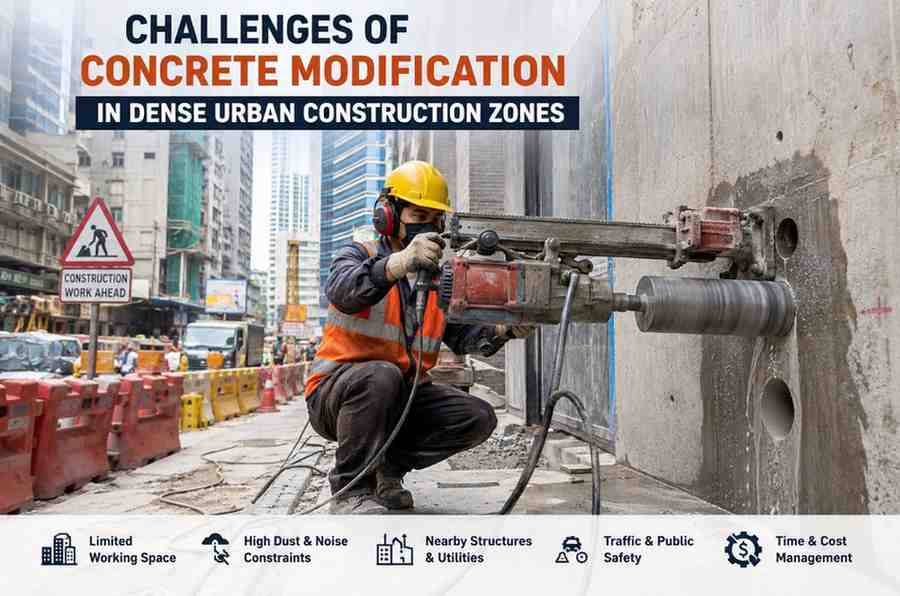
Urban construction has never been more complex. As cities grow taller and denser, construction crews are forced to work in increasingly tight, congested, and sensitive environments — surrounded by occupied buildings, live utilities, heavy foot traffic, and strict municipal regulations. In this landscape, concrete modification — the process of cutting, coring, demolishing, or reshaping existing concrete structures — has become one of the most technically demanding aspects of urban redevelopment and infrastructure work.
At Core Cutting India ([email protected]), we work on concrete modification projects across some of the busiest and most spatially constrained sites in the country. Through years of hands-on experience, we've come to understand that concrete modification in dense urban zones isn't just about breaking or cutting concrete — it's about precision engineering, risk management, and careful coordination with the surrounding environment. In this blog, we explore the core challenges contractors face and the strategies that make successful urban concrete modification possible.
What Is Concrete Modification, and Why Does It Matter in Cities?
Concrete modification refers to any process that alters existing concrete structures — walls, slabs, columns, foundations, or pavements — to accommodate new construction requirements. This includes diamond core drilling for utility openings, wall sawing for doorways and windows, floor sawing for expansion joints, controlled demolition for structural renovation, and precision cutting for retrofitting elevators, staircases, or HVAC systems.
In dense urban environments, concrete modification is almost unavoidable. Older buildings need retrofitting to meet modern seismic codes. New metro lines and underground utilities must be threaded beneath existing structures. Commercial spaces need remodeling without shutting down entire buildings. Every one of these tasks requires modifying concrete that is often decades old, structurally load-bearing, and located inches away from occupied space.
Challenge 1: Extremely Limited Working Space
Perhaps the most immediate and obvious challenge in dense urban zones is the sheer lack of space. Unlike greenfield sites where heavy machinery can maneuver freely, urban construction zones are often squeezed between adjacent buildings, narrow lanes, or active roadways. Concrete cutting and coring equipment — even compact diamond saws and core drills — need enough clearance to operate safely and effectively.
Contractors frequently have to disassemble larger machines and transport them piece by piece through stairwells or narrow corridors before reassembling them on-site. In basements or below-grade levels, low ceiling heights further restrict the type of equipment that can be used. This is where specialized tools like handheld wall saws, low-clearance core drills, and remote-controlled demolition robots become essential — equipment Core Cutting India regularly deploys for exactly these scenarios.
Challenge 2: Structural Safety and Load-Bearing Risks
Every concrete element in a building serves a structural purpose, whether it's a load-bearing wall, a post-tensioned slab, or a foundational pier. Modifying concrete without a thorough structural assessment can compromise the integrity of the entire building — a risk that is dramatically amplified in dense urban areas where adjacent structures, underground parking, and shared walls are common.
Before any cutting or coring begins, engineers must study structural drawings, identify reinforcement patterns using rebar scanners and ground-penetrating radar, and calculate how removing or altering a section of concrete will redistribute load. In post-tensioned slabs, cutting into a live tensioned cable can cause sudden, dangerous cable release. This is why professional concrete modification teams always prioritize non-destructive scanning before committing to any cut.
Challenge 3: Vibration Control Near Occupied Buildings
Traditional demolition methods — jackhammers, impact breakers, and explosive charges — generate significant vibration. In a dense urban setting, this vibration doesn't stay contained to the worksite. It travels through the ground and structural connections into neighboring buildings, potentially causing cosmetic damage, structural micro-cracking, or triggering seismic sensors and alarms in adjacent properties.
Vibration-sensitive environments — hospitals, data centers, heritage buildings, and residential towers — require vibration-free techniques such as diamond wire sawing, diamond core drilling, and controlled hydraulic splitting. These methods rely on abrasion rather than impact, significantly reducing vibration transfer while maintaining cutting precision. Monitoring equipment is often installed on neighboring structures to track vibration levels in real time and ensure they remain within permissible limits set by local authorities.
Challenge 4: Dust, Noise, and Environmental Compliance
Urban construction sites operate under far stricter environmental scrutiny than rural or suburban ones. Concrete cutting inherently generates dust, and dry cutting can release fine silica particles that pose serious respiratory hazards to workers and nearby residents. Noise levels from cutting and demolition equipment can also violate municipal noise ordinances, particularly in mixed-use zones with residential neighbors.
To address this, modern concrete modification relies heavily on wet-cutting techniques, where water is continuously fed to the blade or bit to suppress dust at the source. Noise-dampening enclosures, scheduled work hours, and real-time air quality monitoring are also standard practice on compliant urban job sites. Regulatory bodies in Indian cities have become increasingly strict about Pollution Control Board (PCB) norms, making compliance not just good practice but a legal necessity.
Challenge 5: Coordination with Live Utilities
Dense urban areas are threaded with underground and overhead utility networks — water lines, gas pipes, electrical conduits, fiber optic cables, and sewage systems. Cutting or coring into concrete without knowing what lies beneath or within it can result in utility strikes, which range from costly service disruptions to life-threatening electrical or gas hazards.
Before any modification work begins, contractors must conduct utility mapping using ground-penetrating radar (GPR), electromagnetic locators, and coordination with municipal utility departments. In many Indian metros, this also means navigating bureaucratic processes to obtain updated utility maps, since older buildings may have undocumented or unofficial utility installations added over decades of piecemeal renovation.
Challenge 6: Logistics, Access, and Material Removal
Even after concrete is successfully cut or cored, the resulting debris has to be removed — and in a dense urban zone, this is its own logistical puzzle. There's often no space for large debris containers, and material must be manually carried, hoisted through window openings, or moved via small elevators to reach a loading area. Traffic congestion and restricted loading hours in city centers further complicate the scheduling of debris trucks.
Efficient urban contractors plan material removal routes in advance, often using smaller, more frequent debris removal trips instead of relying on large dumpsters that can't fit or aren't permitted on narrow streets. Vertical transport using core-cut openings themselves — cutting a temporary chute through a floor slab, for example — is sometimes the most practical removal strategy.
Challenge 7: Regulatory Approvals and Permitting Delays
Urban construction projects are subject to a dense web of permits: municipal corporation approvals, fire department clearances, heritage conservation rules (for older structures), pollution control certifications, and labor safety compliance. Concrete modification work, especially involving structural changes, typically requires a structural engineer's certification and sign-off from local building authorities before work can even begin.
Delays in securing these approvals can stall entire projects, and contractors must build regulatory lead time into their project schedules. Experienced concrete modification companies help clients navigate this process by preparing detailed method statements, safety plans, and structural assessments that regulatory bodies expect to see before granting clearance.
Challenge 8: Scheduling Around Building Occupancy
Many urban concrete modification projects take place inside buildings that remain partially or fully occupied — office towers, hospitals, residential complexes, and retail centers rarely shut down entirely for renovation work. This means cutting and coring often has to happen during off-peak hours, overnight shifts, or in tightly sequenced phases that minimize disruption to daily operations.
This constraint changes everything from crew scheduling to equipment selection. Low-noise, low-dust methods become non-negotiable when work is happening a few meters away from a hospital ward or an active office floor. Clear communication with building management and occupants, along with temporary barriers and signage, helps maintain safety and minimize complaints.
Challenge 9: Precision Requirements for Modern Retrofits
Modern urban retrofits — installing elevators in older buildings, creating openings for HVAC ducts, or reinforcing structures for seismic compliance — demand a level of precision that manual demolition simply cannot achieve. A core hole that's a few centimeters off, or a cut that damages surrounding reinforcement, can set back a project by days and add significant cost.
This is where diamond core drilling and precision wall sawing excel. These techniques allow cuts accurate to within millimeters, preserving the structural integrity of surrounding concrete while creating exactly the opening required — whether it's a circular hole for plumbing or a rectangular opening for a new doorway.
How Core Cutting India Solves These Challenges
At Core Cutting India, we specialize in navigating exactly these urban complexities. Our approach combines:
- Pre-cutting structural and utility scanning to identify rebar, tensioned cables, and hidden utilities before any cut is made
- Vibration-free diamond cutting and coring techniques suited for occupied and sensitive structures
- Dust suppression and noise control systems compliant with municipal environmental norms
- Compact, low-clearance equipment designed for tight urban access points
- Experienced project coordination to manage permits, scheduling, and debris logistics with minimal disruption
Whether it's a metro corridor project, a commercial retrofit, or a residential tower renovation, our team plans every concrete modification job around the specific constraints of the urban environment it's happening in — not the other way around.
Conclusion
Concrete modification in dense urban construction zones is a discipline that demands more than raw cutting power — it requires careful planning, structural knowledge, environmental responsibility, and constant coordination with the people and infrastructure around the worksite. From space constraints and vibration control to utility conflicts and regulatory approvals, every challenge compounds the complexity of the job.
Companies that succeed in this space are the ones that treat concrete modification as precision engineering rather than brute-force demolition. If your project involves concrete cutting, coring, or modification in a challenging urban environment, Core Cutting India is ready to help you navigate it safely and efficiently.
Get in touch with Core Cutting India today at [email protected] to discuss your concrete modification project.