
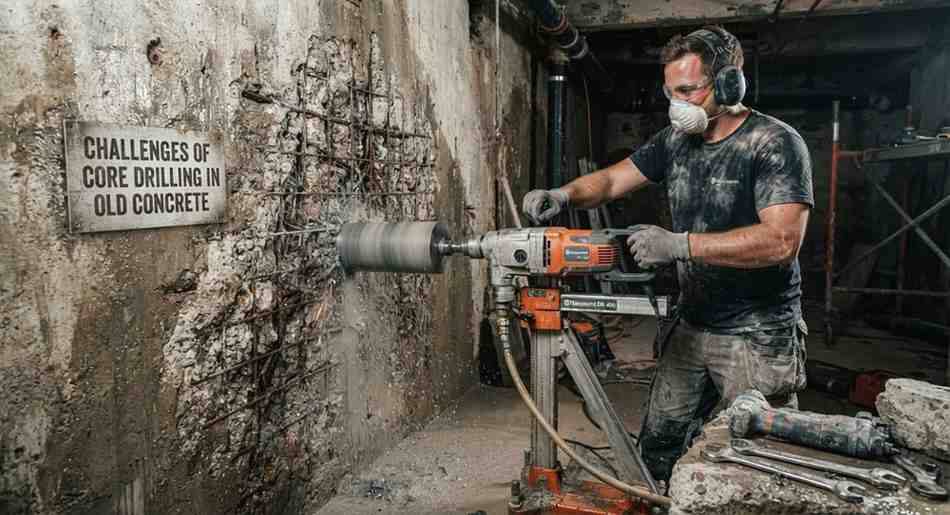
Introduction
India’s infrastructural landscape is a fascinating juxtaposition of ancient heritage and rapid modernization. From pre-independence colonial structures in Mumbai and Kolkata to post-independence brutalist public buildings in Delhi and sprawling industrial complexes across Gujarat, civil engineering constantly evolves. However, as cities expand and structures age, urban renewal, metro rail expansion, and retrofitting projects have become the order of the day.
At the heart of modern structural modification lies core drilling—a precise, non-percussive technique used to create circular openings for utilities, anchoring, or structural testing. While core drilling in modern, high-strength concrete is a standardized routine, tackling old concrete introduces a labyrinth of engineering hurdles. Decades of material degradation, unpredictable aggregate compositions, heavy corrosion of reinforcement bars (rebars), and historical construction quirks make core drilling in aged structures a high-stakes operation.
Brought to you by [email protected], this comprehensive guide dives deep into the intricate challenges of core drilling in vintage and aged concrete, highlighting real-world Indian scenarios, technical hazards, and industry best practices.
1. The Anatomy of Old Concrete in India
Before analyzing the drilling challenges, it is vital to understand what constitutes "old concrete" in the Indian context. Structures built between the 1950s and 1990s possess distinct material characteristics compared to today’s self-consolidating or high-performance mixes.
-
Variable Mix Proportions: Many buildings from the mid-20th century relied on volumetric batching rather than precise weight batching. This led to inconsistent cement-to-aggregate ratios across different sections of the same structural member.
-
Locally Sourced Aggregates: Depending on the region, builders used locally available river gravel, crushed limestone, basalt, or even soft sandstone. In older structures, aggregate hardness can vary wildly, causing uneven wear on cutting tools.
-
Carbonation and Strength Gain vs. Degradation: While some well-cured old concrete exhibits higher compressive strength than its specified grade due to prolonged hydration, it is frequently offset by carbonation, which lowers the pH of the concrete, passivates the embedded steel, and triggers internal micro-cracking.
2. Major Engineering Challenges of Core Drilling in Aged Structures
Executing a clean core cut in concrete aged 30, 40, or 50 years presents several distinct physical and chemical hurdles.
A. Severe Rebar Corrosion and Congestion
In older Indian buildings, particularly in coastal cities like Mumbai, Chennai, and Kochi, decades of high humidity, heavy rainfall, and chloride attack have severely compromised internal steel reinforcement.
-
The Challenge: Corroded rebar expands, causing internal bursting stresses and delamination of the surrounding concrete matrix. When a diamond core bit hits a corroded, delaminated, or unexpectedly thick rebar cage, the vibration can cause the surrounding degraded concrete to spall or fracture catastrophically.
-
The Consequence: Loss of structural integrity around the hole, jamming of the core bit, and potential motor burnout of the drilling machine.
B. Unmapped Utilities and Errant Reinforcement
Unlike modern construction governed by strict BIM (Building Information Modeling) and digital as-built drawings, older structures frequently lack reliable documentation.
-
The Challenge: Modifications, additions, and ad-hoc structural repairs carried out over decades mean that internal layouts rarely match original blueprints. Electric conduits, hidden plumbing lines, and dense, non-standard structural tie-bars are frequently encountered unexpectedly.
-
The Consequence: Striking live electrical lines or structural load-bearing ties poses severe safety and stability risks.
C. Internal Voids, Honeycombing, and Micro-Cracks
Quality control during placement in older infrastructure was occasionally lax, leading to internal flaws.
-
The Challenge: Old concrete often contains internal voids, honeycombing zones, or honeycombed pockets caused by inadequate compaction or segregation during pouring. When a diamond bit transitions from dense concrete into a void, the sudden loss of resistance causes bit deflection, segment chipping, and severe vibration.
-
The Consequence: Out-of-round holes, cracked cores, and structural weakening of the surrounding member.
D. Extreme Abrasiveness and Unpredictable Aggregate Hardness
-
The Challenge: Many older structures utilized riverbed gravel or coarse regional stone matrices. Over decades, thermal cycling (extreme Indian summers followed by monsoons) induces micro-fracturing in the aggregate itself. Hitting weathered, brittle aggregates can cause them to dislodge rather than shear cleanly, tearing up the core wall.
-
The Consequence: Excessive segment wear, glazed diamond bits, and extremely slow penetration rates.
3. Real-World Indian Scenarios and Case Insights
To contextualize these challenges, let us examine common scenarios encountered across Indian urban centers.
Scenario 1: Retrofitting Heritage Structures in South Mumbai
Heritage buildings constructed during the British era or early post-independence often utilize lime-surki mortar combined with stone masonry or early-form reinforced cement concrete (RCC).
-
The Hurdle: The interface between ancient masonry and subsequent concrete patches creates erratic resistance gradients. Core drilling through these multi-layered historical walls often results in structural binding, as the softer mortar erodes faster than the hard stone aggregates, destabilizing the anchor base of the rig.
Scenario 2: Upgrading Industrial Plants in Gujarat and Maharashtra
Aging chemical, textile, and manufacturing plants frequently undergo structural audits and capacity expansions, requiring extensive core extraction for chemical analysis (carbonation depth, chloride penetration) and utility routing.
-
The Hurdle: Decades of chemical exposure, acid mist, and heavy operational vibrations have altered the chemical matrix of the concrete. The surface layers may be heavily carbonated and brittle, while internal cores remain dense, creating differential cutting resistance that stalls standard core barrels.
Scenario 3: Metro Rail Interchanges and Underpass Integration in Delhi and Kolkata
Connecting new underground metro tunnels to older station boxes or integrating old flyovers with new lane expansions requires precision core cutting through aged substructures.
-
The Hurdle: High-vibration risks. Old concrete piers and abutments cannot tolerate heavy percussive loads without risking progressive micro-cracking. Operators must rely exclusively on non-percussive diamond core drilling, meticulously managing water flow to prevent slurry accumulation in congested urban basements.
4. Best Practices and Mitigation Strategies for Contractors
Overcoming the hurdles of old concrete requires a blend of advanced diagnostic technology, specialized equipment, and skilled craftsmanship. Experts at [email protected] recommend the following protocol:
Step 1: Comprehensive Non-Destructive Testing (NDT)
Never drill blindly into old concrete. Deploy advanced NDT techniques prior to mobilization:
-
Ground Penetrating Radar (GPR): To map rebar distribution, slab thickness, and hidden conduits.
-
Pachometer (Rebar Locator): For precise cover depth and bar diameter estimation.
-
Ultrasonic Pulse Velocity (UPV): To identify internal voids, honeycombing, and structural homogeneity.
Step 2: Selection of Specialized Diamond Tooling
Standard off-the-shelf core bits will fail rapidly in degraded, abrasive old concrete.
-
Matrix Selection: Use soft-matrix diamond segments for hard aggregates (to ensure continuous exposure of fresh diamonds) and hard-matrix segments for abrasive, weathered mortar.
-
Variable Speed Motors: Utilize high-torque, variable-speed hydraulic or electric core drill rigs that can adjust RPM dynamically when transitioning through mixed material densities.
Step 3: Rigorous Anchoring and Stabilization
Because old concrete is prone to surface spalling, traditional bolt-down anchoring for the drill rig can pull out under load.
-
Vacuum Pads: Use heavy-duty vacuum base plates on smooth surfaces, or chemical anchor studs with wider load distribution plates to prevent the rig from shifting when the bit encounters hidden rebar.
Step 4: Water Management and Slurry Control
Old structures often lack modern drainage provisions, and water ingress can damage surrounding interiors or trigger electrical hazards.
-
Water Collection Rings: Always employ professional slurry collection rings connected to industrial wet vacs.
-
Controlled Flow: Regulate water pressure to cool the diamond segments effectively without flooding weakened structural cavities.
Conclusion
Core drilling in old concrete is far more than a routine mechanical task; it is a delicate engineering intervention that demands respect for the material's history, structural condition, and physical anomalies. Whether dealing with rusted reinforcement in coastal high-rises or variable aggregate matrices in industrial retrofits, anticipating these challenges is the key to project success.
For professional consultation, structural cutting, and precision core drilling services tailored to India's unique architectural landscape, reach out to the experts at [email protected]. Ensure your structural modifications are executed safely, accurately, and without compromising the integrity of aged assets.
Target-Related Searches
-
concrete core cutting services in India
-
how to drill through old reinforced concrete
-
diamond core drilling contractor price Delhi
-
non-destructive testing and core sampling India
-
rebar cutting in old buildings
-
concrete wall sawing and core drilling safety
People Also Ask (PAA)
-
What are the main hazards of drilling into old concrete?
-
How do you locate rebar before core drilling?
-
Why does a core drill bit get stuck in old concrete?
-
Can core drilling weaken a structural slab in an old building?
-
What is the difference between core drilling in new vs. old concrete?