
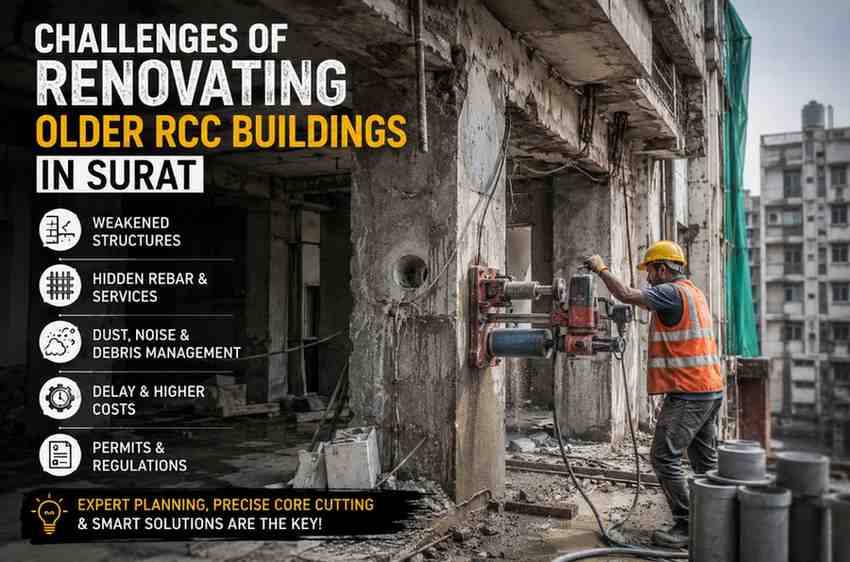
Surat, one of Gujarat's fastest-growing cities, is home to thousands of Reinforced Cement Concrete (RCC) buildings constructed over the last three to five decades. As the textile hub and diamond city continue to expand vertically and horizontally, many of these ageing structures — residential apartments, commercial complexes, and industrial units — are now reaching a stage where renovation, repair, or structural strengthening becomes unavoidable. While renovating an older RCC building may sound like a straightforward construction task, the reality is far more complex. From hidden structural damage to outdated design codes, renovating older RCC buildings in Surat presents a unique set of challenges that require specialized expertise, precision tools, and careful planning.
In this blog, we explore the major challenges builders, engineers, and property owners face when renovating older RCC structures in Surat, and how professional concrete cutting and structural solutions from experts like Core Cutting India can help overcome them.
Why RCC Building Renovation Is Becoming Critical in Surat
Surat's rapid urbanization since the 1980s and 90s led to a construction boom, with many buildings erected quickly to meet housing and commercial demand. Decades later, these structures are showing visible signs of ageing — cracked plaster, exposed and corroded rebar, water seepage, and reduced load-bearing capacity. Add to this Surat's humid coastal climate, proximity to the Tapi River, and high groundwater table, and you have a recipe for accelerated concrete deterioration.
Renovation is no longer optional for many of these buildings. It's a matter of safety, structural longevity, and compliance with updated building codes. However, the renovation process itself is riddled with technical, logistical, and regulatory challenges that must be carefully navigated.
1. Structural Assessment and Hidden Damage
One of the very first challenges in renovating an older RCC building is understanding its actual structural condition. Unlike new construction, where design and reinforcement details are documented and known, older buildings often lack proper records. Original architectural drawings, structural calculations, and material specifications are frequently missing or outdated.
This makes a comprehensive structural audit essential — but also difficult. Engineers must rely on non-destructive testing (NDT) methods such as rebound hammer tests, ultrasonic pulse velocity tests, and carbonation depth testing to assess concrete strength and rebar corrosion without damaging the structure further. Hidden issues like internal cracking, delaminated concrete, or corroded reinforcement bars often only become visible once renovation work begins, leading to scope changes mid-project and unexpected cost escalations.
2. Corrosion of Reinforcement Bars
Surat's humid climate and proximity to water bodies significantly accelerate the corrosion of steel reinforcement within RCC structures. Once moisture penetrates the concrete cover — often due to cracks, poor waterproofing, or age-related porosity — the embedded rebar begins to rust and expand, causing the surrounding concrete to crack and spall.
Renovating such buildings requires careful removal of the affected concrete, treatment or replacement of corroded rebar, and application of anti-corrosive coatings before restoring the structural element. This process demands precision, because excessive or careless concrete removal can further weaken an already compromised structure. Specialized concrete cutting and coring techniques are essential here to remove damaged sections cleanly without causing vibration-induced stress to adjacent structural members.
3. Outdated Design Codes and Seismic Vulnerability
Many older RCC buildings in Surat were constructed before the widespread adoption of modern seismic design codes such as IS 1893 and IS 13920. Gujarat lies in a seismically active zone, as demonstrated by the devastating 2001 Bhuj earthquake, and older structures often lack the ductile detailing and lateral load-resisting systems required by today's standards.
Renovation projects, therefore, frequently need to incorporate seismic retrofitting — adding shear walls, steel bracing, base isolation, or jacketing of columns and beams to improve earthquake resistance. This adds significant technical complexity to what might otherwise be considered a simple cosmetic renovation, and it requires collaboration between structural engineers and specialized retrofitting contractors.
4. Precision Cutting and Coring in Occupied or Sensitive Structures
A major operational challenge in renovating older RCC buildings is that many of them remain occupied or in active commercial use during the renovation process. This means renovation work — including cutting openings for new doors, windows, ducts, staircases, or utility lines — must be carried out with minimal noise, dust, and vibration to avoid disrupting residents or damaging surrounding structural elements.
This is where modern techniques like diamond core cutting and wall sawing become invaluable. Unlike traditional hammering or breaking methods, diamond core cutting offers clean, precise cuts with minimal vibration, reducing the risk of micro-cracking in adjacent concrete. Core Cutting India specializes in exactly this kind of precision concrete cutting and coring work, enabling renovation contractors to create openings for MEP (mechanical, electrical, plumbing) installations, lift shafts, or structural modifications without compromising the integrity of the existing structure.
5. Space Constraints and Congested Urban Layouts
Surat's older neighborhoods, particularly areas like Rander, Nanpura, Varachha, and parts of the walled city, are characterized by narrow lanes, closely packed buildings, and limited access for heavy machinery. Renovation contractors often cannot bring in large equipment or scaffolding trucks, which limits the construction methods available.
This challenge requires renovation teams to use compact, mobile equipment and manual or semi-automated techniques for demolition, cutting, and material removal. Debris disposal also becomes more difficult in congested areas, requiring careful logistical planning to avoid disrupting neighboring properties or public roads.
6. Utility and Service Line Complications
Older buildings in Surat often have plumbing, electrical wiring, and drainage systems that were installed decades ago and may not comply with current safety standards. During renovation, these utility lines frequently need to be rerouted, upgraded, or entirely replaced.
Identifying the exact location of embedded pipes and cables before cutting or drilling into concrete is critical to avoid accidental damage, which can cause water leaks, electrical hazards, or costly repairs. Professional concrete scanning and detection services are often used alongside cutting and coring work to map out embedded utilities before any structural intervention begins.
7. Regulatory and Compliance Hurdles
Renovating an older RCC building in Surat also means navigating a web of regulatory approvals from the Surat Municipal Corporation (SMC) and other local authorities. Depending on the scope of work, permissions may be required for structural alterations, additional floor construction, change of building use, or fire safety compliance.
Many older buildings were constructed before current building bylaws, floor space index (FSI) regulations, and fire safety norms came into effect. Bringing these structures up to code during renovation can involve significant redesign, especially for aspects like staircase width, fire exits, ventilation, and parking allocation — all of which can add time and cost to the project.
8. Balancing Heritage or Architectural Value with Modernization
Certain older buildings in Surat, particularly in historic pols and havelis in the old city area, carry architectural or cultural significance. Renovating these structures involves a delicate balance between preserving original design elements and integrating modern structural reinforcements or amenities.
This challenge requires renovation teams with experience in heritage-sensitive techniques, where structural strengthening must be achieved without visibly altering the building's character. Precision cutting tools are particularly useful here, as they allow for targeted interventions without the extensive damage caused by conventional demolition methods.
9. Cost Overruns and Budget Uncertainty
Because so much of an older RCC building's condition remains hidden until renovation work begins, budgeting accurately from the outset is genuinely difficult. Contingency costs for unexpected structural repairs, additional reinforcement, or extended timelines are common in these projects.
Property owners are advised to work with experienced structural consultants who can conduct thorough pre-renovation surveys and build realistic contingency buffers — typically 15-20% of the estimated budget — into their project planning.
10. Environmental and Safety Considerations
Older buildings may contain construction materials that are no longer considered safe by modern standards, and demolition or cutting work can generate significant dust and debris. Ensuring proper dust control, safe debris disposal, and adherence to occupational safety standards for workers is an ongoing challenge, particularly on sites with limited space and occupied surroundings.
How Core Cutting India Helps Overcome These Challenges
Given the complexity involved in renovating older RCC buildings, having the right technical partner makes a significant difference. Core Cutting India specializes in precision concrete cutting, core drilling, wall sawing, and structural demolition services tailored for renovation projects across Surat and Gujarat.
Our approach focuses on:
- Minimally invasive cutting techniques that preserve the structural integrity of surrounding concrete
- Vibration-free diamond core drilling for utility installations, duct openings, and structural modifications
- Precise, clean cuts for door and window openings, staircases, and lift shafts in occupied buildings
- Experienced handling of space-constrained sites common in Surat's older neighborhoods
- Collaboration with structural engineers to ensure cutting and coring work aligns with retrofitting and strengthening plans
Whether you're renovating a residential apartment building, a commercial complex, or a heritage structure in Surat, working with specialists who understand both the technical and logistical challenges of older RCC buildings can save significant time, cost, and risk.
Conclusion
Renovating older RCC buildings in Surat is a multifaceted challenge that goes well beyond surface-level repairs. From hidden structural damage and reinforcement corrosion to outdated seismic design and regulatory compliance, property owners and contractors must navigate a complex set of technical and logistical hurdles. Success in these projects depends heavily on thorough structural assessment, precise execution, and partnering with experienced professionals who understand the unique demands of Surat's ageing building stock.
If you're planning a renovation project for an older RCC structure in Surat and need expert concrete cutting, coring, or structural modification services, reach out to Core Cutting India at [email protected]. Our team brings the precision, experience, and equipment needed to make your renovation project safe, efficient, and structurally sound.