
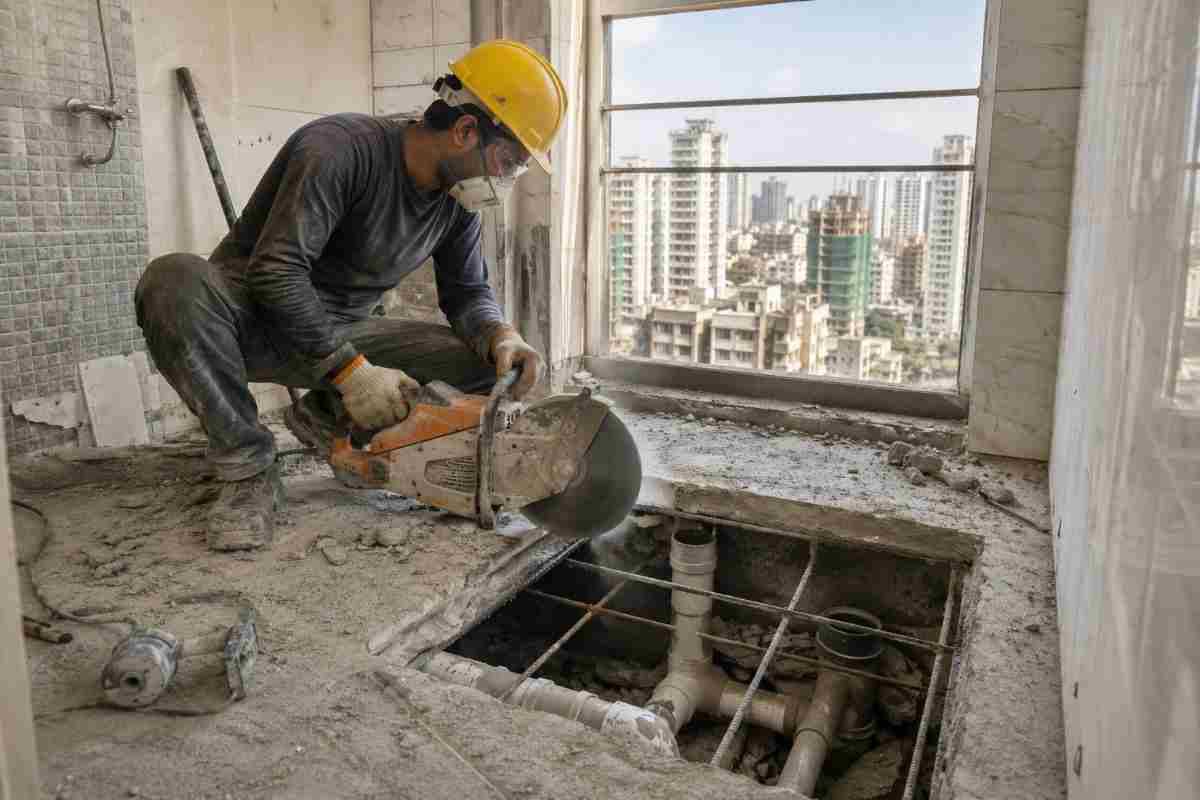
Upgrading or reconfiguring a bathroom in a Mumbai high-rise or cooperative housing society flat comes with unique civil challenges. Whether relocating a WC pan, adding a secondary washbasin, converting a dry toilet into a wet room, or rerouting aging GI and PVC waste lines, traditional heavy manual demolition using hammers and chisels poses major structural risks. Heavy manual impact causes micro-fractures in reinforced cement concrete (RCC) floor slabs, damages existing waterproofing layers, and sends unwanted vibrations through neighboring flats.
Precision chhat cutting (slab cutting and core drilling) provides a controlled, engineered solution for modern flat renovations in Mumbai. Utilizing industrial diamond-tipped core barrels and diamond wall/flat saws, structural experts create clean, vibration-free openings in concrete floor slabs for plumbing lines, floor traps, and soil waste pipes without compromising structural integrity.
This guide explores technical workflows, municipal compliance, structural precautions, cost parameters, and execution standards for slab and chhat cutting during flat renovations across Mumbai.
1. Why Chhat Cutting is Essential for Mumbai Bathroom Renovations
Mumbai’s residential architecture includes decades-old cessed structures in South Mumbai (such as Girgaon, Dadar, and Lalbaug) alongside contemporary high-rise towers across Bandra, Andheri, Powai, and Thane. Older structures frequently feature sunken slab layouts with cast-iron pipes, while newer residential towers utilize rigid post-tensioned or cast-in-situ RCC slabs with strict plumbing shafts.
[Bathroom Renovations in Mumbai Flats]
       │
       ├─► Relocating Soil & Waste Pipes (P-Traps & S-Traps)
       ├─► Shifting Fixtures (WC Pans, Shower Channels, Washbasins)
       ├─► Upgrading to Modern Suspended & Multi-Outlet Drainage
       └─► Core Penetrations Through Floor Slabs (50mm to 160mm+)
When changing the layout of a bathroom or drainage lines, plumber requirements typically fall into three categories:
-
Pass-Through Pipe Penetrations: Drilling vertical cylindrical holes through the floor slab (chhat) to pass new 75mm, 110mm, or 160mm UPVC/SWR soil and waste pipes down into common plumbing drops or ceiling chases.
-
Recessed Trenching for Floor Traps: Cutting neat channels into the upper screed or top layer of concrete to embed multi-inlet floor traps (nahani traps) and linear shower drains flush with tile levels.
-
Structural Expansion for Shaft Access: Expanding existing service cutouts in duct walls or floor margins to fit modern plumbing manifolds.
Attempting these tasks with manual sledgehammers or pneumatic jackhammers destabilizes surrounding concrete, spalls the undersides of neighbors' ceilings, and leads to structural disputes with building managing committees. Professional diamond core drilling and slab cutting execute cuts within millimeter-level tolerances while isolating vibration.
2. Diamond Core Drilling vs. Manual Chiseling
Understanding the technical differences between traditional manual chipping and diamond-tipped machine core cutting is critical before undertaking civil works inside an occupied apartment building.
| Feature / Parameter | Manual Chiseling / Jackhammering | Professional Diamond Chhat Cutting |
| Vibration Level | Heavy impact; high structural vibration | Near zero vibration; smooth rotational grinding |
| Structural Impact | Creates micro-fractures; loosens rebar bond | Clean circular cut; surrounding RCC untouched |
| Ceiling Finish Below | Causes spalling, cracks, and plaster fall | Perfect edges; flat ceiling surface below stays intact |
| Noise & Disturbance | Prolonged, loud pounding noise | Low noise; high-frequency diamond friction |
| Execution Time | 3 to 6 hours per point (high effort) | 15 to 30 minutes per penetration point |
| Waterproofing Risk | Destroys wide surrounding waterproofing | Minimal footprint; easy targeted sealing |
| Rebar Handling | Bends/tears structural steel chaotically | Cuts rebar cleanly with diamond segments |
3. Regulatory Clearances: BMC Guidelines & Housing Society NOCs
Modifying floor slabs or carrying out heavy civil alterations in a Mumbai flat requires clear adherence to municipal laws and society bye-laws.
                [Planning Chhat Cutting Work]
                              │
             ┌────────────────┴────────────────┐
             ▼                                 ▼
   [Non-Structural Work]             [Structural Penetration]
 (Replacing tiles, surface plumbing)    (Core drilling RCC slabs)
             │                                 │
  • Society Intimation Notice       • Society Written NOC
  • Debris Disposal Commitment      • Structural Engineer Review
                                    • BMC Sec. 342 Compliance Check
Municipal Corporation of Greater Mumbai (MCGM / BMC) Guidelines
Under Section 342 of the MCGM Act, routine bathroom surface upgrades, internal plastering, tile replacements, and fixture modernizations are classified as "Tenantable Repairs" and do not require prior BMC structural approvals.
However, core drilling into structural floor slabs, cutting RCC beams, or shifting primary drainage stacks falls under structural modification. When planning deep core penetrations through floor slabs:
-
Never cut through structural beams, load-bearing columns, or post-tensioned cable zones.
-
Ensure all cutouts strictly serve MEP (Mechanical, Electrical, Plumbing) routing purposes.
-
For significant slab modifications, consult a registered structural auditor or civil engineer to certify that reinforcement integrity remains intact.
Cooperative Housing Society (CHS) Bye-Laws & NOCs
In accordance with Model Bye-Law 45(a) and 45(c) of the Maharashtra Cooperative Societies Act, flat owners must obtain a written No Objection Certificate (NOC) from the CHS Managing Committee prior to commencing civil structural alterations.
Requirements for Society NOC:
-
Work Schedule & Working Hours: CHS guidelines generally restrict noisy work to weekdays between 9:00 AM and 6:00 PM, with mandatory silence periods during afternoons.
-
Debris (Kachra) Management Plan: Debris must be bagged inside the flat and transported via service elevators or external hoists, avoiding public hallways and staircases.
-
Water & Slurry Containment Undertaking: Wet core drilling uses water cooling. Contractors must collect runoff slurry to prevent leaks into the flat below.
4. Step-by-Step Execution of Chhat & Core Cutting
Executing a slab penetration in an existing residential flat demands a methodical, step-by-step engineering procedure.
[Step 1: Structural Scan & Rebar Mapping]
                   │
                   ▼
[Step 2: Utility & Lower Flat Verification]
                   │
                   ▼
[Step 3: Machine Rig Mounting & Anchoring]
                   │
                   ▼
[Step 4: Diamond Core Drilling with Slurry Management]
                   │
                   ▼
[Step 5: Plug Extraction & Hole Edging]
                   │
                   ▼
[Step 6: Waterproofing & Pipe Collar Sealing]
Step 1: Structural Scanning & Marking
Before mounting cutting rigs, the floor slab surface is cleaned and inspected. Civil engineers use cover meters or rebar locators to map main steel bars and embedded electrical conduits, marking exact centerlines for cutouts.
Step 2: Lower Flat & Shaft Verification
In multi-story towers, contractors inspect the ceiling directly underneath (inside the lower flat’s bathroom or suspended ceiling shaft) to ensure no existing conduits, fire sprinkler lines, or false ceiling frames will be impacted when the bit passes through.
Step 3: Equipment Setup & Rig Anchoring
The diamond core drilling rig is mounted using heavy-duty drop-in anchors or vacuum suction pads onto the slab. Rigid mounting is critical to prevent bit binding, core eccentricity, or uneven cutting faces.
Step 4: Wet Core Drilling with Slurry Management
During operation, water is supplied directly through the core drill spindle to cool the diamond segments and wash away concrete dust. High-power vacuum slurry collectors trap effluent instantly at the base of the cut, protecting internal walls and lower flats from water damage.
Step 5: Core Plug Extraction
Once the diamond bit cuts through the slab thickness (typically 125mm to 200mm in Mumbai flats), the cylindrical concrete core plug is cleanly extracted. Edge faces are checked to ensure smooth vertical walls that accept PVC pipe collars without friction.
Step 6: Waterproofing, Pipe Installation, and Collar Sealing
After the drainage pipe is set in place, the annular gap around the core cutout is sealed using non-shrink precision polymer grouts (e.g., Sika, Fosroc) combined with polyurethane elastomer sealants and elastomeric waterproofing coats to form a watertight seal.
5. Technical Challenges in Mumbai Flats & Engineered Solutions
Renovating wet areas across Mumbai’s coastal urban environment introduces specific site challenges:
Challenge 1: Corrosion in Coastal RCC Slabs
High ambient humidity and saline air across Mumbai coastal belts accelerate carbonation and rebar corrosion in older flat slabs.
-
Engineered Solution: Core drilling prevents impact shocks that dislodge corroded steel from surrounding concrete. Exposed steel edges inside the core cutout are immediately treated with anti-corrosion zinc-rich epoxy primers before running plumbing pipes.
Challenge 2: Thin Sunken Slabs & Low Headroom
Many mid-century Mumbai flats use shallow sunken slabs (150mm to 250mm depth), leaving minimal space for P-traps and slope gradients.
-
Engineered Solution: Precision diamond floor saws cut narrow, controlled micro-channels along the slab screed, enabling waste lines to achieve required drainage slopes ($1:40$ to $1:50$) without deep structural breaking.
Challenge 3: Slurry Leaks to Lower Apartment Ceilings
Water used during core drilling can migrate through slab micro-fissures into the lower flat’s plaster or paint.
-
Engineered Solution: Core cutting teams apply vacuum containment rings and use controlled misting attachment setups to capture water at the drill face.
6. Cost Factors & Pricing Guidance in Mumbai (2026 Rates)
Chhat cutting and core drilling costs across Mumbai (including Western Suburbs, Eastern Suburbs, South Mumbai, and Navi Mumbai) depend on clear engineering variables:
-
Hole Diameter (mm / inches): Standard plumbing sizes range from 50mm (2") for sink drains, 75mm–110mm (3"–4") for waste/soil pipes, up to 160mm+ (6"+) for main drainage stacks. Larger diameters require higher torque rigs and larger diamond barrels.
-
Slab Thickness & Steel Density: Standard Mumbai flat slabs measure between 125mm and 200mm. Slabs with dense rebar mats or high-grade concrete require higher bit wear allowances.
-
Site Accessibility & Minimum Setup Charges: Moving rigs into tight bathroom spaces or accessing elevated plumbing ducts involves specialized setups.
-
Volume of Cutouts: Mobilizing equipment for multiple core holes across a complete home renovation reduces the per-hole setup cost.
Estimation Note: Property owners should request a site visit or share floor drawings to receive a fixed quotation that includes machinery setup, water containment, and core extraction. Contact verified civil specialists such as Core Cutting India for itemized pricing schedules.
7. Safety Standards, BIS Codes, and Best Practices
All structural modifications, floor core drilling, and slab cutouts must comply with safety codes and construction standards:
-
IS 456:2000 (Plain and Reinforced Concrete - Code of Practice): Mandates preservation of structural load carrying capacities and minimum cover distance for reinforced members.
-
National Building Code (NBC): Outlines structural safety, service duct integration, and fire-stop pipe penetrations across multi-story residential buildings.
-
Vibration Controls: Diamond rotary tools eliminate impact shocks, ensuring compliance with indoor residential vibration thresholds.
-
Fire-Stopping & Acoustic Insulation: Once plumbing pipes pass through slab cutouts between flats, annular gaps must be filled with fire-rated intumescent sealants and acoustic insulation collars to prevent vertical flame spread and noise transfer.
8. Frequently Asked Questions (PAA)
Q1. Is chhat cutting safe for structural slabs during bathroom renovation in Mumbai flats?
Yes, provided it is performed using diamond core drilling machines rather than manual hammers. Rotary diamond core bits grind through concrete and steel rebar smoothly without causing structural impact, micro-fractures, or vibration damage to the slab or surrounding ceiling areas.
Q2. Do I need BMC or society permission for RCC slab core cutting in Mumbai?
Surface repairs, tiling, and inside-flat plumbing upgrades fall under "Tenantable Repairs" under Section 342 of the BMC Act. However, penetration through structural slabs requires prior written permission (NOC) from your Cooperative Housing Society (CHS). For major structural penetrations or stack relocations, a structural engineer's certificate should be provided to the managing committee.
Q3. What is the difference between traditional chiseling and diamond core drilling for drainage pipes?
Manual chiseling relies on heavy impact, which fractures surrounding concrete, damages waterproof layers, risks popping off tiles in the flat below, and leaves rough, irregular holes. Diamond core drilling uses water-cooled rotary diamond bits to carve smooth, precise circular openings in minutes without vibration.
Q4. How much does chhat cutting for bathroom drainage cost in Mumbai?
Costs depend on slab thickness (typically 125mm–200mm), drill diameter (50mm to 160mm+), steel reinforcement density, and the total number of cutouts. Single diagnostic holes carry a base mobilization fee, whereas complete apartment renovation packages offer reduced per-hole rates.
Q5. How can water leakage be prevented after cutting a slab hole for bathroom plumbing?
After installing the UPVC/SWR pipe through the core cutout, the surrounding gap must be packed with non-shrink polymer grout (e.g., Sika/Fosroc). Once cured, elastomeric liquid waterproofing coatings and polyurethane sealants are applied across the joint before laying floor screeds and tiles.
Conclusion & Partnering with Experts
Renovating a bathroom or re-engineering drainage lines in a Mumbai flat requires balancing modern interior design with strict structural engineering and society compliance. Choosing precision diamond chhat cutting over destructive manual breaking ensures your project stays on schedule, avoids structural damage, and maintains peace with your housing society.
For safe, dust-controlled RCC slab cutting, floor trap core drilling, and wall saw opening services across Mumbai, partner with experienced specialists.
-
Company: Core Cutting India
-
Website: https://corecuttingindia.com/
-
Services: RCC Core Drilling, Slab Cutting, Wall Sawing, Floor Trap Cutouts, Concrete Modifications
-
Coverage: All regions across Mumbai, Suburban MMR, Thane, and Navi Mumbai