
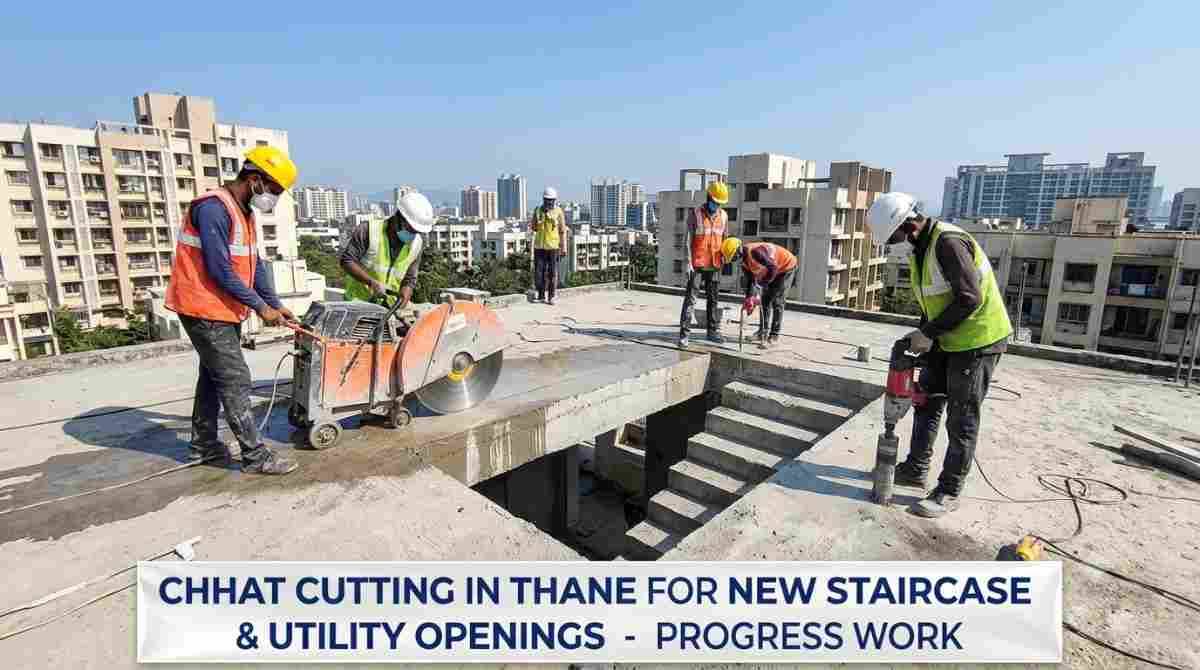
Thane is changing fast. Older buildings in Naupada, Vartak Nagar and Kopri are being renovated. Duplex conversions are happening in Majiwada and Ghodbunder Road. Commercial floors in Wagle Estate are being reworked for new tenants. Almost every one of these projects eventually faces the same question: how do you open a hole in a concrete slab without damaging the rest of the building?
The answer is chhat cutting, the precise, controlled cutting of roof or floor slabs. Done properly, it lets you add a staircase, a lift shaft, a duct, a shaft for plumbing or electrical lines, or a skylight. Done carelessly with a hammer and chisel, it can crack beams, shake the neighbours’ ceilings and put the whole structure at risk.
This guide covers how chhat cutting works, when you need it, what it costs, what permissions to check, and how to choose a contractor. It draws on the kind of work specialists like Core Cutting India handle every day.
What Is Chhat Cutting?
“Chhat” means roof or ceiling in Hindi and Marathi. In construction, chhat cutting means cutting an opening through a reinforced cement concrete (RCC) slab using diamond-tipped tools. Unlike demolition, it removes only a defined section and leaves the surrounding concrete intact.
The edges are clean and straight, and the slab around the opening stays free of micro-cracks. Because diamond tools grind through the concrete and steel rather than pounding it, vibration is minimal. That matters in a densely populated city like Thane, where buildings share walls and residents live directly above and below your work area.
Typical uses include:
- Creating an internal staircase between two floors
- Opening a lift or elevator shaft
- Cutting space for ducts, air-conditioning shafts and pipes
- Making openings for electrical risers, drainage and fire-fighting lines
- Installing skylights or ventilation openings
- Converting a single-storey space into a duplex
Why Hammer-and-Chisel Methods Fail
For decades, labourers broke slabs with jackhammers and hand breakers. Many small contractors still do. The problems are serious:
- Structural damage. Impact vibration travels through the concrete and can crack beams, columns and neighbouring slabs.
- Irregular edges. Broken edges are rough and uneven, so finishing takes extra time and money.
- Exposed and bent reinforcement. Rebar gets twisted rather than cleanly cut, which weakens the structure.
- Noise and dust. Breaking concrete is loud, and it leads to complaints and sometimes society or municipal action.
- Longer timelines. Cleaning up and repairing the damage often costs more than the cutting itself.
Modern cutting methods avoid nearly all of this.
Methods Used for Slab Cutting in Thane
The right method depends on slab thickness, the size of the opening, access, and what is above and below the slab.
Wall Saw / Slab Saw Cutting
A track-mounted saw with a circular diamond blade cuts straight lines through concrete. It is well suited to rectangular openings such as staircases and duct shafts. It produces smooth edges and can cut deep slabs in a single pass. Water cooling keeps dust low.
Wire Saw Cutting
A diamond-impregnated wire loops around the section to be removed and cuts through it. This method suits thick slabs, heavy structures and awkward locations where a large blade cannot fit. It has almost no depth limit, and it is often used for large openings and beam sections.
Core Drilling
For round openings such as pipe sleeves, sanitary lines and small service holes, a cylindrical diamond core bit drills through the slab. It is also used at the corners of a larger opening so the saw cuts do not overshoot. Core drilling is a speciality of Core Cutting India, which is why precise service openings are so tidy.
Hand-Held and Ring Saw Cutting
Where machines cannot reach, hand-held saws handle shallow cuts and finishing work. They are used with care because they lack the guided accuracy of a track-mounted system.
Chhat Cutting for a New Staircase
An internal staircase is the most popular reason for slab cutting in Thane. Families who own two connected floors, or who are converting a loft into a living area, want direct access without going out into the common corridor.
Planning the opening. A standard straight staircase needs roughly 2.4 to 3 metres in length and about 1 metre in width, depending on the design and building code. L-shaped or spiral designs use different footprints. The staircase position should follow the structure, not just the interior layout.
Checking the beams. The opening should avoid main beams and columns. Where the slab is supported by a beam on one side, the engineer may recommend extra framing or edge reinforcement around the cut.
The cutting process. A typical staircase opening goes like this:
- The engineer marks the outline on the slab.
- Core holes are drilled at the corners.
- A wall saw or wire saw cuts along the marked lines.
- The cut section is lifted out in manageable blocks, which are lowered with a hoist or chain pulley.
- The edges are inspected and prepared for finishing.
This avoids the shock of a full breakdown and keeps the rest of the slab undisturbed. The whole process for a standard opening often takes a day or two, depending on thickness and reinforcement.
Chhat Cutting for Utility Openings
Utility openings are smaller than staircases but equally important to get right.
- Lift shafts: Large openings that require careful structural design. Cutting must align exactly with the shaft frame.
- Ducts and shafts: Air conditioning, ventilation and smoke extraction in commercial buildings need clean rectangular openings.
- Plumbing and drainage: Core-drilled round holes for pipes are faster and more accurate than breaking the slab.
- Electrical risers and cable trays: Openings let cables run between floors without exposed damage.
- Fire-safety lines: Sprinkler and hose-reel lines require precise penetrations, which are later sealed with fire-rated material.
For these, accurate sizing is crucial. An oversized hole weakens the slab, while an undersized one means re-cutting.
Structural Safety: What to Check Before Cutting
Cutting a slab changes how loads travel through a building. Never treat it as a casual job.
Hire a structural engineer first. An engineer reviews the drawings, identifies the reinforcement layout and decides whether strengthening is needed. In older buildings in Thane, drawings may be missing or inaccurate, so a site inspection is vital. Ground-penetrating radar or a rebar scanner can locate reinforcement before any cutting begins.
Understand slab type. Two-way slabs, one-way slabs and post-tensioned slabs behave differently. Post-tensioned slabs in particular contain high-tension cables that can be dangerous if cut by mistake, so they need specialist assessment.
Plan temporary support. Props or shoring beneath the slab can take load during and after the cut.
Protect the surroundings. Cover floors, move furniture, and seal doorways to limit dust and slurry. Water from wet cutting needs to be collected and removed.
Permissions and Society Approvals in Thane
Before you cut, confirm the following:
- Society NOC: In a housing society, the managing committee usually needs to approve structural changes. Many societies require a structural stability certificate.
- Municipal permission: Structural alterations may need approval from the Thane Municipal Corporation (TMC). Rules vary by building type and age, so check with the local planning office.
- Neighbour communication: Inform the floor above and below. Even low-vibration cutting makes some noise, and goodwill avoids disputes.
- Working hours: Many societies restrict noisy work to specific hours, so schedule accordingly.
Requirements change from time to time, so verify the current rules with your society and the authority concerned rather than relying on old information.
How Much Does Chhat Cutting Cost in Thane?
Pricing varies widely, so be wary of any fixed figure quoted without a site visit. The main factors are:
- Slab thickness: Thicker slabs take more time and blade wear.
- Opening size: Larger openings mean more cutting length and more debris removal.
- Reinforcement density: Heavy rebar slows cutting.
- Access and height: Upper floors, tight stairwells and limited lifts increase labour.
- Method: Wire saw work generally costs more than wall saw work but handles difficult jobs.
- Debris handling: Lifting and disposing of concrete blocks adds to the cost.
- Timing: Urgent or after-hours work may carry a premium.
Most reputable firms charge by the running metre of cut, by the opening, or on a lump-sum basis. Ask for a written quote that lists what is included, such as cutting, core holes, debris removal and lifting equipment. Compare quotes on scope, not just price. The cheapest option often leaves out the clean-up.
Benefits of Professional Diamond Cutting
Choosing a specialist over a general labour crew brings clear advantages:
- Precision: Edges are straight and dimensions match the drawing.
- Minimal vibration: The rest of the structure stays undisturbed.
- Lower noise and dust: Wet cutting and controlled methods are easier on residents.
- Faster completion: Less rework and finishing.
- Greater safety: Trained operators work with proper equipment and protective gear.
- Better finish: Clean edges are ready for plastering, staircase framing or duct sealing with little extra effort.
How to Choose a Chhat Cutting Contractor in Thane
Use this checklist when you compare providers:
- Experience: Ask how many slab openings they have completed, ideally in residential and commercial buildings like yours.
- Equipment: Confirm they own wall saws, wire saws and core drilling machines rather than only hand tools.
- Site inspection: A good firm visits first, scans the slab and discusses the plan.
- Engineer coordination: They should be comfortable working with your structural engineer.
- Clear quotation: Scope, rates and exclusions should be in writing.
- Safety practices: Look for protective gear, dust control and debris management.
- References: Ask for past clients or photographs of finished work.
Core Cutting India offers concrete cutting, core drilling, wall sawing and wire sawing services, which makes it a solid option to shortlist for staircase and utility openings. It is always wise to request a site visit and a written quote before you commit to any contractor.
Step-by-Step: What to Expect on Cutting Day
- Arrival and setup: The team inspects the area, marks cutting lines and sets up water supply and slurry collection.
- Protection: Floors, furniture and nearby openings are covered.
- Core drilling: Corner holes are drilled to guide the cut.
- Slab cutting: The saw or wire runs along the marked lines.
- Section removal: The cut block is secured and lifted out safely.
- Clean-up: Slurry, dust and debris are cleared.
- Inspection: The opening is checked against the plan, ready for finishing.
Common Mistakes to Avoid
- Skipping the structural engineer. The most expensive mistake of all.
- Cutting before scanning. Hitting a hidden cable or main bar can be dangerous.
- Choosing on price alone. Cheap quotes often hide extras.
- Ignoring society rules. Work can be stopped mid-job.
- Oversizing the opening. Larger isn’t better; it weakens the slab.
- Forgetting the finishing plan. Think about railings, frames and sealing before you cut.
Frequently Asked Questions (People Also Ask)
What is chhat cutting?
Chhat cutting is the process of cutting an opening in a roof or floor slab using diamond tools, so that features like staircases, shafts and ducts can be added without breaking the surrounding concrete.
Is it safe to cut a concrete slab for a staircase?
Yes, when a structural engineer approves the plan and a professional team performs the cut. Safety depends on the slab type, opening location and any strengthening done around the edges.
How long does slab cutting take?
A typical staircase opening can often be cut in one to two days. Thicker slabs, heavy reinforcement and difficult access may extend this.
Do I need permission to cut a slab in my flat in Thane?
Generally you need society approval and may need municipal permission, along with a structural engineer’s certificate. Confirm the current requirements with your society and the Thane Municipal Corporation.
What is the difference between core cutting and slab cutting?
Core cutting drills round holes, ideal for pipes and small service openings. Slab cutting removes larger rectangular or custom sections, such as staircase openings, using saws.
Does slab cutting damage the building?
Diamond cutting causes far less vibration than breaking by hand, so the risk is low when the work is properly planned. Damage usually comes from poor planning, missing support or amateur methods.
How much does chhat cutting cost in Thane?
Cost depends on slab thickness, opening size, reinforcement and access. Request a site visit and written quote for an accurate figure.
Can you cut a slab in an old building?
Often yes, but older buildings need a careful structural assessment because drawings may be missing and the concrete quality can vary.
Final Thoughts
A new staircase or utility opening can transform a home or workplace in Thane, adding space, light and function. The difference between a smooth project and a costly headache lies in the method, the planning and the people you hire. Use diamond cutting rather than hammering, involve a structural engineer early, secure the necessary approvals, and compare written quotes on scope as well as price.
If you are planning a slab opening and want a specialist team to assess it, visit Core Cutting India to learn more about their cutting and core drilling services and to request a site inspection. A clean, accurate cut is the foundation of everything that follows, so get it right the first time.