
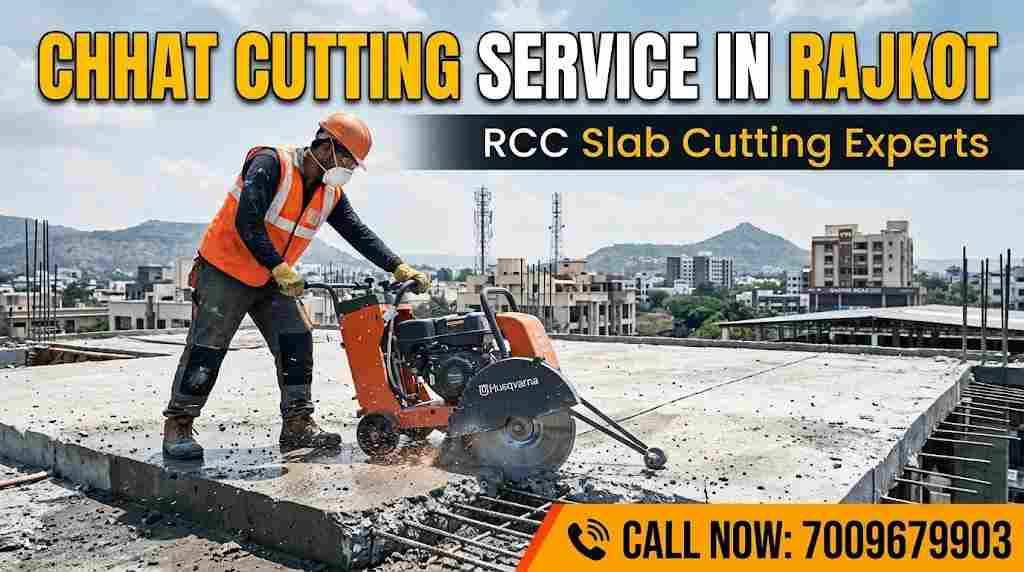
Rajkot is a city of builders, makers and workshop owners. Homes get extended, shops get redesigned, and factories keep adapting their layouts to stay competitive. Sooner or later, many of these plans bump into the same obstacle: a solid concrete chhat.
A professional chhat cutting service in Rajkot turns that obstacle into a clean, accurate opening. This guide covers the real-life situations where slab cutting is used, the method behind it, how to prepare, and what to ask before booking.
First, What Exactly Is Chhat Cutting?
Chhat is the Hindi word for roof or slab. In construction, chhat cutting means removing a planned portion of an RCC (reinforced cement concrete) slab with diamond cutting tools.
Unlike traditional breaking, which relies on force, diamond cutting relies on precision. A diamond blade slices through concrete and the steel inside it along a marked line, leaving a neat edge and protecting the surrounding structure.
Typical cutting methods include:
- Slab sawing for straight cuts in roofs and floors
- Wall sawing for edges and vertical cuts
- Wire sawing for thick or awkward sections
- Core drilling for round holes
Five Real-Life Situations Where Rajkot Property Owners Need Slab Cutting
Scenario 1: The Terrace Staircase
A family wants easy access to the terrace for drying clothes, storing items or building an extra room. The slab needs a clean rectangular opening where the stairs will rise.
Scenario 2: The Lift in an Existing House
As families age, a home lift becomes a necessity rather than a luxury. Fitting one in a finished bungalow means cutting vertical openings through every floor slab.
Scenario 3: The Workshop Upgrade
A small manufacturing unit installs a new machine or exhaust system. The roof must be opened for ducting, ventilation or lifting equipment, without halting production for long.
Scenario 4: The Showroom Renovation
A shop owner wants a double-height space or a feature staircase. The slab above the ground floor is removed in a controlled way to create the new design.
Scenario 5: The Leaking or Damaged Slab
A section of the roof is cracked, corroded or beyond repair. Cutting out the damaged part allows proper replacement without disturbing healthy concrete.
If any of these sound familiar, professional slab cutting is likely the right solution.
Why Not Just Break It?
Many people assume breaking a slab with a hammer is quicker and cheaper. In practice, it often creates more work:
- Shockwaves can crack beams, walls and neighbouring slabs
- Reinforcement bars may be twisted or damaged unpredictably
- Edges are rough and need extra plastering
- Dust and noise disturb everyone nearby
- Debris falls unpredictably, creating safety risks
- Finishing and waterproofing become harder
With diamond cutting, you cut only what you intend to cut, nothing more.
The Chhat Cutting Process: From Call to Clean-Up
Stage 1: The Conversation
You describe your requirement, such as the size of the opening, slab thickness if known, and the purpose of the cut. A good provider asks questions instead of rushing to quote.
Stage 2: The Site Visit
The team inspects the slab, notes the thickness, looks at beams and columns, checks access routes, and identifies utilities that may be running through the area.
Stage 3: The Plan
You receive the cutting method, the support plan, the timeline and the cost. Everything is clear before work starts.
Stage 4: Marking and Support
The opening is marked precisely. Temporary props or supports are installed under the slab to keep the structure stable.
Stage 5: Cutting
Water-cooled diamond equipment cuts along the marked lines. Water reduces dust and keeps the blade cool.
Stage 6: Removal
The separated concrete piece is lifted, lowered or broken into manageable blocks and moved away safely.
Stage 7: Handover
The area is cleaned, slurry is collected, and the opening is ready for stairs, frames, lift rails, ducts or whatever comes next.
Benefits You Can Expect From Professional Slab Cutting
Safety first. A structured process with proper support lowers the risk to your building and everyone around it.
Neat finish. Straight edges reduce the amount of patching and plastering you need later.
Time efficiency. Cutting is much faster than manual demolition, which helps keep your overall project on schedule.
Lower disruption. Reduced vibration and dust make it possible to continue living or working in the building.
Budget control. When you avoid accidental damage, you also avoid surprise repair expenses.
Rajkot-Specific Tips for a Smoother Project
Think About Your Industrial Neighbours
Rajkot's industrial areas are busy and tightly packed. If your unit shares walls or services with neighbours, low-vibration cutting helps avoid disputes and disturbance.
Check Your Building's Age
Rajkot has both older constructions and modern RCC buildings. Older slabs may have different steel layouts or concrete quality, so a pre-cut inspection is very useful.
Time Around Monsoon
If you are opening a terrace slab, cut and finish before heavy rain arrives, or arrange temporary covers. A quick waterproofing plan prevents leakage into the floors below.
Plan for Heat
Summers can be hot. Early-morning work helps crews stay efficient, and wet cutting keeps tools running smoothly.
Coordinate With Other Trades
Keep your mason, welder, carpenter or lift installer ready. The sooner the opening is framed or covered, the sooner your project returns to normal.
How to Prepare Before the Cutting Team Arrives
Use this simple checklist:
- Finalise the size and location of the opening
- Get any required approvals from co-owners, landlords or societies
- Remove furniture, electronics and valuables from the work zone
- Turn off electrical circuits and water lines in the area
- Arrange water and power access for the machines
- Keep children and pets away from the site
- Mark any areas you want protected with sheets or barriers
Understanding the Cost of Chhat Cutting in Rajkot
Rather than quoting a single number, it is more useful to understand what drives the price:
- Thickness of the slab: thicker slabs need deeper cuts
- Length of the cutting line: more length means more time
- Rebar density: heavily reinforced slabs are slower to cut
- Access and height: difficult locations need extra effort
- Support work: propping adds time and material
- Debris handling: lifting and removing concrete blocks
- Number of openings: multiple cuts can improve efficiency
For an approximate figure, try the Core Cutting India rate calculator. For a precise quotation, a site visit is the most dependable route.
Combine Slab Cutting With Core Cutting
Large openings and small round holes often go together in the same project. Once the slab is opened, you may still need holes for drainage, AC lines, electrical conduits or plumbing. Explore our core cutting service in Rajkot to cover those needs through the same trusted team.
Questions to Ask Any Chhat Cutting Provider
Before you hire, ask:
- Will you inspect the site before giving a final quote?
- Do you use diamond cutting equipment?
- How will you support the slab during the work?
- How do you manage dust, slurry and debris?
- What is the expected timeline?
- Is the estimate written and itemised?
- Can you also handle core drilling and wall cutting?
Clear, confident answers show real experience.
Why Core Cutting India Is a Dependable Choice
Core Cutting India offers concrete cutting solutions for residential, commercial and industrial customers. We aim to make the experience simple: clear communication, accurate cutting, tidy work and a respectful approach to your property and schedule.
Learn more about our services at Core Cutting India.
Frequently Asked Questions (FAQ)
1. What is chhat cutting service?
It is the controlled cutting of a concrete roof or floor slab using diamond tools to create openings for staircases, lifts, ducts, skylights or repairs.
2. Is chhat cutting available in Rajkot?
Yes. Core Cutting India provides slab and roof cutting support for homes, shops, offices and industrial units in Rajkot.
3. Will cutting my chhat damage the rest of the building?
Not when done correctly. Diamond cutting is low in vibration, and proper propping protects the surrounding structure.
4. How long does slab cutting take?
Small openings usually take a few hours. Larger or thicker slabs may need a full day or more.
5. How much does chhat cutting cost in Rajkot?
Price depends on thickness, cutting length, reinforcement, access and support work. Use the rate calculator for an estimate, or call for a firm quote.
6. Is it dusty and noisy?
Wet cutting reduces both dust and noise compared with hammer breaking, making it suitable for occupied buildings.
7. Can I cut a slab without an engineer?
For small, simple openings, experienced cutters can advise. For large openings, load-bearing slabs or older buildings, consult a structural engineer.
8. What is the difference between slab cutting and core cutting?
Slab cutting removes larger sections. Core cutting drills round holes. See our core cutting service in Rajkot.
9. Can you cut slabs in factories and workshops?
Yes. Industrial and commercial slab cutting is part of our services, and work can be planned to reduce downtime.
10. How do I book a chhat cutting service in Rajkot?
Call or WhatsApp 7009679903, or email [email protected] with your location and requirement.
Conclusion
A concrete chhat does not have to stand in the way of your plans. With the right method, the right equipment and a clear process, you can create staircases, shafts, ducts and openings without harming the rest of your building. A reliable chhat cutting service in Rajkot brings accuracy, safety and speed to a task that is too important to leave to guesswork.
Check your estimate with the rate calculator, see our core cutting service in Rajkot, or visit Core Cutting India to find out more.
📞 Call Now or WhatsApp for a Free Quote: 7009679903
- Call: 7009679903
- WhatsApp: Chat on WhatsApp
- Email: [email protected]
- Website: https://corecuttingindia.com/
Open your slab with confidence. Contact Core Cutting India today!