
Introduction
Every time a concrete slab is cut, cored, or sawed at a construction or demolition site, it leaves behind more than dust and rubble. It leaves behind a decision point: will that waste end up in a landfill, or will it become the raw material for something new? This is the central question behind the circular economy — a model that replaces the traditional "take-make-dispose" approach with one built on reuse, recovery, and regeneration.
For an industry as material-intensive as construction, concrete cutting waste represents both a significant environmental challenge and a largely untapped opportunity. As urban infrastructure projects, road widening, demolition, and renovation work continue to grow across India, the volume of concrete cutting waste is rising steadily. Companies like Core Cutting India are increasingly adopting circular economy principles to manage this waste responsibly — converting what was once considered debris into valuable secondary raw material.
This blog explores what concrete cutting waste actually consists of, why it matters environmentally and economically, and the practical circular economy approaches being used today to reduce, reuse, and recycle it.
Understanding Concrete Cutting Waste
Concrete cutting operations — including core drilling, wall sawing, floor sawing, and diamond cutting — generate several types of waste:
- Concrete slurry: A wet mixture of water, cement fines, and rock dust produced during wet-cutting processes.
- Solid concrete debris: Chunks and slabs removed during demolition or structural modification.
- Concrete dust: Fine particulate matter generated during dry cutting, which can contain crystalline silica.
- Rebar and metal fragments: Steel reinforcement bars exposed and cut during the process.
Each of these waste streams has traditionally been treated as a disposal problem. Slurry is often washed into drains or dumped, solid debris is hauled to landfills, and dust is left to disperse into the surrounding environment. This linear approach not only wastes valuable material but also creates serious environmental and regulatory concerns, particularly as construction and demolition (C&D) waste rules become stricter across Indian states.
Why the Linear Model No Longer Works
The traditional linear model of concrete cutting waste management — cut, collect, dump — is increasingly unsustainable for several reasons:
Environmental impact: Concrete slurry is highly alkaline, with a pH that can exceed 12. When it enters waterways or soil untreated, it can harm aquatic life, alter soil chemistry, and contaminate groundwater. Airborne concrete dust containing silica poses respiratory hazards to workers and nearby communities.
Resource depletion: Concrete production relies on finite natural resources — sand, gravel, and limestone. Every tonne of usable aggregate that goes into a landfill instead of being recycled represents virgin material that must be freshly quarried to replace it.
Regulatory pressure: Indian regulations, including the Construction and Demolition Waste Management Rules, increasingly require builders and contractors to demonstrate proper waste segregation, treatment, and recycling — with penalties for non-compliance.
Rising disposal costs: Landfill space near urban centers is shrinking, and disposal costs are climbing. Transporting waste to distant dump sites adds both cost and carbon footprint to projects.
Together, these pressures are pushing contractors, engineers, and waste management firms toward a fundamentally different model — one where concrete cutting waste is treated not as garbage, but as a resource stream to be captured and redirected.
What Circular Economy Means for Concrete Cutting Waste
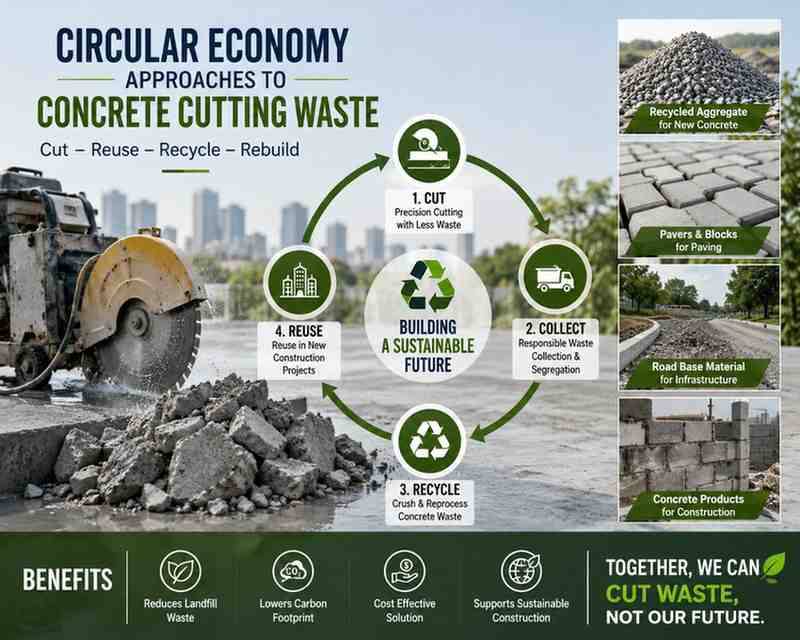
A circular economy approach asks a simple but powerful question at every stage of a project: how can this material be kept in productive use for as long as possible? Applied to concrete cutting waste, this means designing processes around four core principles:
- Reduce — Minimizing waste generation through precision cutting techniques and better planning.
- Reuse — Finding immediate secondary applications for cut concrete without reprocessing.
- Recycle — Breaking down waste into raw materials that can re-enter the production cycle.
- Recover — Extracting energy or usable by-products from material that cannot be reused or recycled.
Let's look at how each of these plays out in practice.
1. Reduce: Cutting Smarter, Not Just Harder
The most effective circular strategy is preventing excess waste before it's generated. Modern diamond wall saws, wire saws, and core drilling equipment allow far more precise cuts than older demolition methods like jackhammering, which tend to shatter concrete indiscriminately and produce large volumes of unusable rubble.
Precision cutting techniques:
- Reduce over-cutting and material breakage
- Allow for controlled demolition that separates structural elements cleanly
- Make it easier to salvage large, intact concrete sections for reuse
- Minimize the amount of fine dust and slurry generated per cubic meter of concrete removed
Project planning also plays a role. When cutting sequences are mapped out in advance — rather than improvised on site — contractors can plan cuts that preserve reusable slabs and reduce fragmentation, directly lowering the volume of waste requiring downstream processing.
2. Reuse: Giving Concrete a Second Life On-Site
Not all concrete waste needs to be broken down and reprocessed. Large, structurally sound sections removed during selective demolition can often be reused directly:
- Precast slabs and blocks can be repurposed as retaining walls, boundary structures, or landscaping elements.
- Cut concrete blocks can serve as ballast, foundation fill, or erosion control material.
- Salvaged rebar-reinforced sections can sometimes be relocated and reintegrated into new structural work with proper engineering assessment.
Reuse is the most resource-efficient stage of the circular hierarchy because it avoids the energy costs of crushing, transporting, and reprocessing material. On-site reuse also reduces transportation emissions, since the material never has to leave the project boundary.
3. Recycle: Turning Debris into Aggregate
For concrete waste that cannot be reused as-is, recycling into aggregate is the most widely adopted circular economy pathway. The process typically involves:
Crushing and screening: Solid concrete debris is fed through mobile or stationary crushers, breaking it down into graded aggregate sizes. Screening separates the crushed material by particle size for different applications.
Contaminant removal: Rebar and metal fragments are extracted using magnetic separators, while other contaminants like wood or plastic are removed manually or through air classification.
Grading for reuse: The resulting recycled concrete aggregate (RCA) can be graded for use in:
- Sub-base and base layers for road construction
- Backfill material for trenches and foundations
- Non-structural concrete for pavements, curbs, and sidewalks
- Aggregate for new concrete mixes, in blended proportions with virgin material
Studies on recycled concrete aggregate consistently show that, when properly processed and quality-tested, RCA can replace 20–100% of virgin aggregate in many applications without significant loss of performance — a substantial reduction in the demand for freshly quarried stone.
4. Managing Concrete Slurry: A Critical Circular Step
Wet-cutting operations generate significant volumes of concrete slurry, and its management is one of the most overlooked aspects of circular waste handling. Effective slurry management includes:
Containment: Using vacuum systems, slurry tanks, or containment barriers to prevent slurry from entering drains, soil, or waterways during cutting operations.
Settling and separation: Allowing slurry to settle in tanks so that solid cement fines separate from water. The clarified water can often be filtered and reused in future cutting operations, reducing fresh water consumption.
pH neutralization: Treating the alkaline solid residue before disposal or further processing, since untreated slurry solids remain hazardous to soil and vegetation.
Dewatering and solidification: Once solids are separated, they can be dewatered and used as a filler material in certain low-grade construction applications, or safely disposed of in compliance with local waste regulations.
Companies offering professional concrete cutting services increasingly build slurry containment and water recycling directly into their site protocols — a practice that reflects circular economy thinking at the operational level, not just at the disposal stage.
5. Managing Concrete Dust
Dry-cutting operations generate fine particulate dust that, if uncontrolled, poses both an environmental and occupational health risk due to crystalline silica content. Circular and responsible approaches include:
- Dust extraction systems attached directly to cutting equipment, capturing particulate matter at the source
- Wet-cutting methods as an alternative where feasible, which suppress dust generation entirely
- Collected dust reuse, where feasible, as a filler in low-grade construction material or soil stabilization, subject to safety testing
- Worker protection protocols, including respiratory equipment, to minimize health impacts during the cutting process
While dust recovery is less mature than aggregate recycling, ongoing research into using fine concrete dust as a partial substitute in cement production (leveraging its residual cementitious properties) points to further circular opportunities in the future.
Economic Benefits of a Circular Approach
Beyond environmental compliance, adopting circular economy practices for concrete cutting waste makes clear business sense:
- Lower disposal costs: Diverting waste from landfills reduces hauling and tipping fees.
- Material cost savings: Recycled aggregate is typically cheaper than virgin material, benefiting both contractors and clients.
- Water savings: Recycling slurry water reduces the need for fresh water on cutting sites.
- Regulatory compliance: Proactive waste management reduces the risk of penalties under evolving C&D waste regulations.
- Reputation and contracts: Increasingly, government and private infrastructure tenders favor contractors with demonstrated sustainable waste practices, making circular capability a competitive advantage.
Challenges to Wider Adoption
Despite clear benefits, circular economy adoption in concrete cutting waste management faces real hurdles:
- Inconsistent enforcement of waste management regulations across regions
- Limited recycling infrastructure, particularly mobile crushing facilities in smaller cities
- Quality perception issues, where recycled aggregate is sometimes viewed as inferior despite meeting technical standards
- Upfront investment required for slurry containment, water recycling, and dust extraction equipment
- Fragmented supply chains, where waste generators, recyclers, and end-users are not well connected
Addressing these challenges requires coordinated action — from regulators tightening enforcement, to contractors investing in on-site systems, to material buyers building confidence in recycled products through testing and certification.
The Road Ahead
The shift toward circular concrete cutting waste management is gaining momentum as sustainability becomes a core requirement rather than an optional add-on in construction. Technologies such as mobile crushing units, closed-loop slurry recycling systems, and precision-guided cutting tools are making it increasingly feasible for contractors of all sizes to adopt circular practices without major disruptions to project timelines.
As awareness grows and infrastructure develops, concrete cutting waste is likely to be treated less as an unavoidable by-product and more as a planned output stream — one with defined pathways for reuse, recycling, and recovery built into every project from the start.
Conclusion
Concrete cutting waste doesn't have to be a dead end. Through smarter cutting practices, on-site reuse, aggregate recycling, and responsible slurry and dust management, the construction industry has a real opportunity to close the loop on one of its most persistent waste streams. Circular economy approaches not only reduce environmental harm but also create tangible cost savings and regulatory advantages for contractors willing to adopt them.
At Core Cutting India, sustainable waste handling is treated as an integral part of every concrete cutting project — not an afterthought. For professional, environmentally responsible concrete cutting and waste management services, reach out at [email protected].
Frequently Asked Questions
1. What is concrete cutting waste and why is it a problem? Concrete cutting waste includes solid debris, slurry, and dust generated during sawing, drilling, or demolition. If left unmanaged, it can contaminate soil and water due to its high alkalinity, consume landfill space, and pose respiratory risks from airborne dust.
2. How can concrete cutting waste be recycled? Solid debris can be crushed and screened into recycled concrete aggregate (RCA) for use in road base, backfill, and new concrete mixes. Slurry can be settled and filtered to recover reusable water, and dust can be captured and, in some cases, repurposed as filler material.
3. What is a circular economy in the construction industry? It's an approach that keeps materials in use for as long as possible through reduction, reuse, recycling, and recovery, rather than following a linear "produce, use, dispose" model that treats waste as a final endpoint.
4. Is concrete slurry hazardous? Yes, untreated concrete slurry is highly alkaline and can be harmful to soil, waterways, and aquatic life. It requires proper containment, settling, and neutralization before disposal or reuse.
5. What are the benefits of recycling concrete waste? Benefits include reduced landfill dependency, lower material and disposal costs, conserved natural resources, reduced water consumption through slurry recycling, and improved compliance with construction and demolition waste regulations.