
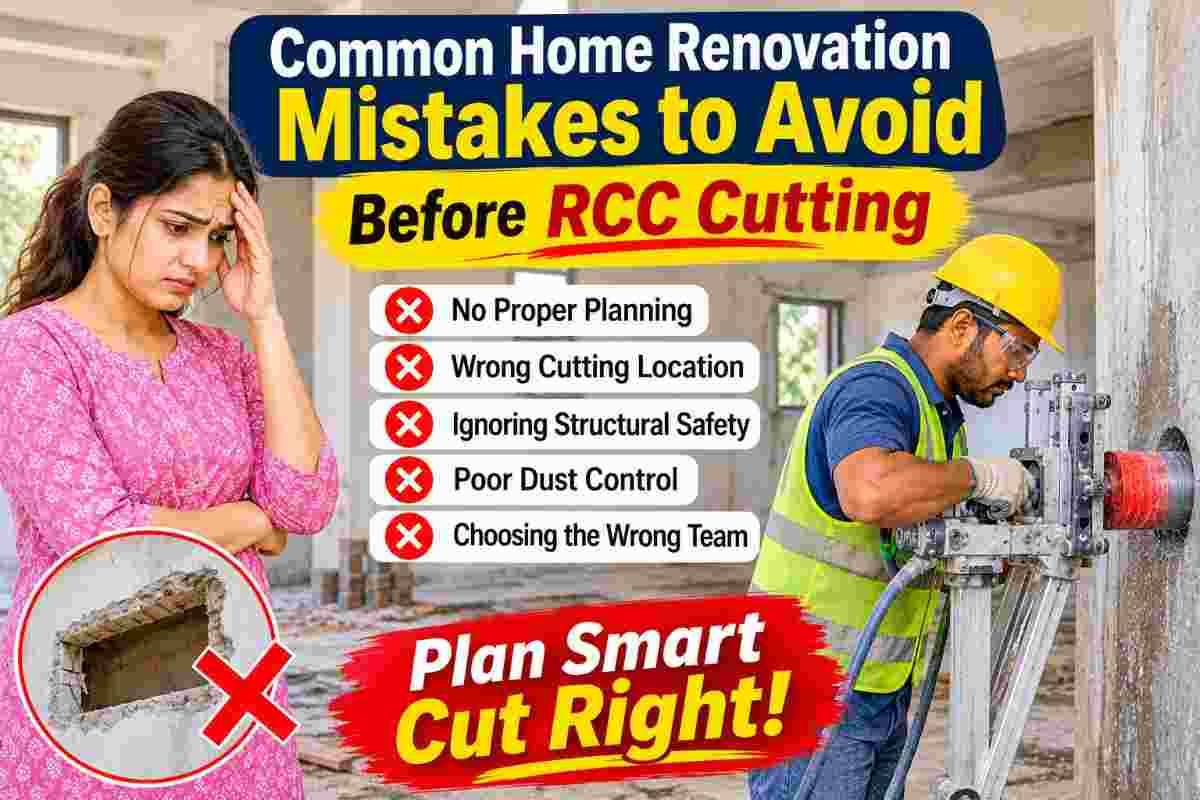
Renovating a home is exciting. A new door between two rooms, a bigger window, a staircase opening, or a removed wall can transform how a house looks and feels. But when your plans involve reinforced cement concrete (RCC), the work is very different from knocking down a brick partition.
RCC is the backbone of most modern Indian homes. It carries the weight of the building, and cutting it wrongly can cause cracks, structural weakness, legal trouble, and repair bills far higher than the original renovation budget.
At Core Cutting India (https://corecuttingindia.com/), we have seen the same avoidable errors repeatedly. This guide covers the most common home renovation mistakes to avoid before RCC cutting, so your project stays safe, legal, and on budget.
What Is RCC Cutting, and Why Does It Need Careful Planning?
RCC cutting is the controlled removal of sections of reinforced concrete using specialised diamond-tipped equipment. Unlike hammering or breaking, it produces clean, precise edges with far less vibration. Common methods include:
- Wall sawing: for doors, windows, and large openings in RCC walls
- Slab sawing: for floor openings, staircase cut-outs, and lift shafts
- Core cutting: for round holes for pipes, drains, AC ducts, and cables
- Wire saw cutting: for thick or irregular sections and hard-to-reach areas
Because RCC combines concrete with embedded steel reinforcement, every cut affects how loads travel through your building. That is why preparation matters as much as the cutting itself.
Mistake 1: Skipping a Structural Assessment
The most dangerous mistake is cutting without knowing what the concrete is doing. Homeowners often assume that a wall which looks like a partition is just a partition. In reality, many RCC walls, columns, beams, and slabs are load-bearing.
What goes wrong:
- Cutting a load-bearing wall without support can cause sagging slabs, diagonal cracks, or partial collapse.
- Removing part of a beam or column weakens the frame that holds up every floor above.
- Problems may not appear immediately. Cracks can develop weeks or months later.
What to do instead:
Hire a qualified structural engineer to review your building drawings and inspect the site. They will tell you which elements can be cut, which cannot, and what reinforcement or support is needed. Get this advice in writing before you book any cutting work.
Mistake 2: Ignoring Permissions and Society Approvals
Many homeowners treat RCC cutting as a private matter. It rarely is, especially in apartments, builder floors, and cooperative societies.
Common oversights:
- No written permission from the housing society or resident welfare association (RWA)
- No check on municipal building bylaws before altering structural elements
- Ignoring builder or developer restrictions on structural modifications
- Not informing the owner when you are a tenant
The risk:
Unapproved structural changes can lead to stop-work notices, penalties, disputes with neighbours, and trouble when you later sell or insure the property.
What to do instead:
Check your society rules and local municipal requirements first. Keep approvals and engineer letters in a file. Reputable contractors will ask whether these are in place.
Mistake 3: Starting Without Scanning the Concrete
Cutting blind is a costly gamble. Inside RCC there can be dense rebar, conduits, water lines, electrical cables, and sometimes post-tensioned cables in modern slabs.
What goes wrong:
- Hitting a live electrical conduit can cause shock hazards and power outages.
- Cutting a water or gas line can cause flooding or serious safety incidents.
- Severing a post-tensioned cable is extremely dangerous and can release stored energy suddenly.
What to do instead:
Request a concrete scan, such as GPR (ground penetrating radar) or rebar detection, before cutting. Check your electrical and plumbing layouts too. Mark every service line on the surface so the cutting crew can work around it. This small step prevents many of the worst accidents.
Mistake 4: Choosing the Wrong Cutting Method
Some homeowners ask for the cheapest or quickest option, which often means a hammer or jackhammer. For RCC, that is usually a bad idea.
Problems with breaking instead of cutting:
- Heavy vibration travels through the structure and can crack adjacent walls, tiles, and plaster.
- Edges come out rough and uneven, which increases finishing costs.
- Neighbours suffer more noise and dust.
- Rebar can be damaged beyond the cut line.
What to do instead:
Ask the contractor why they recommend a particular method. Wall saws suit straight, clean openings. Core drills suit pipe and duct penetrations. Wire saws suit thick or complex sections. Controlled cutting costs more upfront in some cases, but it usually saves money on repairs and finishing.
Mistake 5: Not Planning Temporary Support and Shoring
When you cut through an RCC element, loads shift. If temporary support is not in place, that shift can be sudden and damaging.
Typical errors:
- Cutting a wall opening without propping the slab above
- Removing a section of beam without shoring beneath
- Assuming the remaining concrete will “adjust” on its own
What to do instead:
Ask your engineer to specify props, needles, or steel supports where needed. Install them before cutting and keep them in place until permanent reinforcement, such as a new lintel or steel frame, has been completed and cured. Never remove supports early to save time.
Mistake 6: Forgetting About Permanent Reinforcement
Cutting an opening is only half the job. A new door or window in an RCC wall often needs a lintel or edge reinforcement to carry loads around the gap.
What goes wrong:
- Cut edges are left unsupported, and cracks form at the corners.
- Homeowners finish the opening with plaster and paint only, hiding a structural weakness.
- Cut rebar is left exposed and starts rusting, which expands and cracks the surrounding concrete.
What to do instead:
Plan the post-cutting work in your engineer’s specification: lintels, steel angles, epoxy-coated or treated rebar ends, and proper grouting. Include these items in your budget and schedule from the start.
Mistake 7: Hiring an Unqualified or Unverified Contractor
RCC cutting needs trained operators, calibrated equipment, and safety discipline. Hiring the lowest bidder without checking credentials is a common route to trouble.
Warning signs:
- No site visit before quoting
- No mention of scanning, dust control, or safety equipment
- Vague quotes with no breakdown of cutting depth, area, or number of cores
- No insurance or accountability if something goes wrong
- Pressure to start immediately
What to do instead:
Ask about experience with similar jobs, the equipment used, the crew’s training, and how they handle debris and water. Request a written quotation. A professional company such as Core Cutting India will inspect the site, explain the process, and give clear pricing before work begins.
Mistake 8: Underestimating Dust, Water, and Noise
Diamond cutting is cleaner than breaking, but it is not invisible. Wet cutting produces slurry, and dry cutting produces fine silica dust, which is harmful to breathe.
Common oversights:
- Not protecting furniture, flooring, and electronics
- No plan for slurry drainage, which can stain floors or seep into lower flats
- Forgetting to warn neighbours about noise
- Ignoring silica dust exposure for family members, children, and pets
What to do instead:
Cover or remove belongings. Seal doorways with plastic sheeting. Use wet cutting or dust extraction where possible. Plan work for hours permitted by your society, and move vulnerable family members out of the home during the cutting days.
Mistake 9: No Plan for Debris Removal
Cut RCC blocks are heavy. A single wall section can weigh several hundred kilograms, and slabs even more.
What goes wrong:
- Heavy blocks are dragged across finished floors, causing damage
- Debris blocks stairs, lifts, or common areas
- Disposal is left unplanned, and the society objects to the mess
- Lift damage and floor cracks occur when heavy pieces are moved carelessly
What to do instead:
Agree in advance on how pieces will be sized, lifted, and carried out, and who is responsible for disposal. Confirm permitted routes and timings with your society. Protect floors and lift interiors with boards and sheets.
Mistake 10: Poor Sequencing with Other Renovation Work
RCC cutting should happen early in the renovation, before finishes go in. Many homeowners get the order wrong.
Examples of poor sequencing:
- Laying new flooring or painting before cutting, then damaging both
- Finishing electrical and plumbing work and then cutting through it
- Scheduling carpenters and tile fitters before openings are ready
What to do instead:
Create a simple timeline: assessment and approvals, scanning, cutting, structural reinforcement, then plastering, services, flooring, and painting. Share it with every contractor involved.
Mistake 11: Not Marking and Confirming Cut Lines
Even small measurement errors can be costly. A door opening that is 5 cm too wide or a window cut at the wrong height cannot be undone.
What to do instead:
- Measure twice and mark clearly with chalk or tape
- Confirm dimensions against your architect’s or designer’s drawings
- Have the homeowner, designer, and cutting supervisor all approve the marked lines before the saw starts
- Allow for frame thickness, plaster, and finishing in your measurements
Mistake 12: Ignoring Safety Equipment and Site Rules
Heavy machinery, water, electricity, and concrete dust make RCC cutting a high-risk activity.
What to check:
- Operators wearing helmets, eye protection, masks, gloves, and ear protection
- Proper earthing and safe electrical connections for water and power
- Restricted access to the cutting area
- Clear instructions for children and pets to stay away
If a crew treats safety casually, that is a sign to look elsewhere.
Mistake 13: Not Budgeting for the Full Cost
RCC cutting prices depend on thickness, depth, reinforcement density, location, access, and method. Homeowners often compare only a per-metre rate and miss hidden costs.
Costs that are often overlooked:
- Engineer’s fees and scanning charges
- Temporary shoring and permanent lintels
- Debris removal
- Finishing, plastering, and repainting
- Repairs to nearby surfaces, if any
- Society charges or deposits
What to do instead:
Ask for a complete scope and written quote, and keep a contingency of around 10 to 15 percent for surprises. A cheap quotation that excludes essentials is not actually cheap.
Mistake 14: Forgetting Waterproofing and Services Near the Cut
Cutting near bathrooms, kitchens, terraces, or balconies can damage waterproofing layers and hidden pipes.
What to do instead:
Identify wet areas before cutting. Plan for reapplying waterproofing after the work and test it before finishes go back on. Leaks that appear months later are far harder and costlier to trace.
A Quick Pre-Cutting Checklist
Before you book RCC cutting, confirm that you have:
- A structural engineer’s written assessment
- Society, RWA, or municipal permissions, where required
- A concrete scan and service layout marked on site
- The cutting method chosen and justified
- A temporary support plan and permanent reinforcement design
- A verified, experienced contractor with a written quote
- Dust, water, and noise control arrangements
- A debris removal and disposal plan
- A renovation timeline with correct sequencing
- Confirmed, marked cut lines and a contingency budget
If you can tick all ten, your project is far more likely to finish on time and without surprises.
Frequently Asked Questions (People Also Ask)
Is RCC cutting safe for a building?
Yes, when done properly. Controlled diamond cutting produces much less vibration than breaking, and with an engineer’s guidance and proper support, it is a safe way to modify RCC structures.
Can I cut an RCC wall without permission?
In most cases you should not. Apartments and societies usually require approval, and structural changes may need municipal sanction. Always check before starting.
How do I know if a wall is load-bearing?
You cannot reliably tell by looking. Check the building drawings and consult a structural engineer, who can confirm what the wall carries.
What is the difference between core cutting and wall cutting?
Core cutting makes round holes for pipes, ducts, and cables. Wall cutting, or wall sawing, produces larger straight-edged openings for doors, windows, and similar features.
How much does RCC cutting cost in India?
Pricing varies with thickness, reinforcement, access, location, and method. A site inspection is the only way to get an accurate quote, so request one in writing.
Does RCC cutting damage the rest of the house?
Properly done, it should not. Wire saws and wall saws create minimal vibration compared with hammering, and good planning protects nearby surfaces.
How long does RCC cutting take?
Small core cuts may take under an hour each. Larger wall or slab openings can take a few hours to a few days, depending on thickness and complexity.
Do I need to vacate my home during cutting?
It is often wise to, at least for the noisiest and dustiest hours, especially if you have children, elderly family members, or pets.
Final Thoughts
RCC cutting can open up your home, improve light and flow, and add real value. But the quality of the outcome depends on the planning that happens before the first cut: structural advice, approvals, scanning, the right method, proper support, and a reliable contractor.
Avoid these common mistakes, and your renovation becomes safer, cleaner, and more predictable. Rush any of them, and the repair bill can easily exceed the cost of doing it right the first time.
Talk to the Experts at Core Cutting India
If you are planning wall cutting, slab cutting, core drilling, or any RCC modification, speak to a team that treats safety and precision as standard. Core Cutting India offers professional concrete cutting services backed by trained operators and modern diamond equipment.
📞 Call or WhatsApp: +91 70096 79903
🌐 Website: https://corecuttingindia.com/
Share your plan, get your questions answered, and request a site visit before your renovation begins.