
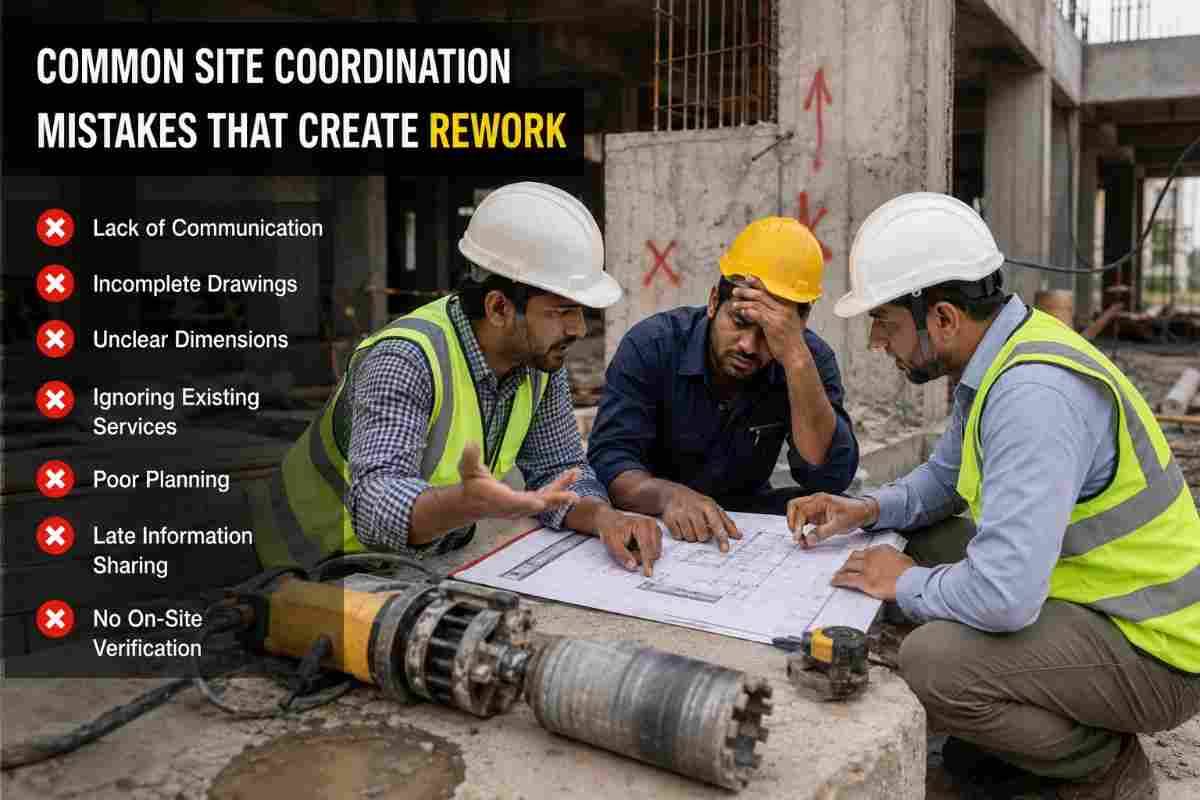
Every construction project runs on coordination. Structural teams, MEP contractors, finishing crews, and specialised service providers like core cutting and coring contractors all need to work off the same page, at the same time, with the same understanding of the site. When that coordination breaks down, even briefly, the result is almost always the same: rework.
Rework is one of the most expensive and least talked-about problems in construction. It eats into budgets, pushes back handover dates, damages contractor relationships, and often shows up in places that are hardest to fix — structural elements, service risers, and load-bearing walls. At Core Cutting India, we see the downstream effects of poor site coordination almost every week, usually in the form of last-minute core cutting or core drilling requests to fix a clash nobody caught in time.
In this article, we break down the most common site coordination mistakes that lead to rework, explain why they happen, and share practical ways contractors, project managers, and site engineers can prevent them — before they turn into an expensive problem.
What Is Site Coordination in Construction Projects?
Site coordination is the process of aligning every trade, drawing, schedule, and site condition so that work happens in the right sequence, in the right location, without one team's work conflicting with another's. It covers everything from structural layouts and MEP routing to access planning, material staging, and inspection sign-offs.
Good coordination means a plumber never has to chase a structural engineer for approval after a pipe run has already been installed. It means an electrician's conduit path doesn't clash with a beam that was poured a week earlier. And it means that when a wall or slab needs an opening for a duct, pipe, or cable tray, the exact location, size, and depth are agreed upon before any cutting or drilling tool touches the concrete.
When this process breaks down, teams end up correcting work that has already been completed — which is the very definition of rework.
Why Site Coordination Mistakes Are So Costly
Rework isn't just an inconvenience. Industry studies consistently show that rework can account for a significant percentage of total project cost, sometimes running into double digits when poor coordination is a recurring issue. Beyond the direct cost of labour and material, rework causes:
- Schedule delays that cascade across dependent trades
- Increased safety risk, especially when cutting or modifying structural elements after the fact
- Strained relationships between contractors, consultants, and clients
- Additional wear on structural integrity when concrete is cut or drilled without proper planning
- Higher costs for specialised interventions, such as emergency core cutting to correct a missed opening
Because so many of these issues surface only after concrete has cured or services have been installed, prevention is always cheaper and safer than correction.
Common Site Coordination Mistakes That Create Rework
1. Poor Communication Between Contractors and Subcontractors
The single biggest driver of rework is simple miscommunication. When structural, MEP, and finishing contractors aren't sharing updates in real time, small misunderstandings compound quickly. A change agreed upon in one meeting may never reach the team actually executing the work on site. Without a shared communication channel or daily coordination huddle, teams end up working off outdated instructions.
2. Inaccurate or Outdated Drawings
Drawings are the backbone of site coordination, but they're only useful if everyone is working from the latest version. When structural drawings, MEP layouts, and architectural plans aren't synced, contractors end up executing work based on conflicting information. A common example: an electrician installs conduit based on an older layout, only for the updated drawing to shift a wall or column position, forcing the entire run to be redone.
3. Skipping Pre-Cutting or Pre-Drilling Site Surveys
One of the most preventable causes of rework in concrete cutting and coring work is skipping the pre-execution survey. Before any core cutting, wall sawing, or drilling activity begins, the exact location should be checked against structural drawings and verified on-site using scanning tools to detect embedded rebar, post-tension cables, or existing services. Skipping this step risks cutting into a load-bearing element or severing a live service line — both of which can trigger extensive rework and safety investigations.
4. Ignoring MEP (Mechanical, Electrical, Plumbing) Clashes
MEP clash issues are among the most common causes of on-site rework. Ducts, pipes, and cable trays are often designed by separate consultants who don't always coordinate their routing in the same 3D space. Without proper clash detection — ideally done digitally before construction begins — these conflicts only get discovered when installation teams physically run into each other's work, forcing one or both systems to be rerouted, and sometimes requiring new openings to be cut into completed structural elements.
5. Lack of Real-Time Coordination Between Trades
Even with good drawings, real-time coordination on site is essential. Sequencing matters: structural work, service installation, and finishing all need to happen in a planned order. When one trade moves ahead without confirming the previous trade's work is complete and verified, mistakes multiply. For instance, if finishing work begins before all core cutting and service penetrations are finalised, any subsequent opening required will now also damage completed flooring, tiling, or plastering — multiplying the cost of the original mistake.
6. Delayed Approvals and Permit Mismanagement
Every core cutting, structural modification, or major service penetration typically requires a structural engineer's approval before execution. When approvals are delayed or skipped due to time pressure, teams sometimes proceed without full sign-off. If the approved location later turns out to be incorrect or unsafe, the completed work has to be undone and redone through the proper channel — costing far more time than waiting for approval in the first place.
7. Inadequate Site Supervision
Coordination plans are only as good as their execution on the ground. Without dedicated site supervisors cross-checking work against drawings and specifications in real time, small deviations go unnoticed until it's too late. A supervisor's job isn't just to monitor progress — it's to catch mismatches between what's planned and what's actually happening before they become permanent.
8. Not Accounting for Structural Load-Bearing Elements
A frequent and serious coordination mistake is failing to identify load-bearing walls, columns, or beams before planning openings for services. Teams sometimes assume a wall is non-structural based on outdated information, only to discover during cutting that it carries load. This mistake doesn't just cause rework — it can compromise structural safety and require engineering remediation, which is far more expensive and time-consuming than the original scope of work.
9. Miscommunication About Cutting or Coring Locations and Dimensions
Even when a coordination plan exists, small miscommunications about exact dimensions, depth, or location markings can lead to incorrectly sized or positioned openings. A duct opening cut a few inches off-centre, or a core hole drilled at the wrong diameter, may seem minor but often means the entire opening has to be corrected or a new one created nearby — adding cost, time, and unnecessary damage to the structure.
10. Failure to Document Changes and As-Built Conditions
Site conditions rarely match the original design perfectly. When changes are made on-site — whether it's a shifted service line, an adjusted opening location, or a modified structural detail — and these changes aren't documented and shared with all relevant teams, the next contractor working in that area will unknowingly work off incorrect information. Poor as-built documentation is one of the most overlooked causes of rework because its effects often only surface weeks or months later.
How to Prevent Site Coordination Mistakes
While every project has its own challenges, most rework caused by coordination failures can be prevented with a few consistent practices:
- Centralise drawings and updates. Use a single source of truth for all drawings, accessible to every trade, with clear version control.
- Hold regular coordination meetings. Daily or weekly cross-trade huddles catch conflicts before they become physical problems on site.
- Invest in clash detection. Digital coordination tools that overlay structural, MEP, and architectural models can identify conflicts before construction begins.
- Conduct pre-execution surveys. Before any cutting, drilling, or coring, verify locations against drawings and scan for embedded reinforcement or services.
- Get proper approvals before proceeding. Never treat structural sign-offs as a formality to be rushed.
- Strengthen on-site supervision. Dedicated supervisors should verify work against plans continuously, not just at milestone checkpoints.
- Document everything. Maintain accurate as-built records and share them promptly with every team working in that area.
- Work with specialised, experienced contractors for technical tasks like core cutting and drilling, where precision directly affects structural safety and downstream coordination.
Role of Professional Core Cutting Services in Reducing Rework
Concrete core cutting and drilling sit at the intersection of structural work, MEP installation, and finishing — which makes them especially vulnerable to coordination failures. An opening cut in the wrong place, at the wrong size, or without checking for embedded services doesn't just create rework for the cutting team; it often triggers rework across multiple trades that depend on that opening.
This is where working with an experienced, specialised core cutting contractor makes a measurable difference. At Core Cutting India, every project begins with a verification step against approved drawings, structural scanning to check for rebar and services, and clear coordination with the site engineer before any cutting or drilling begins. This upfront diligence is what prevents the kind of last-minute, reactive core cutting that often signals a coordination breakdown elsewhere on site.
Precision at this stage doesn't just save the cost of a single opening — it protects the schedule and budget of every trade working around it.
Conclusion
Rework rarely comes from one dramatic failure. It usually builds up from small, preventable coordination mistakes — an outdated drawing here, a skipped survey there, a delayed approval that got rushed. The good news is that every mistake covered in this article is preventable with better communication, disciplined documentation, and the right specialised partners on site.
If your project involves concrete cutting, coring, or drilling and you want to avoid the costly rework that comes from poor coordination, Core Cutting India can help you plan and execute these tasks with precision from day one.
Get in touch: https://corecuttingindia.com
Frequently Asked Questions (People Also Ask)
1. What causes rework in construction projects? Rework is most often caused by poor communication between trades, outdated or conflicting drawings, undetected MEP clashes, inadequate site supervision, and skipping verification steps before critical work like cutting or drilling.
2. How can site coordination be improved in construction? Site coordination improves through centralised, version-controlled drawings, regular cross-trade coordination meetings, digital clash detection, proper structural approvals, and dedicated on-site supervision to catch deviations early.
3. What is the difference between core cutting and core drilling? Core cutting typically refers to cutting larger openings or slots in concrete, often using diamond saws, for doors, windows, or large service penetrations. Core drilling uses a rotary drill with a diamond core bit to create precise, round holes, commonly used for pipes, cables, and smaller service penetrations.
4. How does poor MEP coordination cause rework? When mechanical, electrical, and plumbing systems are designed without checking for spatial conflicts, installation teams discover clashes only after work has begun, forcing pipes, ducts, or cable trays to be rerouted and sometimes requiring new structural openings to be cut.
5. Why is site supervision important in construction? Site supervision ensures that work being executed on the ground matches approved drawings and specifications in real time, catching small deviations before they become costly, permanent mistakes.
6. How much does rework cost a construction project? Rework costs vary by project, but industry data shows it can represent a significant share of total project cost, particularly on projects with weak coordination processes, making prevention far more cost-effective than correction.