
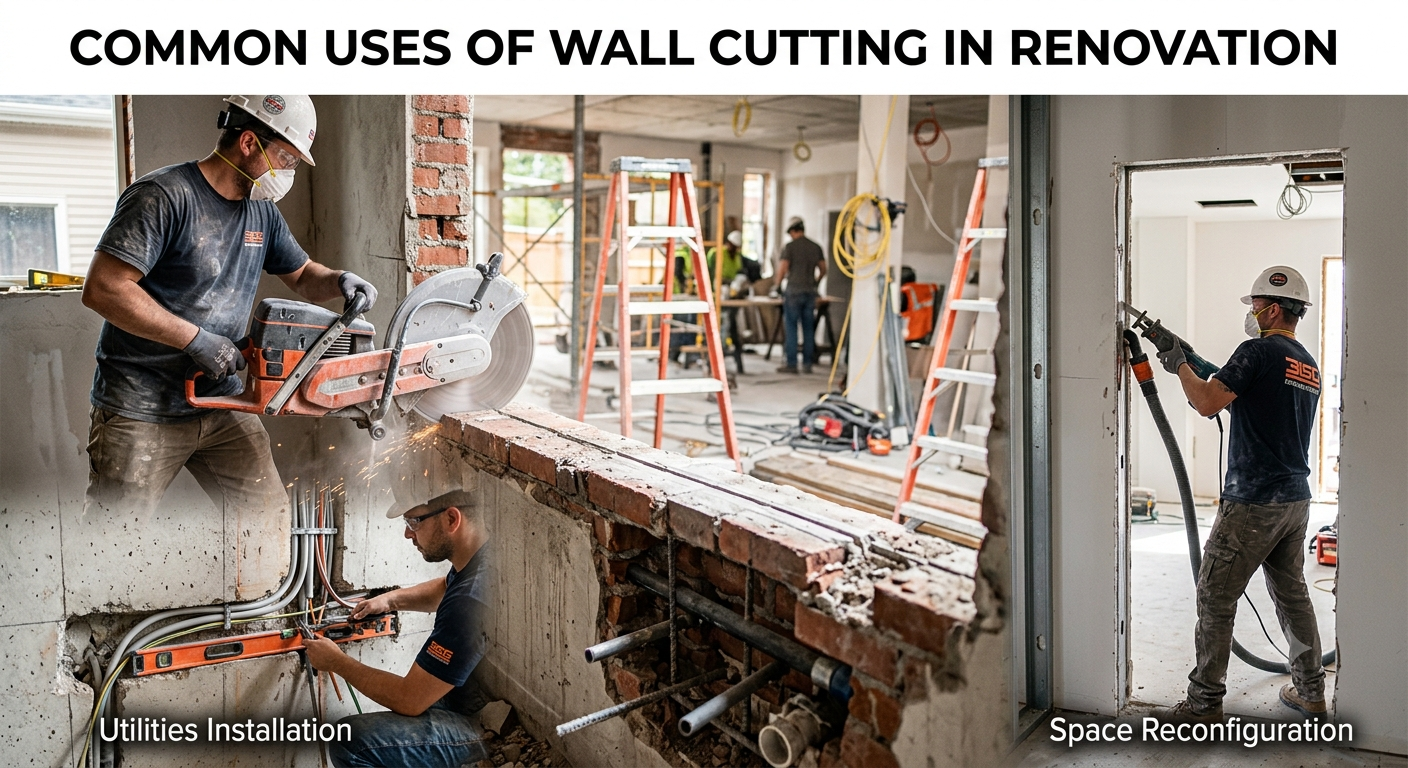
Renovation projects in India, whether in a compact Mumbai apartment, a heritage bungalow in Pune, or a sprawling commercial complex in Gurugram, almost always involve some amount of structural rework. One of the most essential yet often underestimated processes in this rework is wall cutting. Far from being a rough, hammer-and-chisel job of the past, modern wall cutting is a precise, engineered process that uses diamond blades, core drills, and wall saws to reshape spaces without compromising structural integrity.
At Core Cutting India ([email protected]), we work with homeowners, architects, interior designers, and commercial contractors across the country who need clean, accurate, and safe wall cutting solutions. In this blog, we walk through the most common uses of wall cutting in both residential and commercial renovations, along with real-world Indian examples that show just how versatile this service has become.
What Exactly Is Wall Cutting?
Wall cutting is the controlled process of cutting through brick, concrete, or RCC (Reinforced Cement Concrete) walls using specialized machinery such as diamond wall saws, wall chasers, core cutting drills, and hand-held concrete cutters. Unlike traditional demolition, which is often crude and unpredictable, wall cutting is precision-engineered. It allows contractors to create clean openings, grooves, or holes exactly where needed, without disturbing the surrounding structure.
This precision matters enormously in India, where most urban homes and commercial buildings are built with RCC framed structures or load-bearing brick walls. A wrong cut can weaken a wall's load-bearing capacity or damage embedded electrical and plumbing lines, so professional wall cutting services have become a standard part of any serious renovation project.
Why Wall Cutting Is Central to Renovation Work
Renovation, by definition, means changing the existing structure to suit new needs. Families outgrow their homes, businesses need to modernize their storefronts, and old buildings need retrofitting for modern electrical and HVAC systems. In almost every case, some part of a wall needs to be cut, widened, or opened up. This is why wall cutting has become such a common and essential service across Indian cities like Delhi, Mumbai, Bengaluru, Chennai, Hyderabad, and Pune.
Let's look at the specific ways wall cutting is used in both home and commercial renovation projects.
1. Creating New Doorways and Windows
One of the most frequent requests we receive at Core Cutting India is for creating new doorways or windows in an existing wall. Many older Indian homes, especially those built in the 1980s and 90s, were designed with smaller, closed-off rooms. As families renovate to create better ventilation and natural light, cutting a new window or doorway becomes necessary.
For example, in a typical 2BHK renovation in Pune, homeowners often want to convert a store room into a home office, which requires cutting a new window into an external wall for daylight and airflow. Diamond wall saws allow this to be done with minimal dust, vibration, and noise, an important consideration in densely packed housing societies.
2. Widening Existing Door and Window Openings
Renovation isn't always about creating something new. Often, it's about enlarging what already exists. Older apartments in cities like Kolkata and Chennai frequently have narrow doorways that don't meet modern accessibility or design standards. Widening these openings requires careful cutting along the existing frame lines without disturbing the lintel or surrounding brickwork.
This is particularly common when homeowners want to install sliding doors, French windows, or larger glass panels for a more open, contemporary look, a growing trend in metro renovations across India.
3. Electrical and Plumbing Wall Chasing
Wall chasing, a specific form of wall cutting, is used to cut narrow grooves into walls for concealing electrical wiring, conduit pipes, and plumbing lines. This is one of the most common uses of wall cutting in both home and commercial renovation, since almost every renovation project involves rewiring or replumbing at some stage.
In residential renovations across Bengaluru's IT-heavy neighborhoods, for instance, homeowners frequently upgrade their homes with additional power points for modern appliances, smart home systems, and multiple air conditioners. Wall chasing machines cut precise, straight grooves so that these new wiring runs can be embedded neatly into the wall before plastering.
4. Cutting Openings for HVAC and AC Ducts
Air conditioning has become a near-universal requirement in Indian homes and offices, especially in cities like Delhi, Ahmedabad, and Chennai, where summer temperatures regularly cross 40°C. Installing split or ducted AC systems often requires cutting precise circular or rectangular openings in walls for pipe routing and outdoor unit connections.
Core cutting, which uses a diamond core drill to bore clean circular holes through concrete walls, is the preferred method here. It's commonly used in commercial office renovations in Gurugram and Noida, where centralized HVAC ducting needs to pass through multiple RCC walls across different floors.
5. Merging Rooms for Open-Concept Living
The open-concept living and dining layout has become increasingly popular in Indian home renovations, particularly in metro cities where younger homeowners prefer more social, connected spaces. This often involves cutting away a section of a non-load-bearing wall between the kitchen and living room, or between two bedrooms, to create a larger combined space.
In Mumbai, where apartment sizes are notoriously compact, this technique is frequently used to make 1BHK and 2BHK homes feel more spacious. However, this type of cutting always requires a structural assessment first, since even non-load-bearing walls can sometimes provide lateral stability.
6. Creating Breakfast Counters and Pass-Through Openings
A trend that has picked up significantly in urban Indian renovations is the creation of pass-through kitchen counters, essentially a cut-out section of wall between the kitchen and dining or living area, fitted with a counter slab. This requires precise, level cutting to ensure the remaining wall section can support the counter and any fittings above it.
This is especially popular in renovated apartments in Hyderabad and Bengaluru, where compact kitchens benefit from this semi-open layout that maintains some separation while improving interaction and light flow.
7. Structural Modifications: Staircases, Beams, and Slabs
In larger renovation projects, particularly independent houses and villas being remodeled in cities like Chandigarh or Coimbatore, wall cutting is sometimes required to modify staircases, insert new beams, or create openings in concrete slabs for skylights or spiral staircases. This is the most technically demanding category of wall cutting work, requiring structural engineers to assess load paths before any cutting begins.
Core cutting India's teams typically use wall saws with diamond-tipped blades for these jobs, since they provide the clean, straight cuts needed for structural precision, along with minimal vibration that could otherwise stress the surrounding structure.
8. Commercial Retrofitting: Shop Fronts and Shutter Openings
In commercial renovation, wall cutting plays an equally important role. Retail businesses across India frequently renovate their storefronts to install larger glass shop fronts, automatic shutters, or ATM enclosures. This requires cutting wide openings into brick or RCC walls at street level, often in busy commercial areas like Connaught Place in Delhi or Commercial Street in Bengaluru, where work must be fast, low-dust, and minimally disruptive to neighboring businesses.
Diamond wall sawing is typically used here because it produces straight, load-bearing-safe cuts, essential when the wall being cut supports upper floors of a commercial building.
9. Bathroom Renovation: Niches, Plumbing Lines, and Tile Recesses
Bathroom renovations across Indian homes frequently involve wall cutting to create recessed niches for shampoo and toiletries, or to reroute plumbing lines for modern fixtures like rain showers, wall-mounted commodes, and concealed cisterns. This requires shallow, controlled cutting that doesn't compromise waterproofing layers.
This is a particularly common renovation request in Mumbai and Pune, where older bathrooms are being modernized with European-style fittings that require different plumbing configurations than what was originally built.
10. Ventilation and Exhaust Openings in Basements and Parking Areas
Commercial buildings, especially multi-level parking structures and basement facilities common in Indian malls and office complexes, often require new ventilation or exhaust openings to meet updated fire safety and air quality regulations. Core cutting is used extensively here to bore openings through thick RCC walls for ducting and exhaust fans, work that demands industrial-grade equipment and experienced operators.
Techniques Used in Professional Wall Cutting
Professional wall cutting services in India typically rely on a combination of the following techniques, chosen based on the wall material, thickness, and precision required:
- Diamond Wall Saw Cutting: Used for straight, deep cuts through RCC and concrete walls, ideal for doorways, windows, and structural openings.
- Wall Chasing: Used for cutting narrow grooves for electrical and plumbing lines.
- Core Cutting (Core Drilling): Used for circular openings, commonly for pipes, ducts, and cable routing.
- Hand-Held Concrete Cutters: Used for smaller, more localized cutting jobs where mobility and precision are needed in tight spaces.
Each of these methods minimizes dust, noise, and vibration compared to traditional demolition, an important factor in Indian residential societies and commercial complexes where renovation work must comply with building management rules and noise regulations.
Safety and Structural Considerations
Wall cutting, especially in load-bearing walls, should never be attempted without a proper structural assessment. In India, RCC framed structures typically have non-load-bearing infill walls, meaning many walls can be cut with minimal risk. However, brick load-bearing structures, common in older buildings and independent houses, require far more caution.
Before any wall cutting project begins, it's advisable to:
- Consult a structural engineer to confirm whether the wall is load-bearing.
- Check for embedded electrical wiring or plumbing lines using detection equipment.
- Ensure the housing society or building management has approved the renovation work, especially in apartment complexes.
- Hire experienced wall cutting contractors who use calibrated, professional-grade equipment.
Choosing a Professional Wall Cutting Service in India
Given how central wall cutting is to nearly every renovation project, choosing the right service provider matters. A professional wall cutting company should offer structural assessment support, use modern diamond cutting equipment, follow proper dust and noise control practices, and have experience working across both residential and commercial projects.
At Core Cutting India, we specialize in precision wall cutting, wall chasing, and core cutting services for homeowners, architects, and commercial contractors across the country. Whether it's a small doorway modification in a Delhi apartment or a large-scale commercial retrofit in Bengaluru, our team ensures every cut is accurate, safe, and structurally sound.
Conclusion
Wall cutting has evolved from a rough, disruptive process into a precise, essential part of modern renovation work in India. From creating new doorways and windows to chasing walls for electrical wiring, cutting openings for AC ducts, merging rooms for open-concept living, and retrofitting commercial storefronts, its uses span nearly every type of renovation project across residential and commercial spaces alike.
If you're planning a renovation and need reliable, professional wall cutting services, reach out to Core Cutting India at [email protected]. Our experienced team combines the right equipment with careful structural assessment to ensure your renovation goes smoothly, safely, and exactly according to plan.