
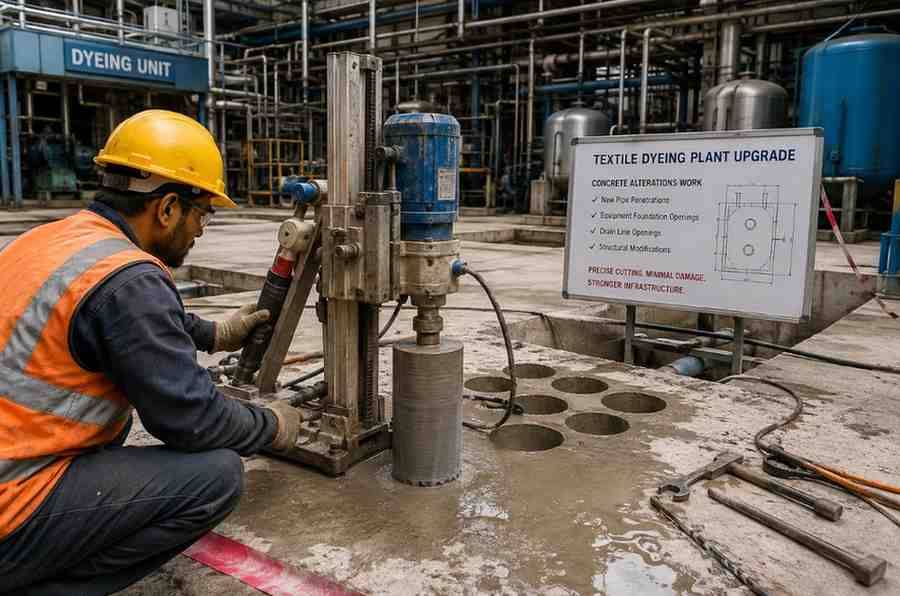
Textile dyeing plants operate under some of the harshest industrial conditions in the manufacturing sector. Constant exposure to moisture, chemical effluents, high temperatures, and continuous machine vibration puts enormous stress on a facility's structural elements. As dyeing units modernize — installing new jigger machines, soft-flow dyeing machines, effluent treatment systems, or automated material handling lines — the existing concrete structure often needs significant alteration to accommodate these upgrades.
This is where specialized concrete cutting and structural alteration services become essential. At Core Cutting India ([email protected]), we work closely with textile manufacturers to plan and execute precise, safe, and code-compliant concrete modifications that keep plant upgrades on schedule without compromising structural integrity.
In this blog, we explore why concrete alterations matter for textile dyeing plant upgrades, the techniques involved, common challenges, and how to choose the right partner for the job.
Why Textile Dyeing Plants Require Concrete Alterations
Dyeing plants are rarely static facilities. As production demands grow and technology evolves, plant owners frequently need to:
- Install new dyeing machines, dryers, or stenter frames that require different foundation dimensions
- Reroute steam, water, and chemical pipelines through existing walls and slabs
- Create openings for larger exhaust ducts and ventilation systems
- Expand effluent treatment plant (ETP) capacity with new tanks and channels
- Reinforce floors to handle heavier machinery loads
- Widen doorways or create new access points for material handling equipment
- Upgrade electrical infrastructure, requiring new cable trenches and conduit routes
Each of these upgrades typically demands precise concrete cutting, core drilling, or partial demolition — work that must be executed without damaging surrounding structural elements, disrupting production schedules, or compromising worker safety.
Common Concrete Alteration Techniques Used in Textile Plant Upgrades
1. Diamond Core Drilling
Core drilling is one of the most frequently used techniques in dyeing plant retrofits. It allows for clean, precise circular holes through concrete walls, floors, and slabs — ideal for installing pipelines, cables, ventilation ducts, and machine anchor points. Diamond core drilling produces minimal vibration and dust, which is particularly important in active production environments where surrounding machinery and materials must remain undisturbed.
2. Wall Sawing
When larger openings are required — for example, to install a new dyeing machine or expand a doorway for material transport — wall sawing offers straight, controlled cuts through reinforced concrete walls. This method is commonly used when connecting adjoining production bays or creating new access corridors between the dyeing unit and finishing or packing sections.
3. Floor Sawing and Slab Cutting
Heavy dyeing machinery, especially soft-flow and jet dyeing machines, requires reinforced foundations capable of bearing dynamic loads. Floor sawing allows contractors to cut out sections of existing slab for foundation upgrades, trench installation, or the creation of sumps and drainage channels essential to dyeing operations.
4. Controlled Demolition and Selective Concrete Removal
Some upgrades call for the removal of entire structural sections — old machine plinths, redundant tank foundations, or outdated partition walls. Controlled, selective demolition ensures that only the targeted concrete is removed, protecting adjacent load-bearing elements and minimizing downtime.
5. Chemical and Vibration-Free Cutting Methods
Because dyeing plants handle sensitive chemical processes, low-vibration and dust-controlled cutting methods are often prioritized. Techniques such as diamond wire sawing and hydraulic bursting reduce the risk of micro-cracking in surrounding concrete, which is critical near chemical storage areas and effluent treatment infrastructure.
Key Considerations for Concrete Alterations in Dyeing Plants
Structural Safety First
Before any cutting or drilling begins, a structural assessment is essential. Dyeing plants often have aging reinforced cement concrete (RCC) structures that may already be under stress from years of chemical exposure and moisture ingress. Identifying load-bearing walls, rebar placement, and existing cracks helps prevent unintended structural failures during alteration work.
Minimizing Production Downtime
Textile dyeing operations typically run in continuous shifts. Alteration work must be carefully scheduled — often during planned maintenance windows or lower-production periods — to avoid costly interruptions. Experienced contractors use low-noise, low-dust techniques that can, in many cases, be carried out with minimal disruption to adjacent operational areas.
Chemical Resistance and Corrosion Factors
Dyeing plants deal with acidic and alkaline effluents, dyes, and steam. Any new concrete work — whether patching, reinforcing, or pouring new foundations — should use chemical-resistant concrete mixes and appropriate waterproofing or epoxy coatings to withstand the corrosive plant environment long-term.
Compliance with Safety and Environmental Regulations
Concrete alteration work in an operational industrial facility must comply with occupational safety norms, dust and noise control regulations, and environmental guidelines — particularly around effluent treatment zones. Professional contractors ensure permits, safety protocols, and environmental safeguards are in place before work begins.
Precision Layout Planning
Because dyeing machines, piping, and ducting must align precisely with production layouts, accurate marking and measurement before cutting is critical. Even small deviations in core hole placement or slab openings can cause costly rework or misalignment with new machinery.
Typical Applications of Concrete Cutting in Textile Dyeing Plant Upgrades
- New machine foundations: Cutting and re-pouring slab sections to install heavier, more efficient dyeing or drying equipment
- Pipeline and duct routing: Core drilling walls and floors for steam lines, chemical dosing pipes, and exhaust ducts
- ETP expansion: Cutting openings for new treatment tanks, channels, and pump housings
- Cable and utility trenching: Floor sawing for new electrical conduits supporting automated systems
- Access modifications: Wall sawing to widen doorways for forklifts, trolleys, and bulk material handling
- Drainage and sump creation: Precision cutting for new floor drains required by updated wet-processing lines
Benefits of Hiring Professional Concrete Cutting Services
Attempting concrete alterations without specialized equipment and expertise can lead to structural damage, safety hazards, and extended downtime. Professional concrete cutting contractors bring:
- Precision equipment such as diamond core drills, wall saws, and wire saws suited to reinforced concrete
- Experienced technicians trained in reading structural drawings and identifying rebar and utility lines before cutting
- Dust and vibration control, protecting sensitive dyeing equipment and chemical storage areas nearby
- Faster turnaround, reducing the operational downtime that comes with plant upgrades
- Safety compliance, including proper protective measures and adherence to industrial safety standards
At Core Cutting India, our teams are experienced in handling concrete alteration projects across textile, chemical, and process industries, and we understand the specific operational sensitivities of dyeing plants.
Planning a Concrete Alteration Project for Your Dyeing Plant
A well-executed concrete alteration project generally follows these steps:
- Site assessment and structural survey — Evaluating existing concrete condition, rebar layout, and load-bearing elements
- Scanning for utilities — Using ground-penetrating radar or rebar detectors to avoid cutting into live electrical lines, pipes, or cables
- Method selection — Choosing between core drilling, wall sawing, floor sawing, or selective demolition based on the scope of work
- Scheduling around production — Coordinating with plant operations to minimize disruption
- Execution with dust and vibration control — Carrying out cutting work using controlled, low-impact techniques
- Post-cutting restoration — Patching, reinforcing, or finishing altered areas with chemical-resistant materials suited to the dyeing environment
- Quality and safety inspection — Verifying that all alterations meet structural and safety requirements before machinery installation begins
Conclusion
Upgrading a textile dyeing plant is about more than just installing new machinery — it requires careful, precise concrete alteration work to ensure the building's structure can safely support modern equipment, expanded utilities, and evolving production needs. From core drilling for pipeline routing to floor sawing for new machine foundations, every cut must be planned with structural safety, chemical resistance, and minimal downtime in mind.
Partnering with an experienced concrete cutting and alteration company ensures your dyeing plant upgrade proceeds smoothly, safely, and on schedule. Core Cutting India specializes in precision concrete cutting, core drilling, and structural alteration services tailored to the demanding conditions of textile and process manufacturing facilities.
For expert guidance on your next dyeing plant upgrade, reach out to Core Cutting India at [email protected].
People Also Ask
1. What is the best method for cutting concrete in an operational textile plant? Diamond core drilling and wall sawing are generally preferred in operational textile plants because they produce minimal dust and vibration, reducing disruption to nearby machinery and chemical storage areas compared to traditional demolition methods.
2. How long does concrete alteration work take during a plant upgrade? Timelines vary based on scope — a few core holes for pipeline routing may take a day, while foundation cutting for new machinery or ETP expansion can take several days to weeks, depending on structural complexity and scheduling around production.
3. Is concrete cutting safe for existing dyeing machinery and infrastructure? Yes, when performed by trained professionals using controlled, low-vibration techniques and proper utility scanning, concrete cutting can be carried out safely near existing machinery, chemical lines, and electrical systems.
4. Do textile dyeing plants need special concrete mixes after alteration work? Yes. Because dyeing plants are exposed to acidic and alkaline effluents, moisture, and chemicals, restored or new concrete sections typically require chemical-resistant mixes, waterproofing, or epoxy coatings for long-term durability.
5. How much does concrete cutting cost for an industrial plant upgrade? Costs depend on factors such as concrete thickness, reinforcement density, cutting method, area of work, and site accessibility. It's best to get a site-specific assessment and quote from a professional concrete cutting contractor.
6. Can concrete cutting be done without shutting down the entire plant? In most cases, yes. Experienced contractors plan alteration work around production schedules and use techniques that allow surrounding sections of the plant to continue operating with minimal interruption.
Target-Related Search Keywords: concrete cutting for textile plants, core drilling services India, industrial concrete alteration, dyeing plant machinery foundation, RCC wall cutting services, floor sawing for factories, effluent treatment plant construction, concrete demolition contractor India, structural alteration for factories, textile plant modernization, precision core drilling, industrial concrete contractor, Core Cutting India services