
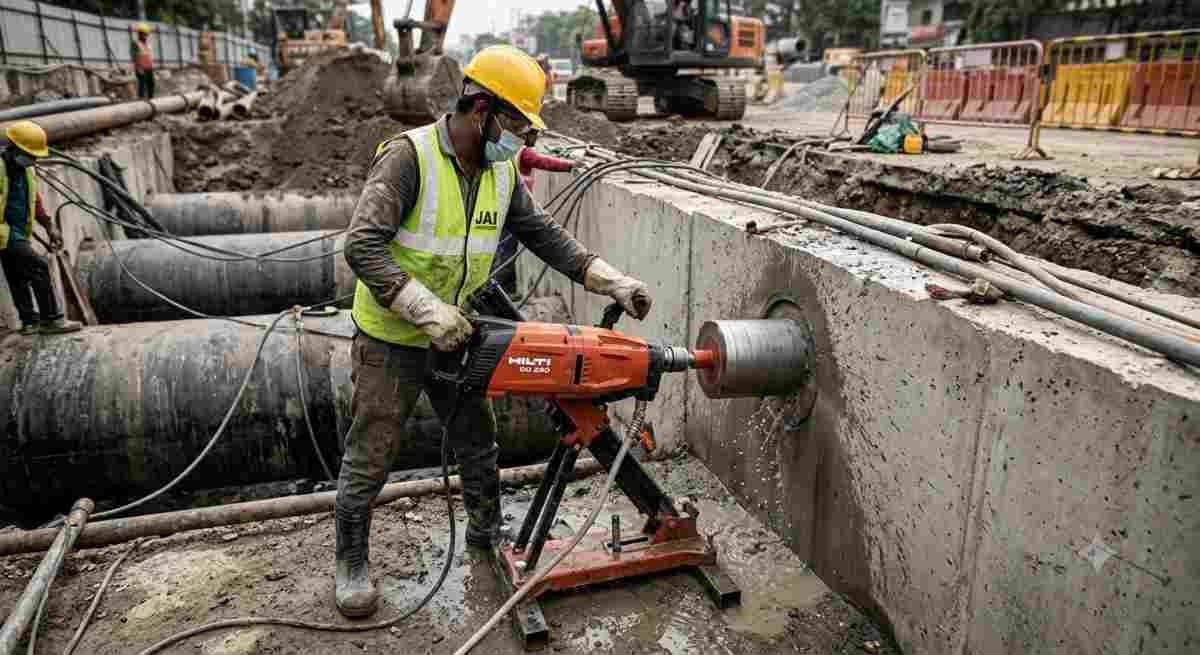
Modern urban infrastructure relies on a vast, intricate network of subsurface utilities to function seamlessly. Among these lifelines, municipal water supply and drainage systems form the bedrock of public health, sanitation, and industrial stability. However, integrating new water pipelines into existing concrete infrastructure—such as massive municipal foundations, reinforced concrete walls, containment tanks, and subterranean vaults—presents a formidable civil engineering challenge.
When engineers need to tie a new water distribution line into an existing subterranean concrete structure, standard demolition tools simply will not work. Heavy impact hammers and pneumatic breakers cause micro-fracturing, compromise structural integrity, and leave ragged, uneven openings prone to catastrophic water leakage.
The definitive solution is concrete core drilling. By utilizing diamond-impregnated rotary drill bits cooled with water, technicians can excise perfectly cylindrical plugs out of heavily reinforced concrete without damaging the surrounding matrix.
https://corecuttingindia.com/rate-calculator/
This comprehensive guide explores the critical role of concrete core drilling in establishing underground water pipeline connections, detailing the engineering principles, specialized machinery, step-by-step methodologies, safety compliance, and operational best practices deployed by industry leaders like Core Cutting India.
Understanding Target-Related Searches & PAA Context
To ensure this resource serves both engineering professionals and property developers effectively, we address the core search intents surrounding utility penetration:
-
Target-Related Searches: Diamond core drilling for utilities, wet core drilling through reinforced concrete, underground pipe penetration sealing, municipal water line core cutting, concrete wall core drilling for plumbing, heavy-duty utility coring equipment, core cutting India services.
-
People Also Ask (PAA) Questions Addressed:
-
How do you drill a hole for a water pipe through concrete?
-
What is the difference between dry and wet core drilling for utilities?
-
How do you seal around an underground water pipe penetration?
-
Can you core drill through heavily reinforced concrete containing rebar?
-
What size core drill bit is needed for a standard water main connection?
-
The Engineering Fundamentals of Utility Core Drilling
Water pipeline connections demand absolute precision. A municipal water line operates under significant hydrostatic pressure—often ranging from 50 to 150 psi or higher depending on municipal booster stations and gravity mains. Therefore, every penetration through a concrete retaining wall, manhole, or utility vault must fit the pipe diameter with millimeter-level accuracy.
Why Diamond Core Drilling Outperforms Conventional Demolition
-
Structural Integrity: Rotary core drills slice cleanly through aggregate and steel rebar simultaneously. Impact-based tools send shockwaves through concrete, weakening the surrounding bond and initiating micro-cracks that can propagate under pressure.
-
Exact Dimensional Tolerance: Core bits are manufactured to exact outer diameters (OD). A 200mm core bit yields an exact 200mm opening, eliminating oversized gaps that require intensive grouting and patching.
-
Smooth Bore Finish: The smooth internal surface of a diamond-drilled hole ensures that mechanical seals, modular rubber links (such as Link-Seals), and rubber gaskets seat uniformly against the concrete, guaranteeing a watertight seal.
Equipment and Machinery Required for Subterranean Coring
Executing a flawless core drilling operation for an underground water pipeline requires specialized heavy-duty equipment. Attempting these tasks with standard commercial drills or makeshift tools leads to equipment burnout, safety hazards, and compromised structural penetrations.
1. Heavy-Duty Core Drill Motors
High-torque, multi-speed electric or hydraulic motors are necessary to drive large-diameter bits through dense, cured concrete. For subterranean and confined space utility work, electric motors with GFCI protection or hydraulic power packs (which eliminate electrical shock risks in damp, water-prone environments) are preferred.
2. Diamond Core Bits
Core bits consist of a steel cylindrical barrel tipped with industrial-grade diamond segments laser-welded or silver-brazed to the leading edge. The diamond matrix is engineered with specific bond hardnesses:
-
Soft Bonds: Used for extremely hard, dense aggregates (like river gravel or quartz) to expose new diamond crystals rapidly.
-
Hard Bonds: Used for abrasive aggregates (like sandstone or lightweight concrete) to prevent premature matrix wear.
-
Rebar-Cutting Segments: Configured to shear through high-tensile steel reinforcement bars without tearing the segment off the barrel.
3. Rig Stands and Anchoring Systems
Core drills cannot be held freehand when boring diameters exceeding 50mm (2 inches). A rigid modular drill stand secured to the concrete surface via heavy-duty anchor bolts or vacuum pads ensures zero lateral deflection during the drilling cycle.
4. Water Slurry Management and Cooling Systems
Water is mandatory during core drilling to cool the diamond segments, suppress airborne silica dust (protecting workers from silicosis), and flush out pulverized concrete. In subterranean or deep excavation environments, professional vacuum slurry recovery rings are attached to capture wastewater instantly.
Step-by-Step Methodology: Executing an Underground Pipeline Penetration
Executing a successful core drilling operation for a water pipeline connection follows a strict, highly regulated engineering workflow.
[Site Assessment & Utility Scanning]
        ↓
[Rig Setup & Laser Alignment]
        ↓
[Wet Diamond Core Drilling]
        ↓
[Core Plug Extraction & Inspection]
        ↓
[Waterproofing & Pipe Sleeve Installation]
Step 1: Site Assessment and Non-Destructive Testing (NDT)
Before a single anchor is set, technicians must perform a comprehensive structural and utility survey. Ground Penetrating Radar (GPR) and electromagnetic pipe locators are deployed to scan the concrete wall or slab. This ensures the drill path does not intersect live electrical conduits, post-tension cables, or existing structural steel members that could endanger operators or compromise the building load path.
Step 2: Rig Setup and Alignment
The core drill stand is anchored securely to the concrete substrate. Using a laser level, technicians align the center axis of the drill motor precisely with the engineering drawings, accounting for required pipe slope, invert elevations, and wall entry angles.
Step 3: Initiation and Controlled Drilling
Water flow is initiated to the bit face. The operator engages the motor at a low initial RPM, gently easing the diamond bit into the concrete surface to establish a clean starting groove (the "kerf"). Once the pilot groove is established, the operator increases feed pressure, maintaining a steady, rhythmic advancement rate based on material hardness and amperage draw on the motor.
Step 4: Core Plug Extraction
When the bit passes completely through the concrete structure, the cylindrical concrete core (slug) remains lodged inside the barrel or breaks free cleanly. Technicians extract the core plug, inspect the interior wall of the hole for smoothness, and measure the final diameter against pipeline specifications.
Step 5: Sleeving and Waterproofing
To protect the pipeline from structural settling and shear stresses, a rigid PVC or steel sleeve is typically grouted into the core-drilled opening. Specialized non-shrink, high-strength hydraulic grout is packed around the sleeve. Finally, mechanical modular seal assemblies are tightened between the pipe and the sleeve, creating a permanent hydrostatic seal capable of withstanding high external water tables.
Overcoming Engineering Challenges in Subterranean Utility Coring
Underground and below-grade environments present unique operational hurdles that require seasoned technical expertise.
-
Heavy Steel Reinforcement (Rebar Congestion): Modern subterranean vaults and water tanks often feature dense double-mat rebar grids. If a core bit hits heavy rebar at an oblique angle, it can deflect. Professional operators adjust spindle speed and feed pressure dynamically to shear through steel without stalling the motor.
-
High Groundwater Tables: Coring into underground structures often occurs below the local water table. Technicians utilize sump pumps, temporary external dewatering, and quick-setting hydraulic plug cements to manage water infiltration during the core-drilling and sleeve-sealing phases.
-
Confined Space Protocols: Subterranean manholes, vaults, and utility tunnels are classified as confined spaces. Crew members must operate under strict OSHA/industrial safety guidelines, utilizing atmospheric gas monitors, forced-air ventilation blowers, and proper harness/retrieval gear.
Safety Standards and Compliance
Compliance with occupational health and safety regulations is non-negotiable in concrete cutting and utility infrastructure work.
-
OSHA Silica Regulations: OSHA mandates strict exposure limits for respirable crystalline silica. Wet drilling methods combined with HEPA-filtered slurry management systems eliminate airborne dust hazards.
-
Electrical Safety: Because water and electricity are in close proximity during wet core drilling, all power sources must feature functional Ground Fault Circuit Interrupters (GFCIs) and waterproof industrial connectors.
-
Personal Protective Equipment (PPE): Operators must wear high-visibility vests, steel-toed waterproof boots, impact-resistant safety glasses, hearing protection, and hard hats.
Why Partner with Core Cutting India?
Executing complex subterranean utility connections requires precision, advanced machinery, and decades of field experience. Core Cutting India stands as a premier provider of heavy-duty concrete cutting, core drilling, and structural modification services across India.
Equipped with state-of-the-art hydraulic and electric diamond core drilling systems, our certified technicians handle challenging municipal and industrial utility penetrations with absolute accuracy and strict adherence to safety timelines.
For professional consultation, project estimation, or emergency service deployment, reach out to our team directly:
-
Website: https://corecuttingindia.com/
-
Digital Rate Calculator: https://corecuttingindia.com/rate-calculator/
-
Direct Phone / WhatsApp: +91 70096 79903
-
Email Inquiries: info@corecuttingindia.com