
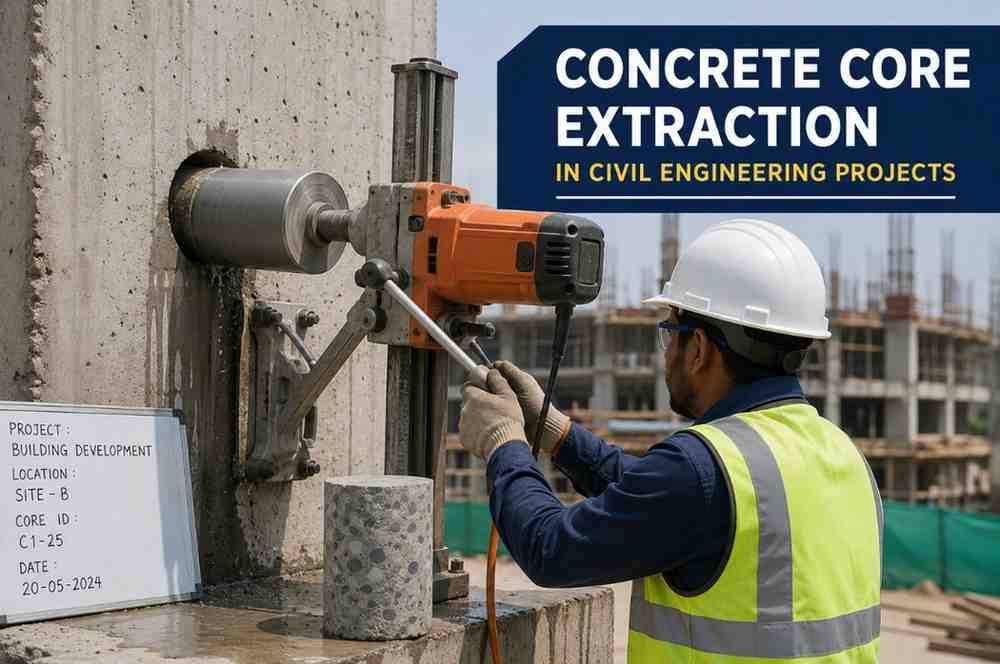
Introduction to Concrete Core Extraction
Civil engineering is a discipline built upon precision, rigorous safety standards, and structural longevity. Among the numerous diagnostic and construction methodologies employed in the field, concrete core extraction stands out as a critical procedure. Often referred to as core drilling or concrete sampling, this technique involves removing a cylindrical section of hardened concrete from structures such as slabs, walls, columns, beams, or pavements.
The primary goal of concrete core extraction is twofold: first, to facilitate structural modifications by creating precise openings for utility integration; and second, to retrieve intact cylindrical samples for laboratory analysis to evaluate material strength and composition. Partnering with seasoned professionals via [email protected] ensures that these sensitive operations are executed with absolute precision, safeguarding the integrity of the built environment.
Understanding the Core Extraction Process
The extraction of concrete cores is not a matter of random drilling; it is a meticulously engineered procedure governed by technical standards and advanced machinery.
1. Pre-Drilling Site Assessment and Scanning
Before any cutting equipment touches a structure, mapping what lies beneath the surface is vital. Modern civil engineering projects utilize Non-Destructive Testing (NDT) methods, particularly Ground Penetrating Radar (GPR) and electromagnetic detection. These technologies locate embedded elements such as reinforcing steel (rebar), post-tension cables, and electrical conduits. Avoiding these elements or planning around them prevents catastrophic structural weakening and equipment damage.
2. Equipment Selection
The efficiency and accuracy of core extraction heavily rely on the equipment used. Diamond-segmented core bits are the industry standard. Because diamond is the hardest known material, diamond-tipped hollow cylindrical bits can effortlessly abrade through high-density aggregate, concrete matrix, and embedded steel reinforcement. Drills are typically mounted on rigid stands anchored securely to the working surface to eliminate vibration and ensure vertical or horizontal alignment accuracy.
3. Execution and Coolant Management
Core drilling is generally conducted as a "wet cutting" process. A continuous stream of water is fed through the core barrel to reduce frictional heat, wash away debris, and control airborne silica dust. In environments where water cannot be used, specialized dry-drilling systems equipped with high-efficiency vacuum dust extraction are deployed.
Once the desired depth is reached, special wedge tools or core catchers are used to snap the base of the cylinder cleanly, allowing the solid concrete core sample to be safely extracted without fracturing.
Key Applications in Modern Civil Engineering
Concrete core extraction serves multiple critical functions across various phases of civil infrastructure development and maintenance.
+-----------------------------------------------------------------+
|              Core Applications of Concrete Extraction            |
+-----------------------------------------------------------------+
|  1. Structural Integrity & Quality Control Testing              |
|  2. MEP (Mechanical, Electrical, & Plumbing) Penetrations       |
|  3. Forensic Engineering & Damage Assessment                    |
|  4. Infrastructure Retrofitting & Modification                  |
+-----------------------------------------------------------------+
1. Structural Strength and Quality Control Testing
One of the most frequent reasons for core extraction is compressive strength testing. When newly poured concrete fails standard cylinder tests, or when historical records are missing for an older building, engineers extract cores to test them in a laboratory under heavy compression machines. This provides an accurate, in-situ assessment of the actual concrete strength.
2. MEP Utility Installations
Modern commercial, industrial, and residential structures require dense networks of piping, electrical conduits, HVAC ductwork, and fire suppression systems. Core cutting allows contractors to create clean, perfectly round apertures through thick reinforced concrete slabs and walls without inducing macro-cracking or destabilizing the surrounding frame.
3. Forensic Engineering and Post-Disaster Assessment
When structures experience environmental distress—such as fires, earthquakes, chemical attacks, or extreme overloading—forensic civil engineers rely on core extraction to examine internal degradation. Microscopic examination of core samples reveals carbonation depth, chloride penetration, internal micro-cracks, and aggregate-paste bonding.
Advantages of Professional Core Extraction Services
Executing core extraction requires specialized training, industrial-grade machinery, and strict adherence to safety protocols. Entrusting these tasks to expert providers like [email protected] yields significant project benefits:
-
Vibration-Free and Low-Noise Operation: Unlike traditional heavy demolition hammers that transmit damaging shockwaves through a structure, diamond core drilling operates with minimal vibration, protecting surrounding architectural elements.
-
Dimensional Accuracy: Core drills produce clean, exact openings that eliminate the need for extensive post-cutting patching or structural grouting.
-
Time and Cost Efficiency: Professional execution minimizes labor hours, prevents accidental utility strikes, and keeps complex construction timelines strictly on schedule.
-
Environmental and Site Cleanliness: Controlled water management and vacuum systems keep job sites clean, containing slurry and reducing airborne dust hazards.
Best Practices and Safety Protocols
Because concrete core extraction involves heavy machinery, high electrical currents, and structural elements under load, safety and compliance are paramount.
-
Personal Protective Equipment (PPE): Operators must wear high-impact safety glasses, steel-toe boots, heavy-duty gloves, and hearing protection against high decibel levels.
-
Rigorous Stability Anchoring: Core drill stands must be bolted or vacuum-anchored securely. A shifting drill bit can bind, snap off, or cause severe kickback injuries.
-
Structural Shoring: When extracting large structural cores or cutting through primary load-bearing members, temporary shoring and props must be installed to support redistribution loads.
-
Disposal and Management: Slurry and concrete waste must be managed in accordance with local environmental regulations to prevent site contamination.
Conclusion
Concrete core extraction is far more than simple drilling; it is a sophisticated engineering process that bridges structural analysis, quality assurance, and modern construction flexibility. Whether verifying the compressive integrity of a skyscraper or carving pathways for complex MEP systems, precision is non-negotiable.
For reliable, precise, and professional execution tailored to modern engineering specifications, reach out to industry experts at [email protected] to elevate the safety, efficiency, and quality of your next civil infrastructure project.