
Introduction
In the dynamic landscape of Indian construction and civil engineering, ensuring the longevity, resilience, and safety of built infrastructure is paramount. From high-rise residential complexes in Mumbai and rapid metro rail expansions in Delhi to expansive highway bridges crossing rivers like the Ganga or Yamuna, concrete serves as the structural backbone. However, what happens when routine cube test results from a batch of concrete fall short of expectations, or when evaluating an aging heritage or commercial structure during a comprehensive structural audit?
This is where concrete core extraction becomes indispensable. As a semi-destructive testing (SDT) technique, core cutting and extraction offer a direct, highly accurate window into the true in-situ compressive strength of hardened concrete. Managed by professional service providers like [email protected], precision diamond core drilling allows engineers to resolve disputes, certify structural capacity, and make informed retrofitting decisions.
Why Concrete Core Testing is Crucial in India
While non-destructive testing (NDT) methods like the Schmidt rebound hammer and ultrasonic pulse velocity (UPV) tests provide quick, qualitative insights, they only measure surface or near-surface properties. They are heavily influenced by factors such as surface carbonation, moisture content, and aggregate type. When absolute legal, structural, or safety clarity is required, nothing replaces a physical core sample.
In India, core extraction is frequently mandated under several critical scenarios:
-
Substandard Cube Test Results: If standard laboratory-cured control cubes fail to meet the characteristic compressive strength ($f_{ck}$) specified in structural designs.
-
Structural Audits and Aging Buildings: Municipal corporations in major urban centers like Mumbai, Kolkata, and Chennai regularly mandate structural audits for buildings older than 30 years to check for concrete degradation, carbonation, and corrosion.
-
Post-Disaster Assessments: Evaluating bridges, flyovers, and buildings after extreme events such as heavy floods, fires, or localized seismic tremors.
-
Quality Control Disputes: Resolving discrepancies between builders, contractors, and clients regarding concrete mix quality during project handover.
Governing Indian Standards (IS Codes)
Engineering practices in India must strictly adhere to Bureau of Indian Standards (BIS) specifications to maintain legal and technical compliance. The primary standards governing core extraction and strength evaluation include:
-
IS 516 (Methods of Tests for Strength of Concrete): Provides comprehensive guidelines on extracting, preparing, and testing concrete cores for compressive strength. (Note: Modern revisions under IS 516 Part 4 provide updated frameworks for in-situ strength assessment).
-
IS 456 (Plain and Reinforced Concrete - Code of Practice): Outlines the criteria for accepting in-situ concrete. According to standard practices aligned with IS guidelines, concrete in a structural member is generally deemed structurally adequate if the average strength of three cores is at least 85% of the specified design strength, with no single core dropping below 75%.
The Step-by-Step Procedure of Concrete Core Extraction
Executing a precise core extraction requires specialized machinery, diamond-impregnated core bits, and skilled technicians to prevent micro-cracking or structural damage.
1. Planning and Location Marking
-
Avoiding Reinforcement: Before drilling, technicians use electromagnetic cover meters or pachometers to map out internal steel reinforcement bars (rebars). Drilling through primary reinforcement compromises both the structural element and the core sample.
-
Strategic Placement: Cores are typically drilled away from high-stress zones, usually near the neutral axis of beams or in the interior of slabs and walls.
2. Diamond Core Drilling
-
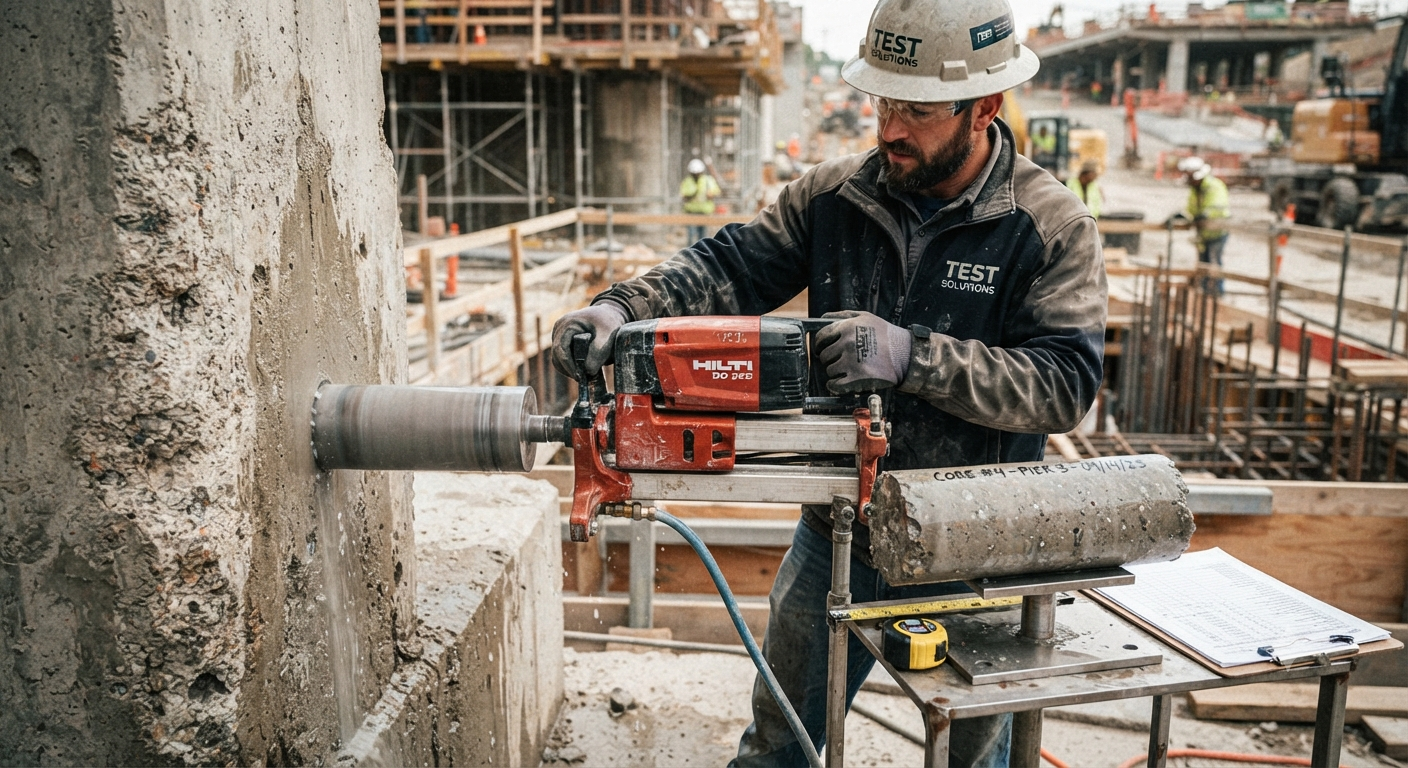
Heavy-duty core cutting rigs equipped with industrial diamond bits are anchored securely to the concrete surface.
-
Water is continuously fed into the cutting zone to cool the diamond bit, flush out debris, and suppress dust.
-
Cylindrical cores are typically extracted in standard diameters of 100 mm or 150 mm, depending on the maximum size of the coarse aggregate used in the mix.
3. Sample Labeling and Transport
-
Extracted cores are immediately labeled with their exact location, orientation (vertical or horizontal casting direction), and depth.
-
Samples are transported to a NABL-accredited laboratory under moisture-controlled conditions to prevent drying shrinkage prior to testing.
Laboratory Preparation and Compression Testing
Once the core reaches the laboratory, rigorous preparation is necessary before it can be crushed in a Compression Testing Machine (CTM).
-
Length-to-Diameter (L/d) Ratio Adjustment: Ideally, test cores should have an L/d ratio of 2.0. If the core is shorter, correction factors must be mathematically applied. Cores with an L/d ratio of less than 1.0 are generally considered unreliable (Stephenson, 2021).
-
End Capping or Grinding: The ends of the core must be perfectly flat and perpendicular to the longitudinal axis. Sulfur capping or high-precision grinding ensures uniform load distribution during testing.
-
Moisture Conditioning: As specified by testing protocols, cores are typically tested either in a saturated surface-dry (SSD) condition or air-dried condition, depending on whether the structure is predominantly wet or dry in service.
Factors Affecting Core Strength Interpretation
Engineers must apply various correction factors to convert raw core test results into true equivalent in-situ cube or cylinder strengths:
-
Effect of Drilling Damage: The mechanical action of diamond drilling introduces micro-cracks along the periphery of the core, which can reduce measured strength slightly compared to molded cylinders (Kabay).
-
Presence of Reinforcement: If a core inadvertently contains a steel rebar, its compressive strength reading can be skewed. Special correction formulas must be applied based on the bar diameter and its location within the core.
-
Coring Direction: Cores drilled horizontally (perpendicular to the direction of concrete placement and compaction) often yield lower strength values than vertically drilled cores due to internal bleeding and aggregate settling during construction (Elsheikh, 2024).
Professional Execution with Core Cutting India
Executing core cutting in active commercial spaces, high-rise apartments, or critical infrastructure projects requires extreme precision, minimal vibration, and strict adherence to safety protocols. Partnering with expert teams ensures that structural integrity remains intact while delivering legally defensible, accurate test data.
For inquiries, professional structural sampling, and specialized testing consultations, reach out directly via [email protected].
Conclusion
Concrete core extraction and strength testing bridge the gap between theoretical mix designs and physical, in-situ realities. By adhering to strict IS standards and utilizing advanced diamond cutting technology, civil engineers across India can accurately diagnose structural health, ensure public safety, and extend the lifespan of vital national infrastructure.