
Introduction: The Backbone of Structural Integrity
In the booming landscape of Indian real estate and infrastructure—spanning from high-rise residential towers in Mumbai and tech parks in Bengaluru to massive highway bridges across national corridors—ensuring the structural safety of concrete is paramount. Concrete is the literal bedrock of modern civilization. However, unlike steel, which is manufactured under strict factory controls, concrete is manufactured and cured on-site, introducing variables like human error, weather fluctuations, variable aggregate quality, and curing inconsistencies.
To verify that a structure can safely bear its design loads, civil engineers rely heavily on compressive strength testing. Two primary methodologies dominate this arena: Concrete Cube Tests and Concrete Core Sample Tests. While both measure compressive strength, they do so under fundamentally different conditions, at different stages of a building's lifecycle, and with distinct regulatory implications.
Brought to you by [email protected], this comprehensive guide explores the core differences, advantages, limitations, and Indian Standard (IS) guidelines governing these two critical testing procedures.
Target-Related Keywords & People Also Ask (PAA) Overview
-
Target-Related Keywords: concrete core cutting services, cube test vs core test, IS 516 compressive strength, non-destructive vs destructive testing, in-situ concrete strength, structural audit India, concrete testing laboratory.
-
People Also Ask (PAA) Questions Addressed in this Article:
-
What is the difference between cube test and core test?
-
Why are core test results lower than cube test results?
-
What is the IS code for concrete core testing?
-
When is a concrete core test required in construction?
-
How many core samples are required as per IS codes?
-
1. Understanding the Concrete Cube Test (The Pre-Construction & Execution Standard)
What is a Cube Test?
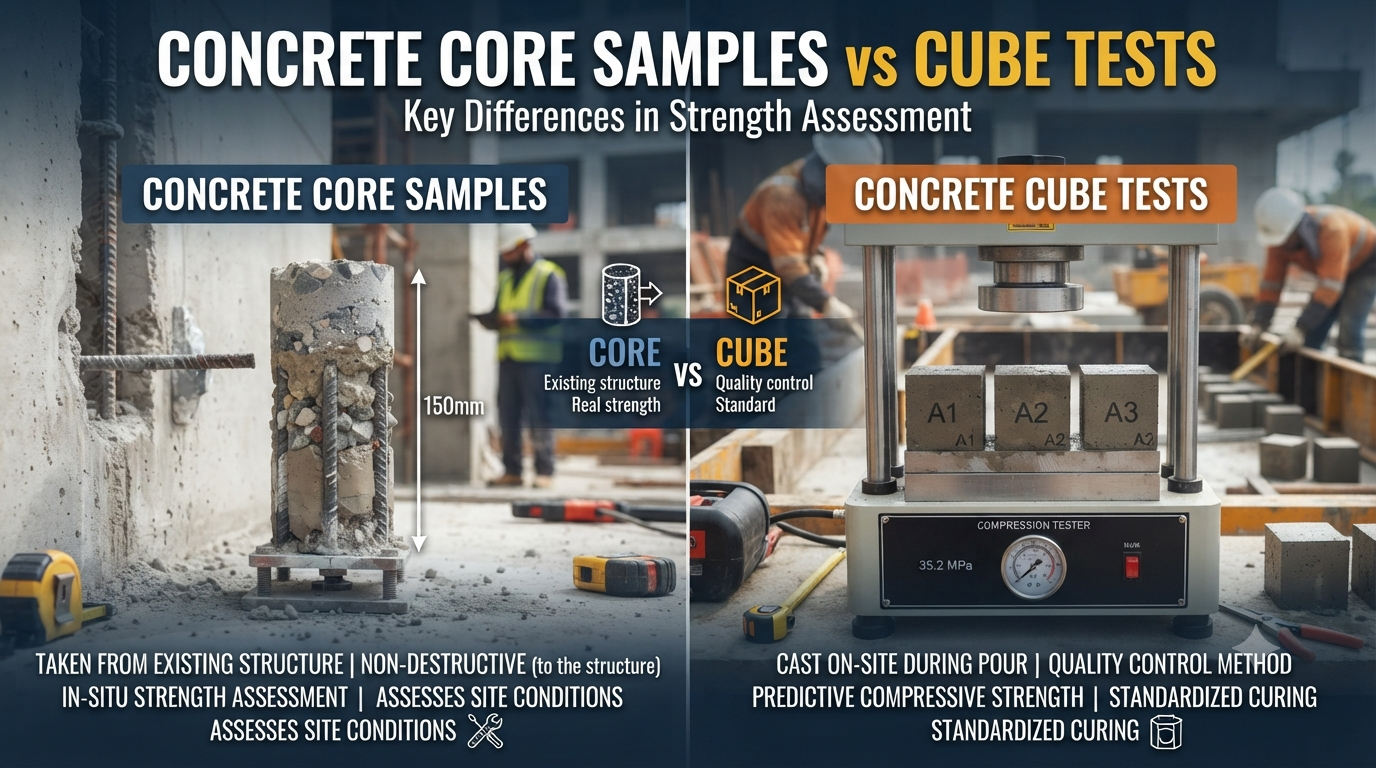
The concrete cube test is a quality control (QC) measure conducted during the construction phase. As concrete is poured into columns, beams, slabs, or foundations on-site, representative samples of the wet concrete mix are collected in standard moulds—typically measuring $150\text{ mm} \times 150\text{ mm} \times 150\text{ mm}$ (or $100\text{ mm}$ cubes for specific aggregate sizes) as specified by Indian Standards.
The Testing Procedure
-
Sampling: Fresh concrete is sampled directly from the transit mixer or chute in accordance with IS guidelines.
-
Casting & Compaction: The mould is filled in layers and compacted using a tamping bar or vibrating table to eliminate entrapped air voids.
-
Curing: The cubes are demoulded after 24 hours and submerged in a curing tank maintained at a constant temperature ($27^\circ\text{C} \pm 2^\circ\text{C}$) until the testing date.
-
Crushing: Cubes are tested in a Compression Testing Machine (CTM) at 7 days (to check early strength gain, usually ~65% of target) and 28 days (to verify full characteristic compressive strength, $f_{ck}$).
Advantages of Cube Tests
-
Proactive Quality Control: Identifies mix design or batching issues before the structure is loaded.
-
Standardized Environment: Tested under controlled laboratory conditions, minimizing external variables.
-
Cost-Effective & Fast: Inexpensive to cast and crush routinely during construction.
2. Understanding the Concrete Core Sample Test (The Post-Construction & Audit Standard)
What is a Core Test?
The concrete core test is a structural audit and diagnostic tool used after the concrete has hardened inside the actual structure. When cube test results fail to meet expectations, when a structure suffers from fire/earthquake damage, or during mandatory periodic structural health audits of older buildings (common in heritage or coastal cities like Kolkata, Chennai, and Mumbai), specialized diamond core-cutting machinery is deployed to extract cylindrical samples directly from structural elements (columns, beams, or slabs).
The Testing Procedure
-
Identification: Structural consultants identify safe zones (away from main reinforcement bars, usually verified via a Rebar Locator/Pachometer) where coring will not compromise load-bearing capacity.
-
Extraction: Specialized core cutting machines fitted with diamond-impregnated drill bits extract cylindrical specimens (typically having length-to-diameter ($L/d$) ratios matching standard guidelines).
-
Preparation: Ends are capped or ground smooth, and samples are conditioned and measured.
-
Crushing: Tested in a CTM to determine the actual in-situ compressive strength.
Advantages of Core Tests
-
True Representation: Measures the actual concrete placed, compacted, and cured inside the structural element, accounting for real-world site conditions.
-
Diagnostic Clarity: Uncovers internal flaws such as honeycombing, segregation, micro-cracks, and depth of carbonation.
-
Legal and Structural Validation: Serves as definitive evidence in disputes between builders, clients, and municipal corporations.
3. Key Differences: Concrete Core Samples vs Cube Tests
To easily understand how these two methods compare, let's break them down across critical parameters:
| Parameter | Concrete Cube Test | Concrete Core Sample Test |
| Timing | During construction (Fresh concrete stage) | Post-construction (Hardened structure stage) |
| Nature of Test | Quality Control / Compliance Test | Diagnostic / Structural Audit Test |
| Specimen Shape | Cubical ($150\text{ mm} \times 150\text{ mm} \times 150\text{ mm}$) | Cylindrical core (Variable diameter & height) |
| Curing Condition | Ideal laboratory curing tank ($27^\circ\text{C}$) | Real-world site curing (often suboptimal) |
| Compaction Effort | Standardized laboratory compaction (table/tamping) | Actual site compaction achieved by workers |
| Impact on Structure | Non-destructive to the building (separate samples cast) | Semi-destructive (leaves a core hole requiring non-shrink grouting) |
| Cost & Speed | Inexpensive, rapid, and routine | Labor-intensive, requires specialized machinery and repair |
4. Why Are Core Test Results Usually Lower Than Cube Test Results?
A frequent point of friction on Indian construction sites occurs when a 28-day cube test passes with flying colors (e.g., achieving M25 or M30 grade easily), but a subsequent core test extracted from a column reads significantly lower (sometimes 15% to 25% lower). This discrepancy causes panic among project managers, but it is scientifically expected due to several factors:
-
Compaction Variance: Laboratory cubes receive intensive, uniform compaction on a vibrating table. Real concrete poured into heavily congested column junctions by manual or needle vibrators often suffers from localized honeycombing or lower compaction density.
-
Curing Discrepancies: Cubes enjoy pristine curing in temperature-controlled water baths. Structural elements on-site are exposed to harsh Indian weather conditions—scorching summer suns in Delhi or high humidity in coastal zones—leading to premature moisture loss and incomplete cement hydration.
-
Shape and Size Effects: Cubes distribute stress differently during crushing compared to slender cylindrical core samples.
-
Presence of Steel Reinforcement: Cores containing minor embedded steel pieces or micro-disturbances during drilling can register lower load capacities.
As per standard engineering consensus and research highlighted in Indian journals, an equivalent core strength of about 85% of the characteristic cube strength is generally considered acceptable, provided there are no major structural distress signs. Engineers are explicitly advised not to reject concrete solely based on low core values without holistic structural analysis.
5. Indian Standards (IS Codes) Governing Concrete Testing
Indian construction practices are strictly regulated by the Bureau of Indian Standards (BIS). Knowing the correct codes ensures legal compliance and structural safety:
-
IS 516 (Part 1/Sec 1): Specifies the methods of testing strength for concrete, detailing how compression tests on cubes are performed.
-
IS 516 (Part 4): Covers sampling, preparing, and testing concrete core samples from existing structures.
-
IS 456: Plain and Reinforced Concrete - Code of Practice. It outlines the acceptance criteria for concrete and outlines guidelines when cube results fall short, paving the way for core testing as a supplementary verification step.
-
IS 13311 (Part 1 & 2): Guides non-destructive testing methods like Ultrasonic Pulse Velocity (UPV) and Rebound Hammer tests, which are frequently combined with core cutting for comprehensive structural audits.
6. When Do You Need Professional Concrete Core Cutting Services?
Property owners, builders, and structural consultants across India call upon professional core cutting experts (such as those at [email protected]) under several distinct scenarios:
-
Failed Cube Tests: When laboratory cube crush reports show substandard results at 28 days, core extraction is mandated to check if the actual structural member has achieved adequate strength.
-
Structural Audits for Older Buildings: Municipal corporations in cities like Mumbai (BMC rules), Delhi (MCD/DDA norms), and Bengaluru mandate structural audits for buildings older than 15–30 years to check concrete degradation.
-
Property Purchase/Due Diligence: Prospective buyers or corporate tenants undertaking large commercial leasehold improvements often commission core tests to verify structural soundness before investing.
-
Unauthorized Additions or Alterations: If a floor is being added to an existing building, core samples verify if the existing foundation and columns can take the enhanced load.
-
Post-Disaster Evaluation: Assessing structural integrity following fires, minor tremors, or severe water seepage.
Conclusion
Both concrete core samples and cube tests are indispensable pillars of structural engineering quality assurance in India. While the Cube Test acts as your frontline guardian during construction—ensuring that the mix design is right and materials are compliant—the Core Test serves as the ultimate truth-teller, revealing the actual health and capacity of hardened concrete within the built environment.
Understanding the fundamental differences between these two methodologies prevents unnecessary panic, guides legal and engineering decisions, and ultimately ensures that Indian infrastructure remains safe, resilient, and enduring for generations to come.
For professional, precise, and damage-controlled concrete core cutting, structural testing, and cutting solutions tailored to your project requirements across India, reach out to the experts today at [email protected].