
Target-Related Searches
-
Concrete core cutting and testing services in India
-
Compressive strength of core samples as per IS codes
-
Structural audit and core sampling procedure for RCC buildings
-
Non-destructive testing (NDT) combined with core drilling
-
Repair and rehabilitation of fire or earthquake-damaged concrete structures
People Also Ask (PAA) Questions
-
What is the procedure for concrete core sampling in damaged RCC structures?
-
How does concrete core cutting help in structural audits in India?
-
What are the acceptable strength limits for concrete cores as per Indian Standards?
-
When is core sampling preferred over non-destructive testing (NDT)?
-
How do environmental factors and aging affect RCC durability in Indian climates?
Introduction: The Imperative of Structural Health in India
India’s rapid urbanization, mega-infrastructure expansions, and dense metropolitan growth mean that reinforced cement concrete (RCC) structures are constantly subjected to immense stress. From the humid coastal environments of Mumbai and Chennai to the extreme thermal variations of Delhi and Rajasthan, Indian buildings and civil assets age rapidly. Over time, factors like environmental carbonation, chloride ingress, poor initial construction practices, accidental fires, or seismic tremors compromise structural integrity.
When an RCC structure shows distress—manifested through spalling concrete, wide structural cracks, or excessive deflections—visual inspections are insufficient. Engineers need empirical, hard data. This is where concrete core sampling becomes indispensable. By extracting a physical cylindrical specimen from the distressed element, engineering consultants can accurately evaluate the residual strength and internal composition of the structure, laying the foundation for safe retrofitting or demolition.
Understanding Concrete Core Sampling
Concrete core sampling is a semi-destructive testing method used when non-destructive testing (NDT) techniques—such as Rebound Hammer or Ultrasonic Pulse Velocity (UPV) tests—yield ambiguous or unsatisfactory results. While NDT provides surface-level or indirect estimations, core drilling physically extracts a cylindrical matrix of hardened concrete from columns, beams, slabs, or walls.
The Core Cutting Mechanism
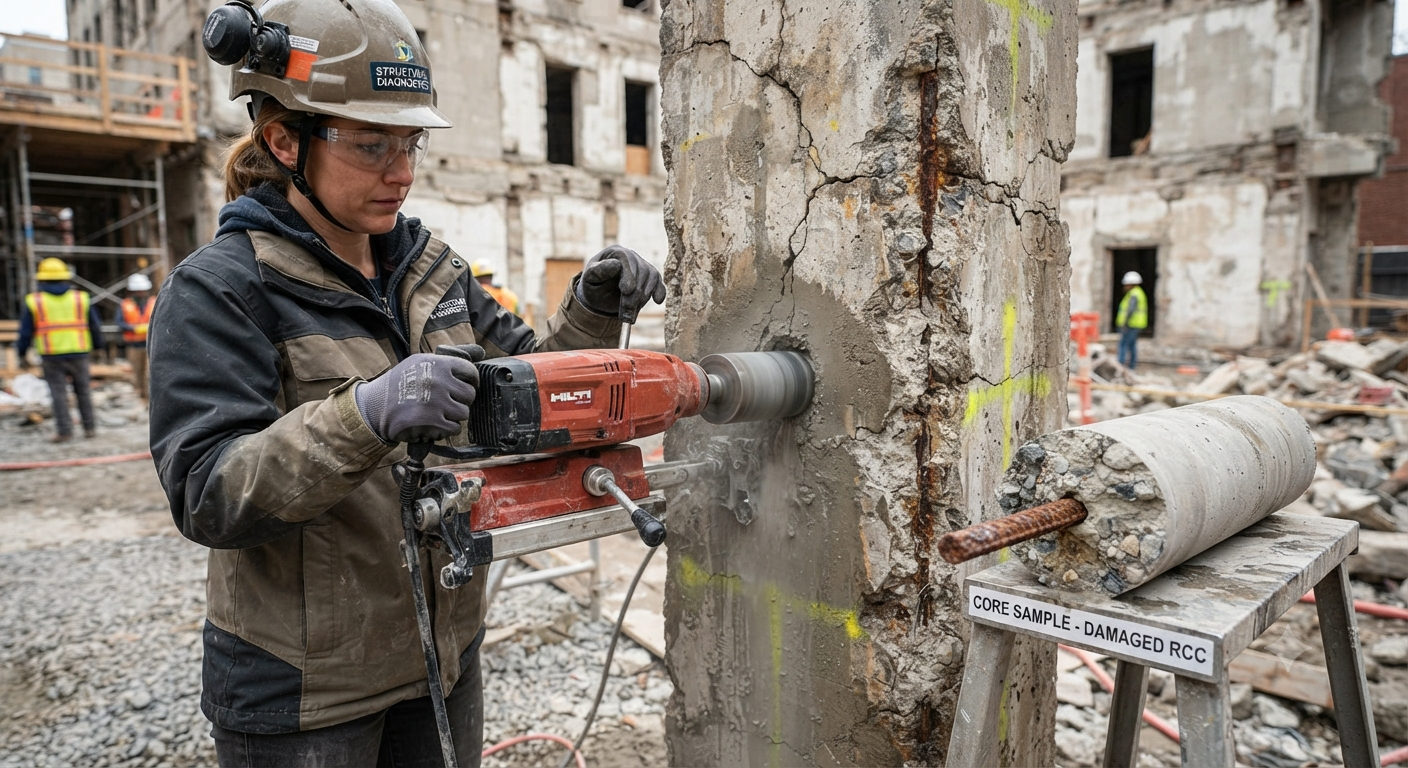
Using industrial-grade rotary diamond-bit core cutters, cylindrical specimens are drilled out smoothly. Water is typically used as a coolant during the operation to minimize frictional heat and prevent micro-cracking of the sample. Once extracted, the core undergoes meticulous laboratory preparation, including visual description, trimming, end-capping, and moisture conditioning before being crushed in a Compression Testing Machine (CTM).
Why Damaged RCC Structures Demand Core Sampling
Damaged structures present complex inner stress distributions. Whether a structure has suffered structural distress due to overloading, chemical attacks, or fire exposure, core sampling provides vital diagnostic advantages:
-
Direct Compressive Strength Evaluation: It provides the true in-situ compressive strength of the concrete rather than an empirical estimation.
-
Internal Flaw Detection: Cores reveal internal honeycombing, micro-cracks, void distributions, and the exact bond quality between concrete and rebar.
-
Depth of Deterioration: In fire-damaged or carbonated structures, cores can be sliced horizontally to measure the gradient of chemical decay or thermal damage from the exposed surface inward.
-
Petrographic and Chemical Analysis: Laboratory evaluation of core slices can uncover alkali-aggregate reactions (AAR), sulfate attacks, and precise chloride/pH profiles.
Indian Regulatory Standards and Compliance
In India, concrete core sampling and testing are governed strictly by established Bureau of Indian Standards (BIS). Adhering to these standards ensures uniformity, legal accountability, and structural safety:
-
IS 516 (Part 5/Sec 1): Outlines methods of test for strength of concrete, including the extraction, preparation, and testing of core specimens.
-
IS 456: 2000: Governs plain and reinforced concrete code of practice, specifying limits for chemical parameters like maximum chloride and sulfate contents.
-
Acceptance Criteria: As per standard guidelines, concrete in a member represented by a core test is considered acceptable if the equivalent average cube strength of the cores is at least 85% of the specified characteristic strength, with no single core dropping below 75%.
Real-World Indian Scenarios and Case Studies
Scenario A: Post-Fire Assessment of Industrial Warehouses
Industrial belts across Gujarat, Maharashtra, and Tamil Nadu frequently witness operational hazards such as chemical plant fires. Following a fire incident, concrete loses its compressive strength and modulus of elasticity due to thermal breakdown.
-
Application: Engineers extract cores from fire-affected RCC columns and beams. Slicing these cores into layers (e.g., 0–20 mm, 20–40 mm, and 40–60 mm deep) helps determine how deep the high temperatures penetrated.
-
Outcome: Decisions are made on whether to execute micro-concreting, jacketing, or complete structural replacement based on core test metrics confirming whether the core concrete satisfies baseline grades (e.g., M25 or M30).
Scenario B: Aging Residential High-Rises in Coastal Metros
Coastal cities like Mumbai, Chennai, and Kolkata deal with aggressive marine environments. Salt-laden air accelerates rebar corrosion, leading to severe concrete spalling in residential co-operative housing societies undergoing structural audits.
-
Application: Structural consultants mandate core cutting alongside Half-Cell Potential tests to ascertain the residual structural capacity of load-bearing columns before granting structural fitness certificates.
-
Outcome: Precise core data prevents unnecessary panic-driven demolitions and supports targeted retrofitting using polymer-modified mortars and carbon fiber wraps.
Factors Influencing Core Test Accuracy
Achieving reliable results from concrete core samples requires accounting for several physical variables:
-
Height-to-Diameter ($H/D$) Ratio: The ideal $H/D$ ratio is around $2.0$. If the ratio deviates, correction factors must be mathematically applied to normalize the compressive strength.
-
Presence of Reinforcement Steel: Extracting a core that contains embedded transverse or longitudinal steel bars alters the failure mechanics under compression, typically causing a variation in measured strength.
-
Maximum Size of Aggregate (MSA): The core diameter should ideally be at least 3 times the nominal maximum size of the coarse aggregate used in the mix.
Step-by-Step Procedure of Core Sampling
[1. Structural Audit & NDT Mapping]
              ↓
[2. Precise Location Selection (Avoiding Main Rebar via Cover Meters)]
              ↓
[3. Core Drilling using Diamond Bits & Water Cooling]
              ↓
[4. Lab Capping, Moisture Conditioning & Visual Inspection]
              ↓
[5. Compression Testing & Engineering Evaluation ([email protected])]
Comparative Matrix: Core Sampling vs. Non-Destructive Testing (NDT)
| Parameter | Concrete Core Sampling (Semi-Destructive) | Non-Destructive Testing (NDT - UPV/Rebound Hammer) |
| Primary Output | Direct in-situ compressive strength & chemical composition | Surface hardness, velocity, qualitative uniformity |
| Structural Impact | Leaves small cylindrical holes requiring non-shrink grouting | Zero physical damage or alteration to the element |
| Accuracy | High precision; universally accepted in legal & structural disputes | Indirect estimation; requires calibration curves |
| Cost & Time | Moderate cost, requires lab curing and testing time | Fast, immediate on-site data generation |
Best Practices for Repairing Core Holes
Extracting a core leaves a void in the structural member. Leaving this untreated can introduce moisture and accelerate corrosion. Professional execution demands prompt restoration:
-
Clean the core hole thoroughly using compressed air to remove concrete slurry and dust.
-
Apply a bonding agent or epoxy primer to ensure adhesion between old and new concrete.
-
Fill the cavity using a high-strength, non-shrink, polymer-modified micro-concrete or flowable grout matching the parent structure's grade.
Conclusion
Concrete core sampling is an irreplaceable diagnostic tool for evaluating damaged RCC structures across India's evolving architectural landscape. By bridging the gap between assumptions and hard empirical data, it empowers structural engineers, builders, and governing authorities to implement precise rehabilitation strategies, ensuring the longevity and safety of human lives.
For professional, NABL-standard compliant core cutting, structural auditing, and concrete sampling services tailored to your project requirements, reach out to industry experts at [email protected]. Secure your infrastructure with precision testing today.