
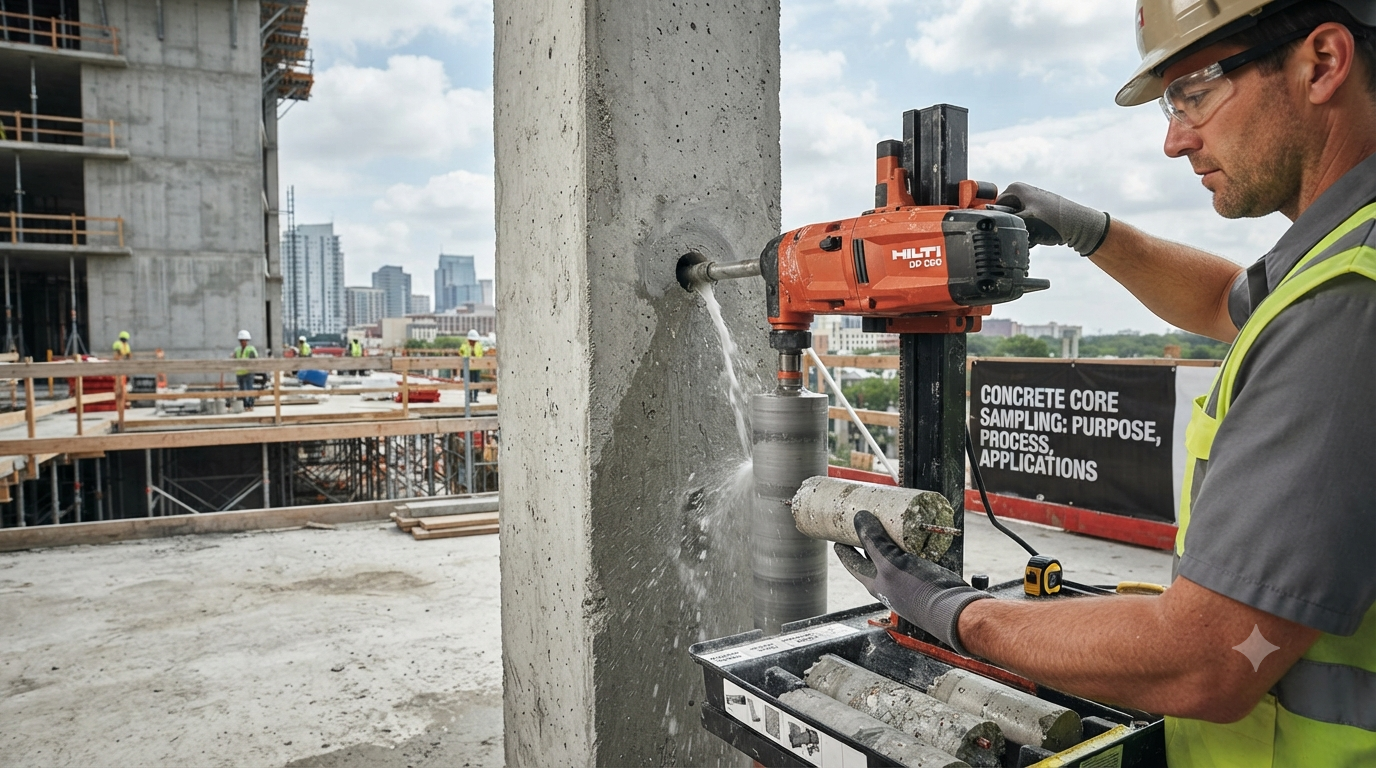
As India continues its unprecedented boom in infrastructure—spanning sprawling metro rail networks, massive highway expansions, and high-rise real estate developments—ensuring structural safety and longevity is paramount. When standard field cube tests show ambiguous results, or when existing structures require safety certification, engineers rely on a definitive, semi-destructive testing method: Concrete Core Sampling.
Brought to you by [email protected], this comprehensive guide delves into the purpose, step-by-step process, and real-world applications of concrete core sampling, heavily anchored in Indian engineering practices and Bureau of Indian Standards (BIS) guidelines.
What is Concrete Core Sampling?
Concrete core sampling involves drilling cylindrical specimens out of hardened concrete structures using a diamond-impregnated rotary cutting tool. Unlike non-destructive testing (NDT) methods like Rebound Hammer or Ultrasonic Pulse Velocity (UPV)—which only estimate properties indirectly—core sampling extracts actual physical material. This sample can then be visually inspected and laboratory-tested to yield precise metrics regarding in-situ compressive strength, density, and internal composition.
The Core Purpose: Why Do We Need Core Sampling?
In the lifecycle of a construction project, uncertainties can arise due to poor curing, honeycombing, or substandard site-mixed concrete. The core test serves several critical functions:
-
Evaluating In-Situ Compressive Strength: When standard site-cured concrete cubes fail to meet target characteristic strengths ($f_{ck}$), core tests act as a supreme court to evaluate actual structural capacity.
-
Investigating Structural Distress: Following events like accidental fires, chemical attacks, or visible structural cracking, cores help determine the depth and extent of damage.
-
Validating Non-Destructive Tests (NDT): Core samples are frequently used to calibrate and validate UPV and Rebound Hammer readings, reducing statistical uncertainty.
-
Verifying Member Thickness: Especially useful for pavements, retaining walls, and thick slabs where access is restricted to one side.
-
Mandatory Structural Audits: In metropolitan hubs like Mumbai, Delhi, and Bengaluru, municipal corporations mandate structural audits for buildings older than 30 years, where core sampling is often a mandatory diagnostic step.
Governing Standards in India
In India, concrete core extraction and testing cannot be performed arbitrarily. They must strictly comply with national standards:
-
IS 516 (Part 4): 2018: Hardened Concrete – Methods of Test (Part 4: Sampling, Preparing, and Testing of Concrete Cores).
-
IS 456: 2000: Code of Practice for Plain and Reinforced Concrete.
According to IS 456 (Clause 17.5.3), concrete in the member represented by a core test is considered acceptable if the average equivalent cube strength of the cores is at least 85% of the specified grade, with no single core dropping below 75%.
Step-by-Step Process of Concrete Core Sampling
Executing a precise core extraction requires specialized machinery, skilled technicians, and rigorous laboratory preparation.
[Site Selection & NDT Scanning] ➔ [Diamond Core Drilling] ➔ [Sample Labeling & Transport] ➔ [End Preparation & Capping] ➔ [Laboratory Compression Test]
Step 1: Location Selection and Rebar Localization
Before drilling, technicians must avoid cutting through primary reinforcement bars. Utilizing a rebar locator (pachometer) or ground-penetrating radar (GPR), the team maps out steel locations to select spots with minimum rebar interference.
Step 2: Core Drilling
A heavy-duty core drilling rig equipped with an industrial diamond bit—water-cooled to prevent overheating and bit damage—is securely anchored to the concrete surface. The machine extracts a cylindrical specimen, typically with diameters of 50 mm, 75 mm, or 100 mm depending on the maximum size of the coarse aggregate.
Step 3: Extraction, Inspection, and Labeling
Once the core cylinder is retrieved, it is thoroughly examined for internal flaws, honeycombing, segregation, or distribution of aggregates. Each core is logged with its exact coordinates, orientation (vertical vs. horizontal), and depth, then immediately sealed in moisture-retaining bags to preserve its natural moisture state.
Step 4: Laboratory Preparation (Sawing and Capping)
Before testing in a Compression Testing Machine (CTM), the ends of the core must be meticulously prepared:
-
Sawing: The uneven ends are cut using a diamond masonry saw to ensure flat, parallel surfaces perpendicular to the longitudinal axis.
-
Capping/Grinding: High-strength sulfur compound or specialized capping mortar is applied to guarantee uniform load distribution during testing.
Step 5: Compression Testing and Correction Factors
The prepared core is measured for its length-to-diameter ($L/D$) ratio. Because core height often deviates from standard cube dimensions, correction factors specified under IS codes are applied to convert the measured core strength into an equivalent standard cube compressive strength.
Real-World Applications and Indian Examples
To understand the practical impact of core sampling, consider these landmark scenarios across India:
1. High-Rise Residential Towers in Mumbai and Noida
In densely populated urban clusters, high-rise construction moves at a rapid pace. During routine quality audits for a 40-story residential tower, lower-floor column cubes showed lower-than-expected 28-day strengths. Core sampling was deployed across critical load-bearing columns. The lab results confirmed that due to intensive summer heat curing lapses, surface layers suffered, but the interior core concrete achieved 92% of the M35 design strength, averting expensive demolition and validating structural safety with localized retrofitting.
2. National Highway and Expressway Projects (NHAI)
The National Highways Authority of India (NHAI) mandates rigorous quality control for rigid pavement structures. On stretches of major corridors like the Delhi-Mumbai Expressway, core cutting is regularly performed on freshly laid Pavement Quality Concrete (PQC). Inspectors extract 100mm cores to verify slab thickness, air void percentages, and flexural/compressive strength conformity before clearing contractor payments.
3. Metro Rail Infrastructure (Chennai & Bengaluru Metro)
Underground tunneling and elevated viaduct segments in metro projects require absolute precision. Core samples extracted from station box walls and pier caps help engineers verify high-performance concrete grades (such as M50 and M60) designed to withstand heavy dynamic loads and high vibration stress.
Frequently Asked Questions (PAA)
What is the purpose of concrete core sampling?
The primary purpose is to assess the true in-situ compressive strength, structural integrity, homogeneity, and internal condition (such as voids or honeycombing) of hardened concrete structures.
How is a concrete core test performed according to Indian Standards?
It is performed using a rotary diamond drill rig adhering to IS 516 (Part 4) specifications. The extracted sample undergoes end preparation, length-to-diameter ratio calculation, and is tested in a CTM to determine equivalent compressive strength.
What is the acceptance criteria for concrete core strength as per IS 456?
As per IS 456:2000, concrete represented by core tests is deemed acceptable if the average equivalent cube strength is equal to or greater than 85% of the specified characteristic strength, with no single core falling below 75%.
Can core sampling weaken a concrete structure?
When executed by professionals at calculated, low-stress structural points (away from maximum bending moment zones) and subsequently backfilled with high-strength non-shrink grout, core sampling causes negligible to zero structural compromise.
Conclusion
Concrete core sampling remains an irreplaceable diagnostic tool in modern civil engineering. It bridges the gap between theoretical mix designs and physical site realities, ensuring that Indian infrastructure stands strong, safe, and resilient against the test of time.
For professional core cutting, testing, and comprehensive structural audit services compliant with all BIS standards, reach out to industry experts at [email protected] to secure your construction projects today.
Target-Related Searches:
-
Concrete core testing procedure as per IS codes
-
Core cutting and testing services in India
-
Non-destructive vs destructive testing of concrete structures
-
Compressive strength of concrete core calculation
-
Structural audit building guidelines India
People Also Ask (PAA):
-
What is the purpose of concrete core sampling?
-
How is a concrete core test performed according to Indian Standards?
-
What is the acceptance criteria for concrete core strength as per IS 456?
-
Can core sampling weaken a concrete structure?