
Introduction
India is witnessing an unprecedented boom in infrastructure development. From sprawling high-rise residential complexes in Mumbai and Gurgaon to massive metro rail networks across Delhi, Bengaluru, and Chennai, the pace of construction is staggering. However, rapid growth brings immense responsibility regarding structural safety and longevity.
How do structural engineers verify that the hardened concrete inside a newly cast bridge pier or a multi-story tower actually meets the design strength promised on paper? While standard cube tests cast during construction provide a general guideline, they do not always reflect the true in-situ conditions of the structure. This is where concrete core testing becomes indispensable.
As a semi-destructive testing method, concrete core testing bridges the gap between absolute visual inspection and complete structural failure analysis. By extracting cylindrical samples directly from structural members, engineers can accurately evaluate compressive strength, density, and internal integrity. For expert execution and reliable evaluation, professionals trust specialized service providers like [email protected] to deliver precision core extraction and diagnostic insights.
What is Concrete Core Testing?
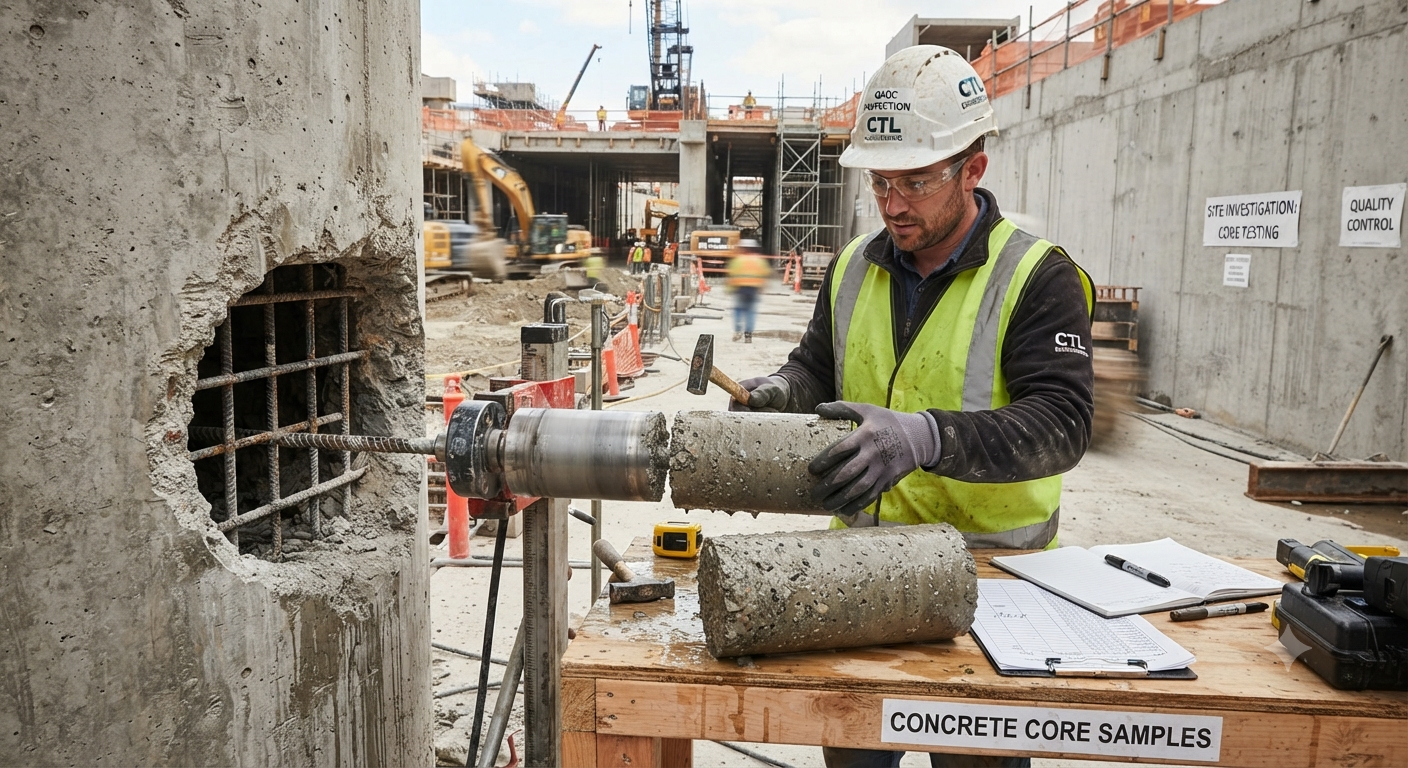
Concrete core testing is a semi-destructive testing (SDT) technique used to assess the structural integrity, homogeneity, and in-place compressive strength of hardened concrete. The process involves drilling a cylindrical specimen—known as a core—out of an existing concrete structure using a diamond-impregnated core-cutting bit.
Unlike non-destructive techniques (NDT) such as rebound hammer tests or ultrasonic pulse velocity (UPV) tests—which only measure surface hardness or pulse transmission—core testing physically retrieves a sample of the actual material. This sample undergoes rigorous laboratory testing, providing direct, quantifiable data on the physical and mechanical properties of the concrete.
Why is Concrete Core Testing Necessary in Indian Construction?
Construction sites across India face diverse environmental challenges, ranging from extreme summer heat in Rajasthan to heavy monsoon downpours in coastal regions like Mumbai and Kerala. These conditions, combined with variations in material quality, workmanship, and curing practices, can lead to discrepancies between designed and actual concrete strengths.
Core testing is typically mandated in several critical scenarios:
-
Low Cube Test Results: If standard concrete cubes cast during construction fail to meet the specified characteristic compressive strength ($f_{ck}$), core testing is used to verify whether the actual structural member is deficient.
-
Suspected Poor Workmanship: Issues like honeycombing, segregation, improper vibration, or inadequate curing can compromise structural strength.
-
Deterioration Over Time: Older buildings, heritage structures, and bridges experiencing environmental degradation, carbonation, or reinforcement corrosion require structural audits.
-
Unauthorized Modifications: When commercial or residential buildings undergo structural changes, core testing helps determine the load-bearing capacity of existing columns and beams.
-
Post-Disaster Assessment: Following earthquakes, fires, or accidental impacts, core testing evaluates the residual strength of affected members.
The Indian Standards Framework for Core Testing
In India, testing methodologies are strictly governed by the Bureau of Indian Standards (BIS). Ensuring compliance with these standards is critical for legal, safety, and contractual purposes.
Key Indian Standards
-
IS 516 (Part 5 / Relevant Sections): Outlines methods of test for strength of concrete, including the extraction, preparation, and testing of drilled cores.
-
IS 456: The primary code of practice for plain and reinforced concrete, which provides guidelines on interpreting core test results and acceptance criteria.
-
IS 13311 (Part 1 & 2): Covers non-destructive testing of concrete, which is often used in conjunction with core testing to map out distressed areas before drilling.
According to standard practices, when core test results are evaluated, the in-situ concrete strength is considered acceptable if the average compressive strength of the cores is at least 85% of the specified characteristic strength, with no single core falling below 75%.
Step-by-Step Procedure of Concrete Core Testing
Executing a core test requires meticulous planning, specialized machinery, and experienced operators. Here is how professional teams execute the process:
1. Planning and Location Selection
Before drilling, structural drawings are reviewed, and NDT techniques (like cover meter surveys or UPV) are deployed to locate internal steel reinforcement. Drilling through main rebars weakens the structure and damages the core cutting bit. Locations with minimum stress concentration are chosen.
2. Core Extraction
A heavy-duty, machine-mounted diamond core drill rig is securely anchored to the concrete surface. Water is continuously pumped to cool the diamond bit and suppress dust. Standard core diameters are typically 100 mm or 150 mm, depending on the maximum size of the coarse aggregate used in the mix.
3. Sample Preparation and Capping
Once extracted, the core sample is labeled, logged, and transported to the laboratory. Technicians inspect the core for internal voids, cracks, or embedded steel. The ends of the core are saw-cut to achieve a smooth, uniform length-to-diameter ratio (typically a $L/D$ ratio of 2.0, or adjusted using standard correction factors if shorter).
4. Laboratory Testing
The prepared core is tested in a Compression Testing Machine (CTM) under a controlled rate of loading until failure. The ultimate load is recorded, and the compressive strength is calculated. Additional tests, such as density measurement and petrographic analysis, can also be performed.
Case Study Application in Indian Infrastructure
Consider a newly constructed flyover project in an urban Indian metropolis. During routine quality audits, a batch of concrete test cubes for a primary pier showed an unusually low compressive strength of 22 MPa against a required design grade of M35.
Tearing down the pier was economically and logistically impossible. Instead, project authorities engaged specialists to perform a concrete core investigation.
-
Action: Technicians extracted six core samples from different heights of the pier.
-
Findings: Laboratory analysis revealed that while the outer surface layer had minor compaction issues due to congested reinforcement, the core interior showed an average equivalent cube strength of 34.2 MPa—well within the acceptable tolerance margin specified in IS 456.
-
Outcome: The structure was certified safe, saving the contractor crores of rupees in demolition costs while ensuring absolute public safety. For complex investigations like this, collaborating with trusted experts via [email protected] ensures defensible, accurate engineering data.
Advantages and Limitations of Concrete Core Testing
Advantages
-
High Accuracy: Provides direct, empirical evidence of actual in-place concrete strength rather than indirect estimates.
-
Definitive Dispute Resolution: Acts as legal and technical proof in contractual disputes between builders, clients, and municipal authorities.
-
Multi-Parameter Analysis: Allows evaluation of density, permeability, and microstructural composition alongside strength.
Limitations
-
Semi-Destructive Nature: Leaves a small cylindrical hole that must be carefully filled with non-shrink, high-strength micro-concrete or epoxy grout.
-
Cost and Time: More labor-intensive and expensive than rapid NDT methods.
-
Rebar Interference: Careless drilling can nick steel reinforcement, requiring careful pre-drilling scanning.
People Also Ask (FAQs)
Q1: What is the minimum compressive strength required for concrete core acceptance in India?
As per Indian Standards (IS 456), the concrete in the member represented by a core test is considered acceptable if the average equivalent cube strength of the cores is equal to at least 85% of the characteristic strength of the grade of concrete specified, and no individual core has a strength less than 75% of that specified value.
Q2: Does core cutting weaken the concrete structure?
When performed at designated structural locations away from high-stress zones and by avoiding main reinforcement bars, core cutting does not compromise structural integrity. The extracted core holes are promptly patched using high-strength non-shrink repair mortar.
Q3: What is the ideal diameter for a concrete core sample?
The diameter of the core depends on the maximum size of the aggregate used in the mix. Typically, core diameters range between 100 mm and 150 mm. According to standard guidelines, the core diameter should be at least three times the maximum nominal size of the coarse aggregate.
Conclusion
Concrete core testing remains the ultimate benchmark for investigating construction quality, diagnosing structural distress, and verifying safety compliance in India's booming infrastructure landscape. By combining scientific precision with adherence to Bureau of Indian Standards (BIS), engineers can make informed, data-driven decisions that safeguard buildings and bridges for decades to come.
For professional core cutting, structural auditing, and concrete testing inquiries, reach out to industry experts at [email protected] to ensure your projects meet the highest standards of safety, quality, and durability.