
Introduction: The Hidden Lifeline of India’s Urban Architecture
Across India’s bustling metropolises—from the high-rise commercial hubs of Mumbai and Gurugram to the heritage structures of Kolkata and Chennai—skyscrapers and residential complexes form the backbone of the modern economy. Yet, concrete is not immortal. Environmental pollution, cyclic weathering, carbonation, chemical attacks, and aging infrastructure gradually weaken the structural integrity of buildings.
When a building begins to show signs of structural distress, such as surface spalling, rusting reinforcement bars, or structural tilting, structural engineers cannot simply guess its internal strength. They need hard, empirical data. This is where Concrete Core Testing steps in.
As a premier service provider in this domain ([email protected]), we explore the ins and outs of concrete core testing for existing buildings, focusing on Indian engineering standards, methodologies, practical applications, and real-world case studies.
What is Concrete Core Testing?
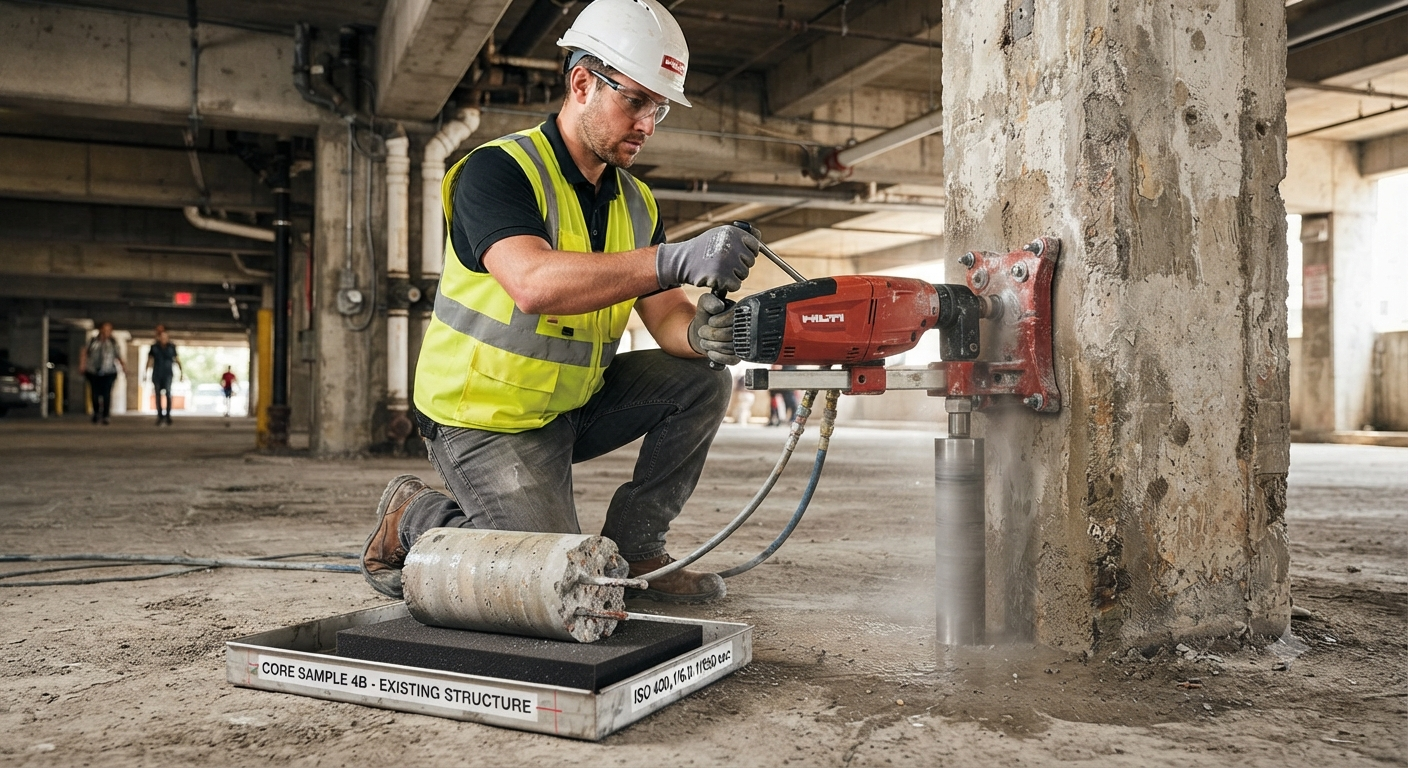
Concrete core testing is a semi-destructive testing (SDT) method used to evaluate the in-situ compressive strength, density, and overall structural quality of hardened concrete.
Unlike Non-Destructive Testing (NDT) techniques like Rebound Hammer or Ultrasonic Pulse Velocity (UPV) tests—which only measure surface properties or provide indirect estimations—core cutting extracts an actual cylindrical specimen of concrete from the structural element (such as columns, beams, slabs, or footings). This cylindrical sample is then brought to a National Accreditation Board for Testing and Calibration Laboratories (NABL) accredited laboratory and subjected to a crushing load in a compression testing machine.
Target-Related Searches & People Also Ask (PAA)
To make this guide comprehensive, let us address the exact queries structural engineers, property developers, and homeowners search for:
-
Target-Related Searches: Core cutting and testing services in India, IS code for core test of concrete, compressive strength core test calculation, structural audit concrete core extraction, cost of core cutting per inch in India, NDT vs core test.
-
People Also Ask (PAA):
-
What is the minimum diameter of a concrete core sample?
-
How many core samples are required per floor?
-
Does core cutting weaken the building structure?
-
What is the acceptance criteria for concrete core strength as per IS codes?
-
Why is Core Testing Essential for Existing Buildings in India?
India’s diverse climatic zones—ranging from the humid coastal air of Mumbai and Chennai to the extreme thermal variations of Delhi and Rajasthan—take a severe toll on concrete structures. Core testing becomes indispensable in several scenarios:
1. Aging Infrastructure and Structural Audits
Municipal corporations across major Indian cities (such as the BMC in Mumbai or MCD in Delhi) mandate periodic structural audits for buildings older than 15 to 30 years. Core testing validates whether the aging concrete retains its designed characteristic strength ($f_{ck}$).
2. Suspected Substandard Construction
In cases of contractor malpractice, improper curing during construction, or the use of sub-standard raw materials (such as unwashed river sand or low-grade cement), core tests reveal the true internal quality of the structure.
3. Fire Damage Assessment
When a building suffers a fire breakout, high temperatures alter the crystalline structure of cement gel and weaken aggregate bonds. Core testing helps structural engineers determine the depth of thermal damage and decide whether to demolish or retrofit.
4. Structural Modifications and Vertical Extensions
If a society or commercial owner plans to add extra floors to an existing building, core testing ensures that the foundation and load-bearing columns can handle the augmented dead and live loads.
Indian Standards (IS Codes) Governing Concrete Core Testing
In India, testing procedures are strictly regulated by the Bureau of Indian Standards (BIS) to maintain uniformity, accuracy, and safety. The primary codes governing this process include:
-
IS 516 (Part 4 / Relevant Sections): Method of test for strength of concrete (covering the preparation, curing, and testing of bored cores).
-
IS 456: Plain and Reinforced Concrete - Code of Practice (provides guidelines on accepting core test results).
-
IS 13311 (Part 1 & 2): Non-Destructive Testing of Concrete (often used alongside core cutting for correlation).
According to Indian Standards, the core diameter should ideally be at least three times the maximum nominal size of the coarse aggregate used in the concrete, and typically not less than $75\text{ mm}$ (though $100\text{ mm}$ or $150\text{ mm}$ cores are preferred for accurate compressive strength evaluation).
The Step-by-Step Procedure of Concrete Core Testing
Executing a core cutting and testing operation requires precision engineering, specialized machinery, and adherence to safety protocols. Here is how experts at [email protected] perform the procedure:
Step 1: Structural Mapping & Rebar Localization
Before drilling, technicians use an electromagnetic cover meter or pachometer to scan the concrete element. This step ensures that the diamond drill bit does not cut through critical primary reinforcement bars, which could compromise structural safety.
Step 2: Core Extraction Using Diamond Drill Rigs
A heavy-duty, water-cooled diamond core drilling machine is securely anchored to the concrete surface. Water is pumped continuously to cool the diamond bit and suppress dust. The machine extracts a cylindrical specimen (core) smoothly without causing shock or micro-cracks to the surrounding concrete.
Step 3: Core Handling, Labeling, and Patching
-
The extracted core is labeled meticulously with location details, orientation, and depth.
-
The core hole left in the structure is immediately backfilled using high-strength, non-shrink structural micro-concrete or epoxy mortar to restore structural integrity.
Step 4: Laboratory Preparation and Testing
-
Capping or Grinding: The ends of the core cylinder are ground flat and parallel to ensure even load distribution during testing.
-
Moisture Conditioning: Depending on testing standards, cores are typically tested in a saturated or air-dried state.
-
Crushing: The core is placed in a Universal Testing Machine (UTM) until failure, and the ultimate crushing load is recorded.
Calculating and Interpreting Core Strength as per IS 456
Translating the raw crushing strength of a core into the actual in-situ cube strength ($f_{ck}$) requires mathematical correction factors. A core cylinder behaves differently than a standard concrete cube.
The equivalent cube strength is calculated by factoring in:
-
Length-to-Diameter (L/D) Ratio: Standard test cores have an L/D ratio of $2:0$. If the ratio differs, correction multipliers are applied as per IS 516.
-
Diameter Effect: Smaller cores tend to show higher variability.
-
Presence of Reinforcement: If a core contains a steel bar running through it, specialized mathematical adjustments are applied to neutralize the steel's contribution.
As a rule of thumb under IS 456, concrete in a member is considered acceptable if the average equivalent cube strength of the cores is at least 85% of the specified characteristic strength ($f_{ck}$), with no single core falling below 75%.
Real-World Indian Case Studies
Case Study 1: Commercial Complex Retrofitting in Gurugram, Haryana
-
The Problem: A 12-year-old commercial IT park in Cyber City, Gurugram, planned to install heavy server rooms and backup diesel generators on the upper intermediate floors. The facility management team needed proof that the floor slabs could bear the concentrated dynamic loads.
-
The Execution: Our engineering division deployed diamond core cutting rigs across designated column-beam junctions. A total of 24 cores were extracted.
-
The Finding: Laboratory results indicated an average compressive strength of $M28$ grade against the originally designed $M25$ grade, confirming sound structural health. However, two localized beams showed carbonation depths requiring protective anti-corrosion coating. The client successfully proceeded with their upgrade safely.
Case Study 2: Heritage Building Assessment in Kolkata, West Bengal
-
The Problem: A century-old heritage institutional building managed by a public trust required a mandatory structural safety audit following heavy monsoon water seepage.
-
The Execution: Because traditional hammering or heavy machinery could damage heritage brickwork and lime-surki mortar matrices, delicate core drilling was executed under strict supervision.
-
The Finding: The core samples revealed deep moisture ingress and degradation of internal lime-mortar bonding. The data enabled structural consultants to design a lime-based micro-garth retrofitting plan rather than tearing down the historic edifice.
Advantages and Limitations of Concrete Core Testing
| Advantages | Limitations |
| Direct Measurement: Provides exact, undisputed compressive strength values. | Semi-Destructive: Leaves a small hole that requires professional patching. |
| Material Quality Check: Exposes internal voids, honeycombing, and segregation. | Access Constraints: Difficult to execute in congested reinforcement nodes or tight spaces. |
| Legal Validity: Highly trusted by municipal authorities, courts, and insurance agencies. | Cost & Time: More expensive and time-consuming than basic NDT methods. |
Factors Influencing the Cost of Core Testing in India
When budgeting for a structural audit, clients often inquire about pricing. The cost of concrete core testing in India depends on several variables:
-
Number of Cores: Bulk testing reduces the per-sample cost.
-
Location and Height: Core cutting on high-rise exterior facades requires specialized scaffolding or rope-access technicians, influencing labor charges.
-
Grade of Concrete & Reinforcement Density: Heavily reinforced high-strength concrete ($M40$ and above) consumes more diamond bits and time.
-
Laboratory Testing Fees: NABL certified crush tests and petrographic analysis add to the overall billing.
For precise estimates tailored to your project requirements, reach out directly to our technical team at [email protected].
Best Practices for Building Owners and Facility Managers
If your building is slated for a structural audit involving core testing, keep these pointers in mind:
-
Hire Certified Professionals: Never rely on local uncertified masonry contractors for core cutting; structural miscalculations or severing structural rebars can cause localized collapses.
-
Combine with NDT: For optimal results, use core testing to calibrate Non-Destructive Testing (such as UPV and Rebound Hammer tests) across the entire building footprint.
-
Ensure Timely Patching: Ensure that all extracted core holes are refilled using high-performance expansive grout within 24 hours to prevent moisture ingress.
Conclusion
Concrete core testing is an indispensable diagnostic tool for safeguarding India's urban landscape. By cutting through guesswork and revealing the true internal caliber of structures, it empowers engineers to make life-saving decisions regarding building retrofitting, repair, and longevity.
Whether you manage a residential housing society in Bengaluru, a commercial facility in Pune, or an industrial warehouse in Chennai, proactive testing prevents catastrophic failures. For professional, NABL-compliant core cutting and structural auditing services, trust the experts at [email protected]. Protect your investment, secure your occupants, and build on a foundation of proven facts.