
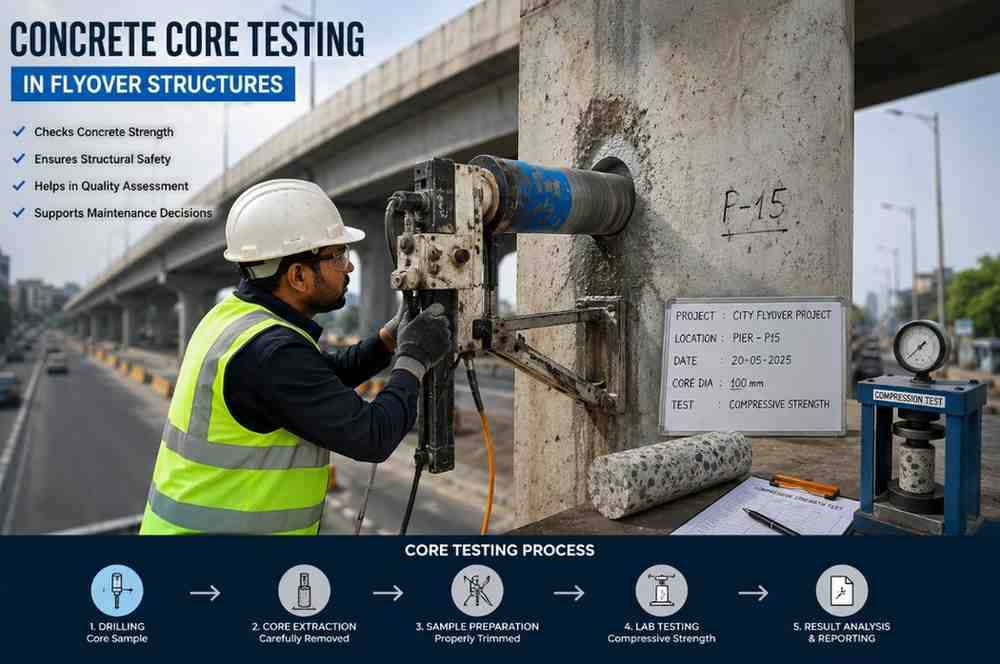
Flyover structures serve as the backbone of modern urban transit, mitigating congestion and ensuring continuous traffic movement over busy intersections. However, due to continuous dynamic loading, harsh weather conditions, and environmental factors, these massive concrete structures experience gradual degradation over time. Ensuring their structural health requires rigorous quality control and diagnostic evaluations. Among the various evaluation methods available, concrete core testing stands out as the most definitive and reliable technique for assessing internal structural strength.
Brought to you by [email protected], this comprehensive guide explores the critical importance, methodologies, and applications of concrete core testing in flyover structures.
1. Understanding Concrete Core Testing in Flyover Structures
Concrete core testing is a semi-destructive testing (SDT) method used to evaluate the in-situ compressive strength, density, and overall quality of hardened concrete in existing structures. While non-destructive testing (NDT) methods like rebound hammer tests or ultrasonic pulse velocity (UPV) provide surface-level estimates, core testing physically extracts a cylindrical specimen from the structural element—such as a flyover pier cap, girder, or deck slab—to deliver precise laboratory-verified data.
Why Flyovers Require Specialized Testing
Flyovers endure complex stress cycles, including heavy vehicular loads, thermal expansions, vibrations, and potential chemical attacks like carbonation or chloride ingress. Over decades of service, micro-cracks or internal honeycombing can compromise safety margins. Core testing offers direct insight into whether the concrete inside the structure matches the specified design grade.
2. The Core Cutting Procedure for Bridges and Flyovers
The execution of core cutting on critical infrastructure like flyovers demands high precision, specialized diamond-tipped core drilling equipment, and strict adherence to engineering standards (such as IS 516 or ASTM C42).
-
Location Identification: Structural engineers locate safe extraction points using Ground Penetrating Radar (GPR) or bar locators to ensure that the diamond drill bit does not sever vital internal reinforcement steel bars (rebar).
-
Core Drilling: A rotary core drill fitted with an industrial diamond barrel bit cuts into the concrete member, using water cooling to prevent thermal damage to the sample.
-
Specimen Extraction: Cylindrical core samples—typically having a diameter-to-length ratio suited for testing—are carefully extracted.
-
Laboratory Preparation and Testing: The ends of the core are capped or ground flat before being placed in a compression testing machine to determine the actual compressive strength.
-
Hole Restoration: The core hole is immediately backfilled with high-strength, non-shrink structural grout to restore the element's integrity.
3. Key Parameters Evaluated Through Core Testing
Concrete core testing provides vital quantitative metrics that guide structural audits and rehabilitation strategies:
-
Compressive Strength: Establishes the real load-bearing capacity of the concrete in megapascals (MPa).
-
Density and Porosity: Helps identify whether the concrete mix suffered from poor compaction or high void content during construction.
-
Depth of Carbonation: Chemical tests applied to fresh core cross-sections reveal how deeply carbon dioxide has penetrated, signaling risks of rebar corrosion.
-
Petrographic Analysis: Detailed microscopic examination identifies aggregate-paste bonding issues, alkali-silica reaction (ASR) distress, or micro-cracking patterns.
4. When is Core Testing Mandatory for Flyovers?
Bridge management authorities and civil engineers typically mandate core testing under specific scenarios:
-
Quality Disputes: Discrepancies or doubts regarding the cube test results during initial flyover construction.
-
Pre-Purchase or Structural Audits: Assessing older flyovers nearing or exceeding their designed service lifespan.
-
Post-Disaster Evaluation: Checking structural stability following severe accidents, vehicle impacts, or minor seismic events.
-
Retrofitting and Widening Projects: Determining whether existing piers and decks can safely bear additional loads from lane expansions.
Conclusion
The structural safety of urban transportation corridors relies heavily on proactive maintenance and accurate diagnostic assessments. Concrete core testing remains the gold standard for verifying the true inner health of flyover infrastructure, bridging the gap between assumptions and engineering reality.
For expert advice, professional core cutting services, and comprehensive structural testing solutions, connect with industry specialists at [email protected].