
Related Target Searches
-
Concrete core cutting and testing price in India
-
IS 516 part 4 core compressive strength calculation
-
Structural audit guidelines for Mumbai and Delhi buildings
-
Destructive vs non-destructive testing for old RCC structures
People Also Ask (PAA)
-
What is the procedure for concrete core testing as per Indian standards?
-
When is core cutting required during a structural audit?
-
How does core testing differ from rebound hammer tests?
-
What is the minimum diameter and length-to-diameter ratio for a concrete core sample?
Introduction to Structural Health Monitoring in India
India’s booming urbanization, infrastructure development, and aging metropolitan landscapes—ranging from colonial-era heritage buildings in Mumbai and Kolkata to rapid high-rise constructions in Delhi-NCR, Bengaluru, and Hyderabad—demand rigorous structural evaluations. Concrete is the backbone of modern civil engineering, but over time, environmental exposure, carbonation, chloride attack, seismic activity, and overloading cause degradation.
When non-destructive evaluations (NDT) present ambiguous results or highlight localized distress, engineers rely on the definitive diagnostic method: Concrete Core Testing. Offered expertly by specialized entities like [email protected], core testing bridges the gap between estimation and absolute physical certainty regarding a structure's in-situ load-bearing capacity.
What is Concrete Core Testing?
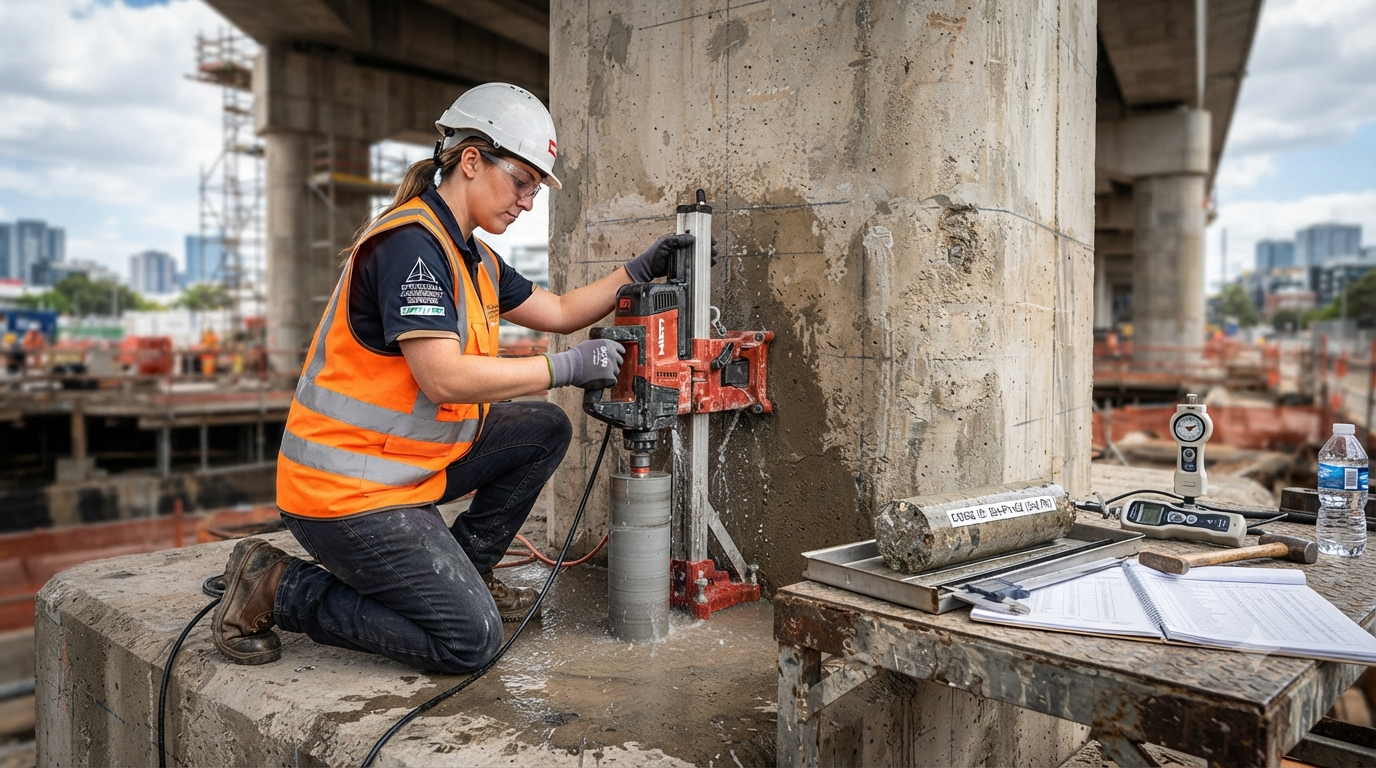
Concrete core testing is a semi-destructive testing (SDT) technique that involves drilling cylindrical specimens out of hardened concrete structural elements (such as columns, beams, slabs, shear walls, and bridge piers) using a diamond-impregnated core drill bit.
Unlike purely non-destructive methods like the Rebound Hammer or Ultrasonic Pulse Velocity (UPV) tests—which only measure surface hardness or pulse propagation times—core testing extracts an actual physical sample of the concrete matrix. This sample is then prepared, conditioned, and crushed in a laboratory compression testing machine to determine its true in-situ compressive strength (Gangele, 2024).
Why Core Testing is Critical for Indian Structures
In the Indian construction ecosystem, structural audits are legally mandated by municipal corporations (such as the Brihanmumbai Municipal Corporation under the Mumbai Municipal Corporation Act) for buildings older than 30 years (Bhargava, n.d.). Core testing becomes indispensable in several scenarios:
-
Low NDT Correlation: When Schmidt rebound hammer or UPV tests yield doubtful or erratic results due to carbonated surface layers or high moisture content.
-
Suspected Substandard Construction: Resolving disputes regarding low cube strengths reported during initial construction phases.
-
Post-Disaster Evaluation: Assessing structural integrity following fires, earthquakes, or severe chemical/industrial exposure.
-
Adaptive Reuse and Vertical Extension: Verifying whether an existing low-rise structure can safely bear additional floors.
Regulatory Framework & Indian Standards (IS Codes)
To maintain uniformity, precision, and safety, Indian engineers strictly adhere to Bureau of Indian Standards (BIS) specifications when planning, extracting, and testing concrete cores:
-
IS 456:2000: Code of practice for plain and reinforced concrete, dictating chemical limits (chlorides, sulfates, and pH thresholds).
-
IS 516 (Part 4): 2018 / IS 516 (Part 5/Sec 1): 2018: Governs the testing of hardened concrete, including methods for extracting, preparing, and testing core specimens for compressive strength (Agrawal & Deulkar, 2024).
-
IS 13311 (Part 1 & 2): 1992: Standard guidelines for ultrasonic pulse velocity and rebound hammer testing used in tandem with core extraction.
The Step-by-Step Core Testing Methodology
Executing a precise core test requires meticulous planning to avoid damaging the internal steel reinforcement matrix while capturing a representative sample.
1. Locating Reinforcement (Rebar Detection)
Before drilling, technicians use an electromagnetic cover meter or Ground Penetrating Radar (GPR) to scan the member. This ensures the diamond core bit does not sever primary reinforcement bars, which would compromise both the structure and the integrity of the test sample.
2. Core Extraction
Using specialized hydraulic or electric core-cutting rigs equipped with water-cooled diamond bits, cylindrical cores of standard diameters (typically 100 mm or 150 mm, adhering to the rule relative to maximum aggregate size) are extracted (Ivanchev, 2023).
3. Sample Preparation and Conditioning
The extracted cores undergo rigorous trimming using a diamond saw to achieve smooth, parallel end faces. Per Indian Standards, the length-to-diameter (L/D) ratio is adjusted or accounted for through standard correction factors. Samples are then capped with high-strength sulfur or high-alumina gypsum plaster and submerged in water at for 48 hours prior to testing (Agrawal & Deulkar, 2024).
4. Laboratory Compression Testing
The conditioned core is placed in a calibrated digital compression testing machine (typically of 2000 kN to 3000 kN capacity). Load is applied continuously and without shock until structural failure occurs, yielding the ultimate crushing load (F).
Calculating and Interpreting In-Situ Strength
The equivalent cube compressive strength (fck,eq) is calculated using the formula:
Where:
-
Pmax = Maximum applied load at failure
-
Ac = Cross-sectional area of the core
As per Indian practice, core strength values are generally expected to be at least 75% to 85% of the standard characteristic cube strength designed for the structure, accounting for stress redistribution and localized variations (Bhargava, n.d.).
Real-World Indian Applications and Case Studies
-
Bhakra Dam Assessment: Major national assets, such as the 225.5-meter-high Bhakra Dam across the Sutlej River in Himachal Pradesh, utilize concrete core sampling coupled with petrographic analysis and Scanning Electron Microscopy (SEM) to monitor long-term matrix durability against alkali-aggregate reactions (AAR) and ettringite formation (Patel, 2021).
-
Aging Residential Co-operatives in Mumbai: Thousands of residential cooperative housing societies in Mumbai undergo structural audits annually. Combining Rebound Hammer mapping with selective core extraction helps structural consultants differentiate between superficial plaster degradation and deep-seated concrete carbonation (Bhargava, n.d.).
-
Highway and Bridge Infrastructure: Across National Highways (NHAI) and state expressways, core extraction from RCC piers, abutments, and bridge girders ensures structural compliance following heavy freight loading or environmental weathering (Agrawal & Deulkar, 2024).
Limitations and Best Practices
While concrete core testing is exceptionally accurate, it is categorized as semi-destructive because it leaves a small cylindrical void. To manage this:
-
Strategic Location Selection: Cores should always be drilled in low-stress zones (such as near the neutral axis of beams or uncritical sections of columns) rather than high-moment regions.
-
Professional Patching: Voids left by core extraction must immediately be filled using non-shrink, high-strength structural epoxy mortars or micro-concrete grouts matching the original grade.
-
Expert Execution: Partnering with accredited testing professionals ensures safety, compliance with IS codes, and actionable diagnostic reports.
Conclusion
Structural health assessment is not merely a regulatory formality in India; it is a critical investment in public safety and asset longevity. While non-destructive testing provides a preliminary overview, concrete core testing delivers the definitive empirical evidence required for accurate load ratings, seismic retrofitting, and rehabilitation.
For reliable, precise, and standards-compliant core cutting and structural testing services across India, consult the experts at [email protected] to secure your structures for generations to come.