
Introduction
Surat's skyline is changing fast. Once known primarily for its textile and diamond trade, the city has become one of Gujarat's fastest-growing urban centers, with high-rise residential towers rising in areas like Vesu, Pal, Adajan, Dumas Road, and City Light. As builders push vertical to meet housing demand, one specialized trade has quietly become essential to almost every stage of construction: concrete cutting.
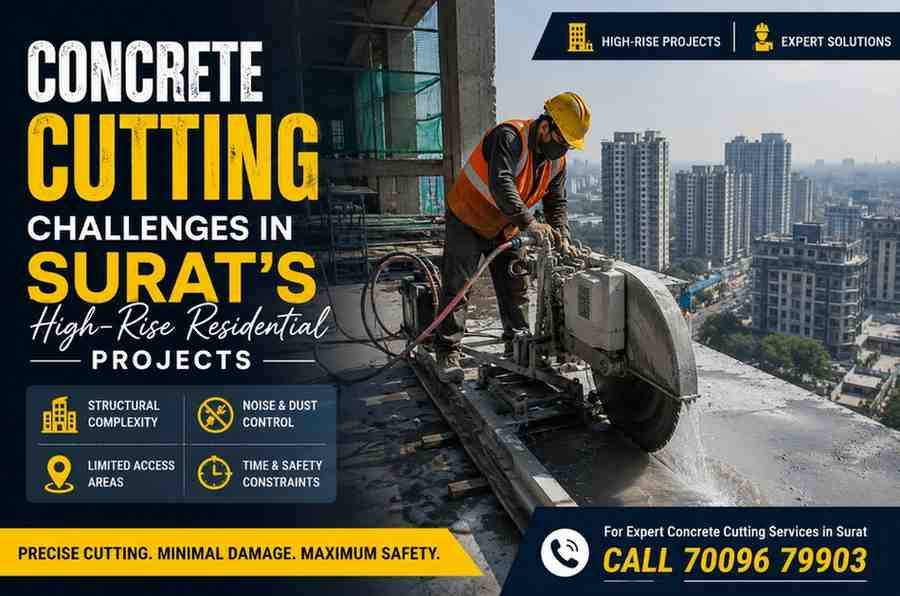
From core drilling for plumbing risers to wall sawing for new openings, and from expansion joint cutting to floor slab modifications, concrete cutting plays a critical role in shaping modern apartment towers. But cutting concrete forty, fifty, or even seventy floors above ground level is nothing like cutting a slab at ground level. It comes with a unique set of engineering, logistical, and safety challenges that contractors in Surat must navigate every single day.
In this blog, we explore the biggest concrete cutting challenges faced in Surat's high-rise residential projects, and how a professional agency like Core Cutting India ([email protected]) helps developers and contractors overcome them.
Why Concrete Cutting Matters in High-Rise Construction
Before diving into the challenges, it helps to understand why concrete cutting is so central to high-rise residential construction:
- MEP installations: Plumbing, electrical conduits, HVAC ducts, and fire-fighting pipelines all require precise openings in RCC slabs and walls.
- Structural modifications: Builders often need to cut expansion joints, create door and window openings, or modify layouts based on late-stage architectural changes.
- Demolition and renovation: Older buildings undergoing redevelopment need controlled demolition without disturbing adjoining structures.
- Elevator shafts and staircases: Precision core cutting is required to create vertical shafts that must align perfectly across dozens of floors.
- Balcony and terrace modifications: Many Surat developers are now offering customizable balcony extensions, which require careful slab cutting.
Given how central this work is, even small errors in execution can lead to costly delays, structural risk, or safety hazards — which is exactly why experienced concrete cutting contractors are in high demand across Surat's construction industry.
Challenge 1: Working at Extreme Heights
The most obvious challenge in high-rise concrete cutting is height itself. Cutting concrete on the 25th or 40th floor of a residential tower is a completely different operation than ground-level work. Wind speeds increase significantly at height, scaffolding and working platforms must be reinforced, and every tool, cable, and piece of equipment has to be transported vertically — often without the benefit of a fully operational elevator system, since many of these towers are still under construction.
Concrete cutting teams must use certified fall-protection systems, secure anchoring points, and specialized lifting mechanisms to move diamond blades, core bits, and water tanks to upper floors. In Surat's hot and humid climate, this also means managing worker fatigue and hydration carefully, since sustained work at height in high temperatures increases the risk of accidents.
Challenge 2: Space Constraints on Live Construction Sites
Unlike a standalone demolition project, high-rise residential construction in Surat is typically a live, multi-trade environment. Concrete cutting crews are working alongside electricians, plumbers, formwork teams, and finishing contractors — often on the same floor, at the same time.
This creates serious space constraints. Diamond cutting machines, core drilling rigs, and slurry management equipment all require dedicated working area, yet floor plates in residential towers are often congested with material stacking, temporary partitions, and other trade activity. Coordinating cutting schedules with the main contractor becomes essential to avoid conflicts, and experienced concrete cutting companies in Surat build detailed floor-by-floor execution plans before work even begins.
Challenge 3: Structural Safety and Load-Bearing Concerns
Cutting into concrete — especially in RCC-framed high-rise buildings — is never a simple mechanical task. Every wall, slab, or beam in a residential tower plays a structural role, and cutting through the wrong section, or cutting too close to embedded reinforcement, can compromise the building's load-bearing capacity.
This is one of the most serious challenges in Surat's high-rise projects, where structural drawings must be studied carefully before any cutting begins. Reputable contractors use ground-penetrating radar (GPR) or rebar scanning tools to detect the exact position of steel reinforcement, post-tension cables, and embedded services before cutting. Skipping this step is one of the most common causes of structural damage or accidental cable strikes on Indian construction sites — something Core Cutting India actively works to prevent through pre-cutting surveys on every project.
Challenge 4: Dust and Debris Control
Concrete cutting generates significant dust, and in a residential tower that may already have families moving in on lower floors while upper floors are still under construction, dust control becomes both a safety and a compliance issue.
Airborne silica dust from dry-cutting concrete is a known respiratory hazard, and Gujarat Pollution Control Board (GPCB) guidelines, along with general construction safety norms, increasingly require contractors to adopt dust suppression measures. In Surat's high-rise projects, this typically means:
- Using wet-cutting techniques wherever possible to suppress dust at the source
- Installing vacuum extraction systems connected directly to cutting equipment
- Sealing off work areas with physical barriers to prevent dust migration into occupied or finished sections
- Providing PPE, including respirators, to all workers involved in cutting operations
Managing slurry runoff from wet-cutting is an added challenge at height, since water and cement slurry must be safely channeled and disposed of without damaging finished floors below or violating drainage regulations.
Challenge 5: Noise Regulations and Resident Sensitivities
Many high-rise residential projects in Surat are phased developments — meaning some towers or floors are already occupied while others are still being built or modified. Concrete cutting is a noisy activity, and local municipal regulations under the Surat Municipal Corporation typically restrict construction noise to specific daytime hours.
Balancing project timelines with these restrictions requires careful scheduling. Contractors often need to plan cutting activities in shorter, more frequent working windows rather than long continuous shifts, which can extend project timelines if not managed efficiently. Clear communication with residents' welfare associations, where applicable, also helps minimize complaints and keeps projects running smoothly.
Challenge 6: Precision Alignment Across Multiple Floors
For elements like elevator shafts, plumbing risers, and electrical service ducts, cutting must be precisely aligned across every single floor of a tower. Even a small deviation of a few centimeters on one floor can cause misalignment issues that cascade upward, leading to costly rework.
This challenge is amplified in Surat's high-rise residential projects because many towers exceed 30-40 floors, and even minor surveying errors compound significantly over that height. Professional concrete cutting teams rely on laser alignment tools, structural drawings cross-checked against as-built conditions, and floor-to-floor verification before finalizing cuts — particularly for core drilling used in vertical service shafts.
Challenge 7: Equipment Logistics and Power Supply
Transporting heavy-duty concrete cutting equipment — including wall saws, wire saws, and core drilling rigs — to upper floors of a building under construction is a logistical challenge in itself. Many high-rise sites in Surat rely on construction hoists or tower cranes for material movement, and cutting equipment must be scheduled into these lifts alongside other essential construction materials.
Power supply is another consideration. Diamond cutting equipment requires stable electrical power, and voltage fluctuations on active construction sites can affect cutting precision and equipment lifespan. Reliable contractors often bring backup generators or voltage stabilizers to ensure consistent performance, particularly during Surat's summer months when power demand across construction sites is at its peak.
Challenge 8: Weather and Seasonal Constraints
Surat experiences a hot semi-arid climate with intense heat from March through June, followed by a monsoon season from June to September. Both extremes create challenges for concrete cutting crews working at height.
During summer, extended outdoor work becomes physically demanding, requiring shaded rest breaks and adjusted work hours. During monsoon season, wet-cutting operations must be managed carefully to avoid excess water accumulation on open floor plates, and safety protocols around scaffolding and open edges become even more critical due to slippery surfaces.
Challenge 9: Compliance with RERA and Safety Standards
Since the implementation of the Real Estate (Regulation and Development) Act (RERA) in Gujarat, residential developers are held to stricter documentation, safety, and quality standards. Any structural modification — including concrete cutting for layout changes — often needs to be documented and, in some cases, approved by the project's structural engineer to ensure compliance doesn't affect the building's occupancy certificate.
This adds an administrative layer to concrete cutting work that experienced contractors must navigate alongside the physical execution of the job. Core Cutting India works closely with site engineers and project management teams to ensure that all cutting work is properly documented, structurally approved, and compliant with local building codes.
How Core Cutting India Solves These Challenges
At Core Cutting India, we specialize in professional concrete cutting, core drilling, and demolition services designed specifically for the demands of high-rise residential construction. Our approach to overcoming the challenges outlined above includes:
- Certified height-safety trained crews equipped for multi-storey residential towers
- Pre-cutting structural surveys using rebar detection to avoid damaging reinforcement or embedded utilities
- Wet-cutting and dust extraction systems to meet environmental and health safety standards
- Detailed scheduling coordination with main contractors to minimize disruption on live sites
- Precision laser-guided alignment for multi-floor service shafts and risers
- Modern, well-maintained equipment including diamond wall saws, wire saws, and core drilling rigs suited for vertical construction environments
Whether it's a 15-floor residential tower in Vesu or a 45-floor luxury project near Dumas Road, our team brings the technical expertise and safety-first approach needed to execute concrete cutting work without compromising structural integrity or project timelines.
Conclusion
As Surat continues its rapid vertical expansion, concrete cutting has evolved from a routine construction task into a specialized discipline requiring engineering knowledge, safety expertise, and careful project coordination. The challenges — from working at extreme heights and managing dust, to ensuring structural safety and regulatory compliance — demand experienced professionals who understand both the technical and practical realities of high-rise residential construction.
For developers and contractors looking for a reliable concrete cutting partner in Surat, working with a specialized team ensures that every cut is precise, every structure remains safe, and every project stays on schedule.
Get in touch with Core Cutting India today at [email protected] to discuss your high-rise concrete cutting requirements.