
Introduction
India's skyline is changing faster than ever. From heritage buildings in old Delhi being retrofitted for modern use, to IT parks in Bengaluru adding new floors, to residential societies in Mumbai and Pune knocking down walls to create open-plan living — structural modification has become a routine part of the country's construction and renovation landscape. At the heart of almost every such project lies one critical, often underestimated process: concrete cutting.
Whether it's creating a new doorway in a load-bearing wall, installing a lift shaft in an existing commercial tower, or cutting an opening for a staircase in a multi-storey apartment, precision concrete cutting determines whether a structural modification project succeeds safely or turns into a costly, dangerous mistake. At Core Cutting India ([email protected]), we work with architects, structural engineers, contractors, and property owners across the country to ensure that every cut is planned, executed, and finished with engineering precision.
This blog explains what concrete cutting during structural modification really involves, the methods used, real Indian examples, safety considerations, and how to choose the right partner for the job.
What Is Concrete Cutting During Structural Modification?
Structural modification refers to any change made to the load-bearing or structural elements of a building — walls, slabs, beams, columns, or foundations — after the original construction is complete. This could be to:
- Add a new door, window, or ventilation opening
- Create space for a staircase, lift shaft, or escalator
- Install new plumbing, electrical, or HVAC ducting through slabs and walls
- Widen an existing opening for accessibility or aesthetic redesign
- Demolish a portion of a structure for extension or reconstruction
- Retrofit a building for seismic strengthening
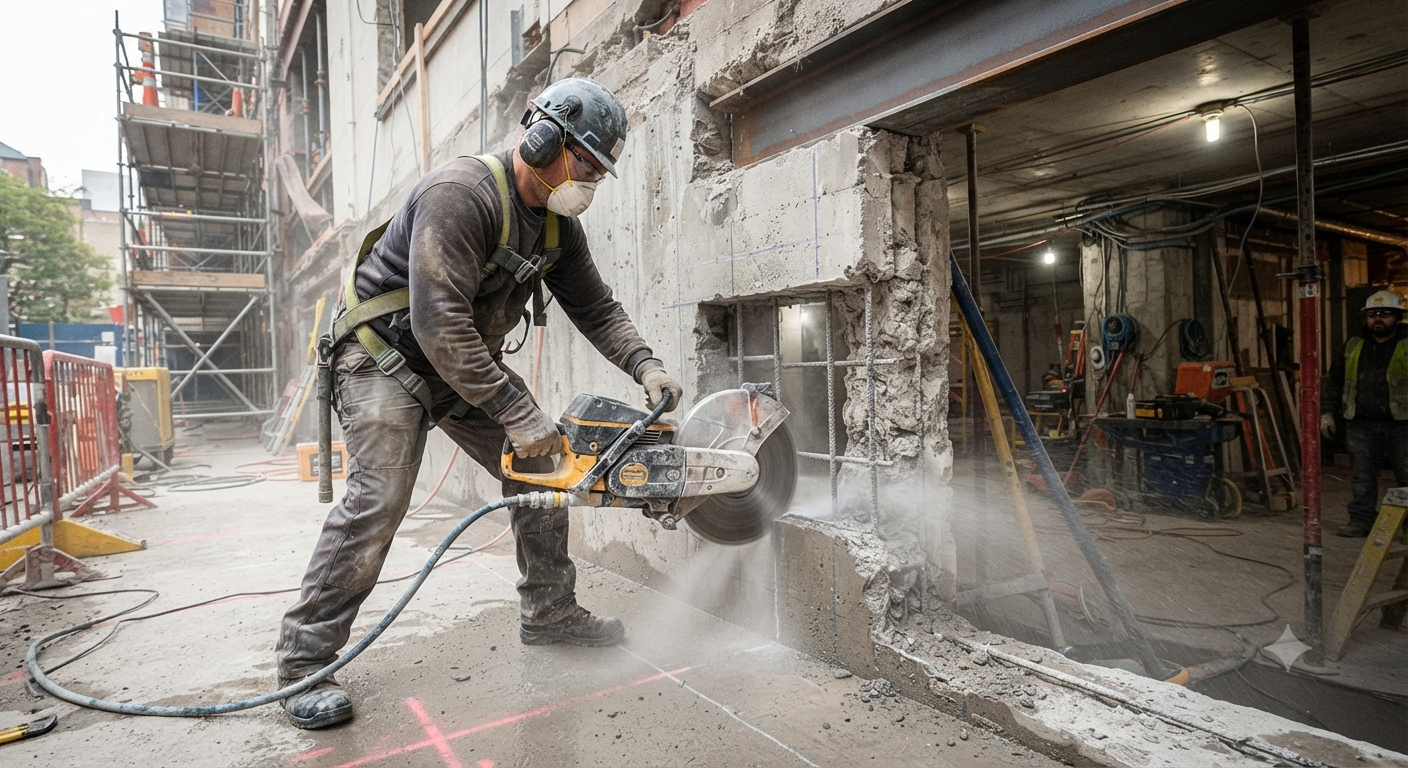
Because reinforced cement concrete (RCC) is extremely hard, dense, and reinforced with steel, ordinary demolition tools like hammers and chisels are unsuitable for controlled modification work. This is where specialised concrete cutting techniques come in — techniques that allow contractors to remove concrete with millimetre-level precision, minimal vibration, low dust, and no damage to the surrounding structure.
Why Precision Matters in Structural Concrete Cutting
Unlike general demolition, structural modification cutting has to respect the integrity of the building that remains standing. A poorly planned cut can:
- Compromise load paths and cause cracking or structural failure
- Sever critical reinforcement bars (rebar) that were meant to be preserved
- Create vibration damage to adjacent finishes, tiles, or neighbouring units
- Trigger unsafe settlement in older buildings, especially heritage structures common in cities like Jaipur, Lucknow, and Kolkata
This is why concrete cutting for structural work is never a "just start drilling" job. It requires a structural assessment, method selection, and often coordination with a structural engineer before a single cut is made.
Common Concrete Cutting Methods Used in India
1. Diamond Wall Sawing
Wall sawing uses a diamond-tipped circular blade mounted on a track to make straight, precise vertical or horizontal cuts through walls, slabs, and beams. This is the most common method used when creating new door openings, window enlargements, or wall removals in RCC-framed buildings.
Indian example: In several Gurugram and Noida high-rise residential towers, wall sawing is regularly used when residents want to merge two adjacent flats into one larger unit — a growing trend in NCR's premium housing market. The technique allows a clean opening to be cut in a shared RCC wall without disturbing the structural columns on either side.
2. Diamond Core Drilling
Core drilling creates circular holes through concrete slabs, walls, or foundations, typically for MEP (mechanical, electrical, plumbing) penetrations, elevator installations, or structural testing. The equipment uses a hollow diamond bit that drills out a cylindrical "core" of concrete.
Indian example: During the retrofitting of older government office buildings in Delhi and Chennai for modern data cabling and air-conditioning ducts, core drilling is used to create clean vertical shafts through multiple RCC floor slabs without disturbing adjacent structural elements.
3. Wire Sawing
For large, thick, or heavily reinforced sections — such as bridge piers, large columns, or thick foundation rafts — diamond wire sawing is used. A diamond-embedded wire loop is threaded around the structural element and drawn through it at high speed, capable of cutting through metres of concrete and steel reinforcement.
Indian example: Wire sawing has been employed in metro rail infrastructure projects, including sections of the Delhi Metro and Mumbai Metro networks, where existing concrete piers or slabs needed controlled removal for alignment changes or station expansions without affecting nearby live structures.
4. Track-Mounted and Handheld Slab Sawing
Flat sawing (using a walk-behind or track-mounted saw) is used for horizontal cutting of floor slabs, pavements, and rooftops — commonly seen when creating new staircases, skylights, or service risers.
Indian example: Several IT park redevelopment projects in Bengaluru's Whitefield and Electronic City corridors have used flat sawing to cut new floor openings for internal staircases connecting previously separate office floors, a popular modification as companies redesign workspaces for collaborative layouts.
5. Chain Sawing
Chain saws fitted with diamond segments are used for cutting corners, door frames, and window openings where a wall saw's circular blade cannot reach — ideal for creating clean 90-degree corners.
Applications of Concrete Cutting in Structural Modification Projects Across India
1. Residential Renovation: Homeowners in cities like Mumbai, Pune, and Hyderabad frequently modify apartment layouts — merging balconies, creating open kitchens, or adding bathrooms — all of which require controlled cutting in RCC walls and slabs.
2. Commercial Retrofitting: With India's commercial real estate sector rapidly repurposing old office buildings into modern co-working spaces, concrete cutting is essential for creating new entrances, fire exits, and service shafts.
3. Heritage Building Adaptive Reuse: Cities such as Ahmedabad, Jaipur, and Kolkata have seen heritage structures converted into hotels, museums, or offices. These projects demand extremely careful, low-vibration cutting methods to preserve historic masonry and RCC elements alike.
4. Seismic Retrofitting: In earthquake-prone zones like the Himalayan belt and parts of Gujarat, structural modification often includes cutting sections of existing concrete to install steel bracing, jacketing, or base isolation systems — all requiring precise, engineer-approved cutting plans.
5. Infrastructure Upgrades: Bridges, flyovers, and metro structures across Indian metros regularly undergo modification for widening, strengthening, or utility integration, relying heavily on wire and wall sawing techniques.
Safety Considerations for Structural Concrete Cutting
Cutting into a structural element is inherently risky if not managed correctly. Key safety practices followed by professional concrete cutting teams include:
- Structural assessment first: A structural engineer identifies load-bearing elements, rebar locations (using GPR — Ground Penetrating Radar — scanning), and confirms whether temporary shoring or propping is needed before cutting begins.
- Temporary support systems: Props, needle beams, or steel shoring are installed to carry loads temporarily diverted away from the section being cut.
- Dust and vibration control: Wet-cutting techniques suppress dust (important for compliance with pollution control norms in cities like Delhi-NCR, which frequently enforce construction dust regulations), while diamond blades minimise vibration compared to older hammering or jackhammer methods.
- Sequenced cutting: Cuts are made in a specific order to avoid sudden load shifts, especially in multi-storey buildings.
- Protective measures: Adjacent utilities, finishes, and occupied spaces are protected or evacuated as required during cutting operations.
- Post-cut inspection: Once cutting is complete, exposed rebar is checked, and new structural elements like lintels or steel frames are installed as designed before finishing work proceeds.
Choosing the Right Concrete Cutting Partner
Structural modification projects fail not because cutting is impossible, but because it's done without the right expertise, equipment, or planning. When selecting a concrete cutting contractor in India, consider:
- Experience with structural (not just decorative) cutting work
- Access to modern diamond cutting equipment (wall saws, wire saws, core drills)
- Ability to coordinate with structural engineers and read structural drawings
- Compliance with local safety and pollution control norms
- A track record across residential, commercial, and infrastructure projects
At Core Cutting India, our teams combine engineering coordination with hands-on cutting expertise to deliver safe, precise, and efficient concrete cutting for structural modification projects nationwide — from individual apartment renovations to large-scale commercial and infrastructure works.
Conclusion
Concrete cutting is far more than a demolition task — it's a precision engineering process that underpins the safety and success of structural modification projects across India. As Indian cities continue to grow vertically and existing buildings are renovated, retrofitted, and repurposed at an unprecedented pace, the demand for skilled, safety-conscious concrete cutting services will only increase.
Whether you're a homeowner planning a renovation, an architect designing an adaptive reuse project, or a contractor managing a large-scale retrofit, partnering with an experienced concrete cutting specialist ensures your structural modification is completed safely, on time, and without compromising the building's integrity.
For expert concrete cutting services — including wall sawing, core drilling, wire sawing, and structural demolition support — reach out to Core Cutting India at [email protected].
Target-Related Search Keywords
- concrete cutting services in India
- structural modification concrete cutting
- RCC wall cutting contractor
- core drilling services India
- diamond wall sawing India
- concrete cutting for door opening
- wire saw cutting concrete
- concrete cutting company near me
- structural retrofitting concrete cutting
- concrete slab cutting services
- concrete cutting for staircase opening
- load bearing wall cutting India
People Also Ask
- Is it safe to cut a load-bearing wall for a door or window opening?
- What is the difference between concrete cutting and concrete breaking/demolition?
- How much does concrete cutting cost in India?
- What equipment is used for cutting reinforced concrete (RCC)?
- Do I need a structural engineer's approval before cutting concrete walls?
- How long does concrete core drilling take for a residential flat?
- Can concrete cutting be done without damaging nearby walls or flooring?
- What is diamond wire sawing used for in construction?
- Is concrete cutting noisy or dusty, and how is it controlled?
- How do I choose a reliable concrete cutting contractor in India?