
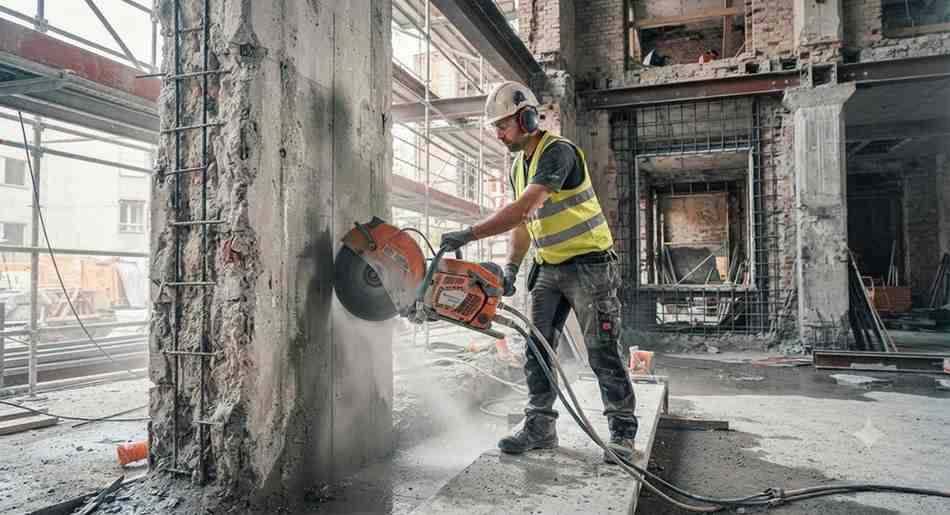
India’s urban landscape is in a fascinating state of transition. On one side, gleaming high-rises pierce the skylines of Mumbai, Gurugram, and Bengaluru; on the other, millions of residential, commercial, and heritage structures built decades ago stand as silent witnesses to the country's rapid post-independence expansion.
Time, environmental pollution, shifting urban zoning laws, and severe weathering take a heavy toll on reinforced cement concrete (RCC) structures. Rather than tearing down these valuable structures—which carries a staggering environmental footprint and massive economic cost—urban planners, structural engineers, and developers are increasingly turning toward building rehabilitation.
At the heart of modern structural retrofitting and rehabilitation lies a critical methodology: precision concrete cutting.
Target-Related Searches & PAA Overview
-
Target-Related Searches: RCC core cutting services in India, concrete cutting contractor near me, structural strengthening and retrofitting, diamond wire sawing price in India, concrete wall sawing for renovation.
-
People Also Ask (PAA):
-
How is concrete cutting used in building rehabilitation?
-
What are the main techniques of concrete cutting in India?
-
Why is retrofitting preferred over demolition in Indian cities?
-
How much does core cutting and concrete cutting cost in India?
-
Why Building Rehabilitation is Crucial for India
India possesses an immense stock of aging infrastructure built in the 1970s, 80s, and 90s. Many of these structures suffer from:
-
Carbonation and Chloride Attack: High humidity, heavy monsoons, and industrial pollution accelerate the corrosion of internal steel rebars.
-
Seismic Vulnerability: Older buildings often fail to meet modern Bureau of Indian Standards (BIS) seismic codes, particularly in earthquake zones (such as Zones III, IV, and V covering Delhi-NCR, the Himalayas, and parts of the Northeast).
-
Change of Use: Transforming an old residential block into a commercial complex or upgrading a municipal utility layout requires major spatial overhauls.
Demolition generates massive volumes of construction and demolition (C&D) waste, chokes landfills, and worsens air quality—a sensitive issue across major Indian metropolitan areas. Rehabilitation preserves the embodied energy of the structure while upgrading its safety, functionality, and lifespan.
The Core Techniques of Concrete Cutting in Rehabilitation
Gone are the days of manual sledgehammers and jackhammers, which sent destructive shockwaves through structures, loosened surrounding bonds, and created hazardous working environments. Today, advanced non-percussive engineering techniques dominate the rehabilitation sector.
1. Diamond Core Drilling
Core cutting involves drilling precise circular holes through thick concrete slabs, beams, and foundation walls.
-
Application in Rehabilitation: Essential for routing new electrical conduits, plumbing lines, HVAC ducting, and installing chemical anchors or rebar dowels for column jacketing.
-
Advantage: Leaves smooth finishes without micro-cracking the surrounding structural zone.
2. Wall Sawing and Track Sawing
Utilizing track-mounted circular diamond blades to execute vertical or horizontal cuts.
-
Application in Rehabilitation: Creating new elevator shafts, enlarging windows, cutting architectural door openings in load-bearing RCC walls, or slicing away damaged sections of parapets and balconies.
3. Diamond Wire Sawing
A continuous steel cable embedded with industrial diamond beads is pulled through a pulley system to slice through massive blocks of heavily reinforced concrete.
-
Application in Rehabilitation: Ideal for cutting massive bridge piers, heavy industrial foundations, thick columns, or executing controlled selective dismantling of multi-story buildings without affecting adjacent structures.
Indian Context: Real-World Scenarios and Case Studies
Case Study 1: Retrofitting Heritage Structures in Mumbai
Mumbai is home to hundreds of heritage structures featuring aging lime-mortar and stone or early-stage RCC elements. When retrofitting columns and inserting modern seismic shear walls to protect against structural fatigue, traditional breakers risked collapsing historical archways.
Engineers deployed diamond wire sawing and core drilling to insert stainless-steel micro-piles and structural ties with absolute precision. This allowed engineers to strengthen the core load paths without causing vibrational damage to the architectural aesthetics.
Case Study 2: Commercial Space Expansion in Delhi-NCR
In bustling commercial districts like Connaught Place or corporate hubs in Gurugram, old office buildings frequently undergo adaptive reuse. To merge smaller rooms into open-plan layouts, contractors use wall sawing and slab cutting to remove redundant sections of RCC slabs and beams safely.
Because commercial properties often operate in tight deadlines, quick turnaround times managed by professional teams sourced via platforms like [email protected] ensure minimal operational downtime for neighboring tenants.
Table: Comparison of Traditional Breaking vs. Modern Concrete Cutting
| Feature | Traditional Jackhammering | Modern Diamond Concrete Cutting |
| Vibration Level | Extremely high (causes micro-cracks) | Near-zero vibration (protects structural integrity) |
| Noise & Dust | High noise; massive dry dust clouds | Controlled via wet-cutting and vacuum attachments |
| Precision | Ragged edges, requires extensive patching | Clean, exact dimensional cuts |
| Structural Safety | High risk of damaging surviving rebars | Safe, selective material removal |
The Step-by-Step Rehabilitation Process Using Concrete Cutting
-
Structural Audit & Non-Destructive Testing (NDT):
Before any cut is made, engineers utilize NDT methods (such as Rebound Hammer and Ultrasonic Pulse Velocity tests) to map rebar locations and concrete strength.
-
Marking and Layout:
Precise lines are mapped out by structural consultants to ensure load paths remain undisturbed.
-
Execution of Cuts:
Specialized operators deploy core drills, wall saws, or wire saws equipped with continuous water-cooling lines to suppress dust and cool the diamond segments.
-
Extraction and Removal:
Heavy cut blocks are carefully rigged, hoisted, and cleared using controlled cranes or pulley systems.
-
Retrofitting and Rebar Grouting:
New structural elements are tied in using chemical anchor fasteners and high-strength non-shrink grouts to restore or exceed the original load capacity.
Cost Dynamics of Concrete Cutting in India
Pricing for concrete cutting services across Indian cities depends on several parameters:
-
Core Drilling: Generally charged per inch of diameter and depth, ranging roughly from ₹30 to ₹200+ per inch depending on RCC hardness and rebar density.
-
Wall and Slab Sawing: Calculated per square foot, varying based on the thickness of the concrete slab or wall.
-
Project Scale: Large industrial or infrastructure assignments benefit from competitive bulk pricing, whereas residential modifications factor in site accessibility and mobilization.
Property owners and construction managers looking for verified, cost-effective, and safe execution can streamline their vendor discovery process directly through specialized networks via [email protected].
Best Practices for Safe Concrete Cutting on Indian Sites
-
Utility Scanning: Always scan walls and floors using ground-penetrating radar (GPR) or electromagnetic scanners to avoid live electrical conduits and plumbing lines.
-
Personal Protective Equipment (PPE): Operators must wear heavy-duty ear protection, safety harnesses for elevated tasks, face shields, and steel-toed boots.
-
Slurry Management: Wet cutting creates a slurry mixture. Proper containment channels and industrial vacuums must be utilized to keep job sites compliant with local environmental guidelines.
Conclusion
Building rehabilitation is no longer just an alternative option—it is a sustainable, economic imperative for modern Indian urban development. By combining engineering science with high-tech concrete cutting techniques, dilapidated structures are transformed into safe, earthquake-resistant, and modernized spaces for the future.
Whether you are handling a residential renovation or a massive industrial retrofitting project, partnering with certified professionals ensures precision, speed, and absolute structural safety. To connect with expert teams and secure reliable project quotations, reach out to [email protected] today.