
Target-related searches: industrial concrete cutting, factory floor modification, heavy equipment foundation cutting, wire sawing for manufacturing plants, trenching for factory retooling, concrete cutting contractor india
People Also Ask:
-
How does concrete cutting support manufacturing plant retooling?
-
What are the main methods of concrete cutting used in industrial facility upgrades?
-
Why is precision essential when modifying concrete slabs for new production lines?
-
How do you manage dust and vibration during factory floor alterations?
Modern manufacturing is a landscape of constant evolution. To stay competitive, meet shifting consumer demands, and integrate advanced automation, industrial facilities must frequently update their operations. This process—known as production line reconfiguration or factory retooling—often requires more than just shifting lightweight tables or rerouting simple data cables. Heavy industrial machinery requires specialized structural foundations, subterranean utility trenches, and precise floor alterations.
At the center of these complex facility transformations is professional concrete cutting. Whether you are installing multi-ton CNC machines, embedding robotic assembly stations, or rerouting high-capacity plumbing and electrical grids, structural concrete modifications are unavoidable.
1. The Strategic Role of Concrete Cutting in Plant Upgrades
When a factory shifts its operational layout, the physical infrastructure must adapt to support new loads, dimensions, and workflows. Production lines are carefully timed ecosystems where every square foot matters. Introducing new equipment or expanding capacity usually disrupts existing floor plates.
Accommodating Heavy Machinery Foundations
Modern manufacturing equipment, ranging from stamping presses to industrial robotics, generates immense vibration and dynamic loads. These machines cannot simply sit on standard warehouse flooring; they require deep, isolated concrete block foundations or reinforced anchor points.
-
Precision Excavation: Specialized concrete cutting allows contractors to carve out exact footprints within existing slab-on-grade floors without compromising the surrounding structural integrity.
-
Load Distribution: By cleanly separating sections of old flooring, engineers can pour dedicated, high-strength concrete pads designed to absorb heavy mechanical shock and prevent structural settling.
Rerouting Utilities and Drainage Channels
A new layout demands a completely new network of utilities. Coolant lines, pneumatic air pipes, high-voltage electrical conduits, and industrial drainage systems must be relocated to feed the new machinery directly.
-
Trenching via Sawing: Instead of using brute-force jackhammers—which cause uncontrolled fracturing, structural weakening, and massive debris—precision floor sawing creates clean, straight vertical trenches.
-
Minimal Sub-slab Disturbance: Controlled cutting ensures that adjacent utility lines buried deep beneath the factory floor remain completely undisturbed.
2. Core Industrial Concrete Cutting Techniques
Executing a flawless production line reconfiguration requires deploying the right cutting technology tailored to the facility's unique environment and structural layout.
+--------------------------+---------------------------------------------------+
| Cutting Technique        | Primary Industrial Application                    |
+--------------------------+---------------------------------------------------+
| Diamond Wire Sawing      | Massive concrete blocks, thick machine bases      |
| Floor & Slab Sawing      | Trenching, expansion joints, layout boundaries    |
| Wall Sawing              | Creating new doorways, conveyor pass-throughs     |
| Core Drilling            | Precision anchor holes, pipe and conduit routing  |
+--------------------------+---------------------------------------------------+
Diamond Wire Sawing
For heavy manufacturing plants dealing with massive reinforced concrete foundations, thick machine bases, or structural columns that need removal, diamond wire sawing is unmatched. Utilizing a continuous cable embedded with industrial diamond beads, this method can slice through virtually any thickness of heavily reinforced concrete with surgical accuracy. It produces minimal vibration, protecting sensitive nearby equipment from shock damage.
Flat Sawing (Slab Sawing)
Flat saws are gas, diesel, or electric-powered units mounted on heavy-duty frames that glide across the factory floor. They are indispensable during production line reconfigurations for:
-
Cutting precise geometric blocks of concrete for removal.
-
Sawing clean expansion or control joints to separate old and new concrete pours.
-
Opening straight-walled trenches for underground cabling.
Core Drilling
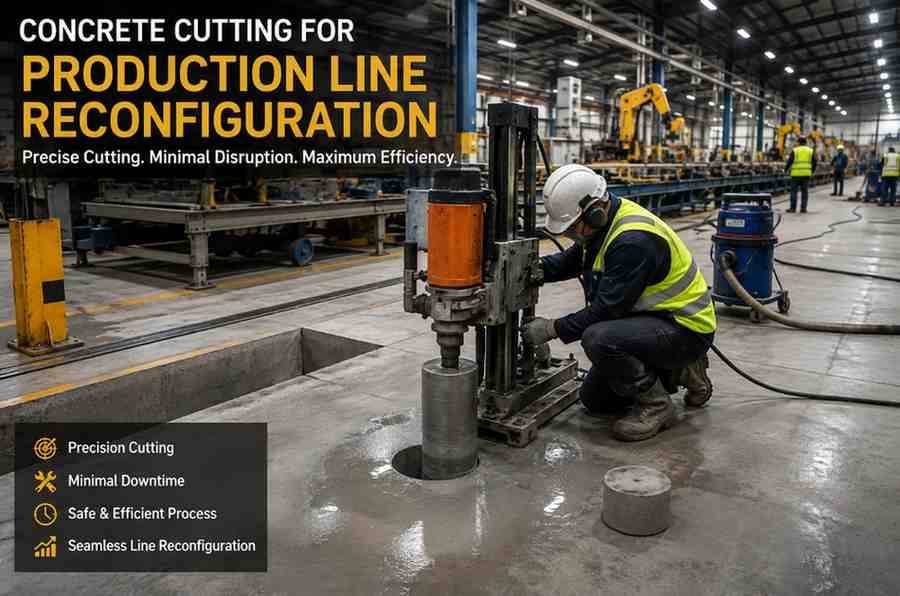
When routing individual utility lines, fiber-optic pathways, or heavy anchor bolts through existing floors, walls, or ceilings, core drilling creates perfectly cylindrical holes ranging from small diameters to over 30 inches. This method ensures tight tolerances, eliminating gaps and maintaining structural load capacities.
3. Engineering Challenges in Active Manufacturing Environments
Reconfiguring a production line often happens under strict time constraints. Facility downtime directly translates to lost revenue, meaning factory managers and contractors must work efficiently and strategically.
Crucial Consideration: Industrial facilities are rarely empty during retooling phases. Operations may continue in adjacent bays, making safety, dust control, and structural integrity top priorities.
Controlling Dust, Slurry, and Emissions
Concrete cutting produces heavy dust containing silica, which poses severe health risks and can permanently damage sensitive electronic assembly equipment or computer numerical control (CNC) machinery.
-
Professional contractors employ wet-cutting techniques combined with heavy-duty industrial vacuum systems to capture slurry right at the blade source.
-
In sensitive clean-room or electronics manufacturing zones, specialized electric saws with zero direct emissions and airtight containment barriers are deployed to protect ongoing production.
Managing Vibration Control
Traditional demolition tools like pneumatic breakers send shockwaves deep into the surrounding concrete slab. These vibrations can disrupt nearby calibrated equipment, fracture aging sub-grades, or weaken structural foundations. Diamond cutting technologies minimize vibration entirely by shearing through aggregate and steel rebar smoothly through abrasive friction rather than impact.
4. Step-by-Step Execution of a Reconfiguration Project
To ensure a seamless transition from old layout to new, a structured methodology must be implemented by experienced professionals:
-
Site Assessment and Mapping: Ground-penetrating radar (GPR) and structural blueprints are analyzed to locate existing embedded utilities, post-tension cables, and rebar grids before a single cut is made.
-
Isolation and Containment: Work zones are physically isolated using heavy plastic sheeting and negative-air scrubbers to protect the rest of the active facility.
-
Precision Cutting and Scoring: Saws and core drills trace the exact layout lines required by the new engineering schematics, establishing clean fracture boundaries.
-
Extraction and Removal: Cut sections of concrete—often weighing several tons—are systematically lifted and hauled away using specialized rigging and heavy machinery.
-
Sub-base Preparation and Pouring: Trenches and foundation pits are cleared, re-compacted, and prepped for new utility installations or high-PSI machinery pads.
5. Why Partner with Professionals?
Production line reconfigurations leave zero room for error. A miscalculated cut can sever a main electrical feed, compromise a load-bearing column, or delay a multi-million-dollar equipment installation schedule.
Collaborating with specialized experts guarantees that every cut is executed with absolute precision, adherence to safety protocols, and minimal operational downtime. For top-tier industrial services tailored to your exact manufacturing requirements, reach out to [email protected] to consult with seasoned professionals who understand the rigorous demands of modern factory retooling.
Conclusion
Adapting a manufacturing facility to meet the demands of tomorrow requires careful planning, robust engineering, and specialized technical execution. Concrete cutting is far more than simple demolition—it is a foundational engineering discipline that shapes the future efficiency, safety, and capability of your production line. By investing in professional cutting and reconfiguration services, industrial plants can modernize their infrastructure seamlessly, ensuring long-term operational success.