
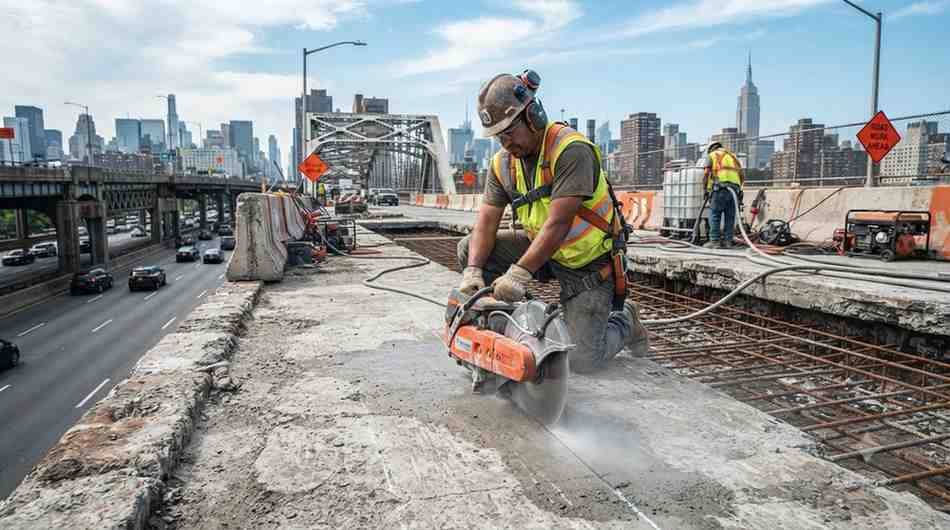
India's roads, bridges, flyovers, and dams are ageing fast. Many were built forty, fifty, even seventy years ago, and they are now carrying loads their designers never imagined. Repairing this infrastructure without shutting it down for months, or without damaging what's still structurally sound, is one of the biggest engineering challenges facing Indian cities today. This is where concrete cutting has quietly become one of the most valuable tools in a contractor's kit.
Unlike old-style demolition with hammers and breakers, modern concrete cutting is precise, controlled, and far less damaging to the surrounding structure. For a country racing to modernise its infrastructure while keeping traffic moving and budgets in check, this precision matters enormously.
Why Aging Infrastructure Needs a Different Approach
India's infrastructure boom of the 1960s to 1990s left behind a huge stock of concrete structures that are now well past their originally intended design life. The Ministry of Road Transport and Highways has repeatedly flagged that a significant share of India's bridges are over 50 years old, many built during the British era or in the early decades after independence. Add to this the seismic vulnerability of regions like the Himalayan belt and the North East, and the corrosive effects of monsoon flooding and coastal humidity, and you have a huge maintenance backlog.
Traditional demolition methods — jackhammers, wrecking balls, hydraulic breakers — are blunt instruments. They generate heavy vibration, unpredictable cracking, dust, and noise. On an old structure already weakened by decades of load and weather, this kind of shock can do more harm than good, sometimes destabilising sections that were never meant to be touched. That's a serious risk when the surrounding structure needs to stay in service, such as a flyover that can't be closed for six months or a dam gallery that has to stay watertight during repairs.
Concrete cutting solves this problem by removing only what's needed, in a controlled, low-vibration way, while leaving adjacent concrete and reinforcement steel intact.
What Concrete Cutting Actually Involves
Concrete cutting is not a single technique — it's a family of methods, each suited to a different repair scenario.
Diamond wall sawing uses a track-mounted circular saw fitted with diamond-tipped blades to cut straight, clean openings in walls, decks, and slabs. It's commonly used to cut out damaged sections of a bridge deck or to create openings for utility ducts and expansion joints without disturbing nearby concrete.
Core drilling creates precise circular holes through concrete, often for inserting bolts, dowels, or sensors, or for taking core samples to test the strength of ageing concrete before repair work begins. Structural engineers rely on these core samples to decide whether a bridge pier can be strengthened or must be replaced.
Wire sawing uses a diamond-embedded wire loop to cut through very thick or heavily reinforced sections, such as bridge piers, dam spillways, or massive foundation blocks. It can cut through steel-reinforced concrete of almost any thickness with minimal vibration, which makes it ideal for repairing structures where even small cracks could spread.
Floor sawing and slab sawing cut straight lines into road surfaces and bridge decks, often used to mark out and remove deteriorated sections of pavement for resurfacing, a very common sight during expressway and highway rehabilitation projects across India.
Chain sawing handles corners and tight junctions that a wall saw's round blade can't reach, useful in stairwell repairs, culvert modifications, and confined utility spaces.
Each of these techniques allows contractors to remove exactly the section of concrete that has deteriorated — cracked, carbonated, spalled, or corrosion-damaged — while leaving healthy concrete completely undisturbed.
Indian Examples: Where Concrete Cutting Is Already at Work
Delhi's flyovers and the Signature Bridge network. Delhi has one of India's densest urban road networks, much of it built in the 1980s and 90s. As expansion joints fail and deck slabs develop cracks from decades of heavy traffic, contractors have increasingly used diamond sawing to cut out and replace damaged deck panels overnight, allowing the flyover to reopen for the morning rush rather than staying closed for weeks.
Mumbai's ageing flyovers and sea-facing structures. Mumbai's coastal humidity accelerates corrosion in reinforced concrete. Structures like the city's older flyovers and the Western Express Highway network have needed repeated repair of corroded deck sections. Core drilling is used extensively here to extract samples and test the extent of chloride-induced corrosion before deciding whether a section needs full replacement or can be patched.
Chennai's stormwater and bridge rehabilitation after the 2015 floods. After the severe flooding that exposed weaknesses in the city's bridges and culverts, several rehabilitation projects used wire sawing to remove damaged pier sections without destabilising the rest of the structure, since many of these bridges could not be closed for long given the city's traffic dependency on them.
The Delhi Metro and other metro networks. Metro construction and retrofitting projects across Delhi, Mumbai, Bengaluru, and Chennai regularly use core cutting to create openings for utility routing, ventilation shafts, and structural connections in existing concrete viaducts and station structures, all without disturbing the load-bearing elements around them.
Dam rehabilitation in Maharashtra and Gujarat. Several of India's older dams, built in the mid-20th century, have required spillway and gallery repairs. Because dam concrete cannot be cracked or vibrated carelessly without risking seepage, wire sawing and controlled core drilling are the preferred methods for cutting out deteriorated concrete sections during rehabilitation.
National Highway resurfacing projects. As the National Highways Authority of India continues its pavement rehabilitation programmes, slab sawing is a routine sight — cutting precise joints into ageing concrete pavement so that damaged panels can be lifted out and replaced without cracking the surrounding road surface.
These examples show that concrete cutting isn't a niche technique reserved for special projects. It has become a standard part of how India maintains and extends the life of its ageing infrastructure.
The Benefits That Make Concrete Cutting the Preferred Choice
Precision. Cuts can be made to within millimetres of accuracy, allowing engineers to remove exactly the deteriorated section and nothing more. This is especially important in reinforced structures where cutting through the wrong section could sever load-bearing steel.
Low vibration. Diamond cutting generates far less shock than hammering or blasting, which matters enormously on a structure that is already weakened by age, cracking, or corrosion. A small vibration that a healthy structure would shrug off could propagate a crack through an old one.
Reduced dust and noise. Most modern concrete cutting is done with water-cooled blades, which suppress dust significantly. This matters in dense Indian cities where cutting work often happens close to residential buildings, hospitals, or busy markets.
Faster turnaround. Because cutting is targeted rather than wholesale demolition, repair work can often be completed in hours rather than days, minimising road closures and traffic disruption — a critical factor in cities where a single flyover closure can cause citywide congestion.
Structural safety. By preserving the surrounding concrete and reinforcement, cutting techniques reduce the risk of unintended structural damage during repair, which is especially important for bridges and dams where public safety is directly at stake.
Cost efficiency over the structure's lifetime. Precise repair extends the usable life of infrastructure at a fraction of the cost of full replacement, an important consideration given the scale of India's infrastructure maintenance needs.
Challenges Specific to the Indian Context
Concrete cutting in India does come with its own set of challenges. Many older structures lack detailed as-built drawings, so contractors often need to combine core sampling with non-destructive testing (like rebar scanning and ground-penetrating radar) before cutting, to avoid accidentally severing critical reinforcement or utility lines. Dense urban traffic means most major cutting work has to be scheduled for night hours, which raises costs and logistical complexity. And skilled operators trained specifically in diamond and wire sawing techniques are still relatively limited outside major metros, making experienced contractors a genuinely valuable resource for project planners.
Water management is another consideration — most cutting techniques use water for cooling and dust suppression, and on sites with limited water access or drainage, contractors need vacuum slurry collection systems to manage runoff responsibly, particularly on projects near rivers or water bodies.
What This Means for Infrastructure Owners and Contractors
For municipal bodies, highway authorities, and private contractors managing ageing structures, the choice of cutting technique can directly affect project timelines, public safety, and long-term durability. Getting it right requires:
- Accurate structural assessment before any cutting begins, using core samples and non-destructive testing
- Choosing the cutting method suited to the material thickness, reinforcement density, and location constraints
- Working with contractors experienced in cutting near live structures, whether that's a functioning bridge, an occupied building, or an active dam
- Planning around traffic and public disruption, particularly in dense urban corridors
As India continues to invest heavily in road, rail, and urban infrastructure — while also needing to maintain everything built over the last seven decades — concrete cutting will only become more central to how repair and rehabilitation projects get done. It offers a way to extend the life of critical infrastructure without the cost, disruption, or risk of full-scale demolition and rebuilding.
Final Thoughts
Aging infrastructure is not going away — if anything, India's maintenance backlog will keep growing as more structures cross the half-century mark. The good news is that modern concrete cutting techniques give engineers a genuinely surgical option: remove exactly what's damaged, protect what's sound, and get structures back in service faster and safer than older demolition methods ever allowed.
Whether it's a flyover deck in Delhi, a dam spillway in Maharashtra, or a highway pavement panel on a national corridor, the same principle applies — precise, low-vibration concrete cutting is what makes responsible, cost-effective infrastructure repair possible at the scale India needs.
For infrastructure repair and concrete cutting services across India, reach out to Core Cutting India at [email protected].
People Also Ask
What is concrete cutting used for in infrastructure repair? Concrete cutting is used to remove deteriorated, cracked, or corroded sections of concrete from bridges, roads, dams, and buildings without disturbing the surrounding structure, allowing engineers to repair or replace only the damaged part rather than the whole element.
How is concrete cutting different from concrete demolition? Concrete cutting is a precise, controlled process using diamond-tipped saws and drills to remove specific sections, while demolition typically involves breaking up large volumes of concrete with less regard for the surrounding structure. Cutting produces far less vibration, dust, and collateral damage.
Is diamond concrete cutting safe for old structures? Yes, diamond cutting is generally considered safer for aging structures than percussive demolition because it generates minimal vibration and shock, reducing the risk of new cracks forming in already weakened concrete.
How much does concrete cutting cost in India? Costs vary widely depending on the technique, concrete thickness, reinforcement density, and site accessibility, ranging from a few hundred rupees per running foot for basic sawing to significantly higher rates for wire sawing thick, heavily reinforced structures. Getting a site-specific quote from an experienced contractor is the best way to estimate cost accurately.
Which Indian cities are using concrete cutting for bridge repair? Major metros including Delhi, Mumbai, Chennai, Bengaluru, and Kolkata regularly use concrete cutting for flyover, bridge, and metro infrastructure repair, alongside highway rehabilitation projects carried out under the National Highways Authority of India across the country.
Target-related searches: concrete cutting services in India, core cutting company near me, diamond wall sawing India, bridge rehabilitation techniques, road repair concrete cutting, concrete cutting cost India, structural concrete repair contractors, infrastructure rehabilitation India, concrete sawing and drilling services, concrete demolition without vibration
People Also Ask:
- What is concrete cutting used for in infrastructure repair?
- How is concrete cutting different from concrete demolition?
- Is diamond concrete cutting safe for old structures?
- How much does concrete cutting cost in India?
- Which Indian cities are using concrete cutting for bridge repair?