
Introduction
Urban real estate across India is booming at an unprecedented pace. From sprawling commercial tech parks in Bengaluru and Hyderabad to densely packed corporate hubs in Mumbai and Connaught Place in New Delhi, space is a premium commodity. Consequently, tearing down an entire building to accommodate modern HVAC systems, electrical upgrades, or architectural redesigns is rarely practical or economical. Instead, building owners and facility managers frequently opt for structural retrofitting, expansion, and interior modifications.
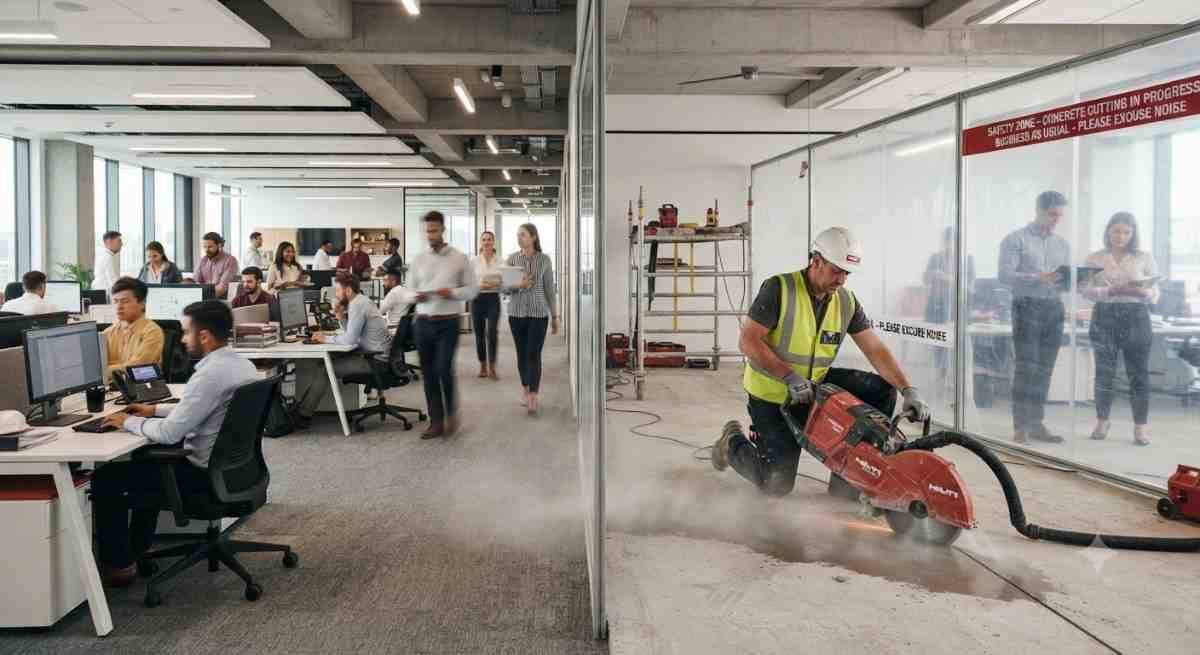
However, a major challenge arises when these heavy modifications must be made while the building is buzzing with occupants. Whether it is a functioning multi-specialty hospital in Chennai, a busy bank headquarters in Mumbai, or a high-rise IT office in Gurugram, halting daily operations or evacuating occupants for weeks is often out of the question.
This is where specialized concrete cutting in occupied buildings becomes essential. Executing precision diamond core cutting, wall sawing, and wire sawing without triggering panic, violating safety norms, or halting business requires a masterclass in engineering, advanced machinery, and meticulous planning. At [email protected], we handle these high-stakes operations smoothly. Let us dive deep into how modern engineering handles concrete modification in living, breathing structures.
The Complexity of Working in Occupied Indian Structures
Carrying out heavy construction tasks like cutting through Reinforced Cement Concrete (RCC) beams, columns, and slabs is inherently disruptive. In traditional demolition and retrofitting scenarios, heavy pneumatic breakers create deafening noise, excessive structural vibrations, and billowing clouds of hazardous silica dust.
When applied to an active building, these traditional methods spell disaster:
-
Health Hazards: Inhaling fine crystalline silica dust poses severe respiratory risks to office workers, patients, and residents.
-
Structural Panic: Uncontrolled vibrations can crack surrounding finishes and alarm building inhabitants who fear structural collapse.
-
Operational Downtime: Excessive noise makes communication, client meetings, and critical patient care nearly impossible.
In India, building typologies add another layer of complexity. Many commercial spaces are housed in older, high-density structures where structural drawings may be outdated or unavailable. Balancing the need for precise structural alteration with the comfort and safety of daily occupants demands advanced non-disruptive technologies.
Advanced Technologies for Occupied Buildings
To successfully cut concrete while people work, shop, or recover just floors or walls away, contractors must move away from archaic jackhammers and adopt precision diamond-cutting tools.
1. Diamond Core Drilling
When routing new plumbing lines, fire suppression pipes, or electrical conduits through thick RCC slabs, core cutting is the preferred technique. Using industrial diamond-impregnated drill bits, operators can carve clean, cylindrical openings ranging from small anchor holes to massive 500mm diameter vents.
-
Why it fits occupied spaces: It is virtually vibration-free, produces minimal noise, and creates zero structural micro-cracks in the surrounding matrix.
2. Wall Sawing and Track Sawing
Creating new doorways, windows, or ventilation shafts in load-bearing RCC walls requires absolute precision. Track-mounted diamond wall saws glide smoothly along a fixed path, delivering razor-sharp, flush cuts against floors and adjacent walls.
-
Why it fits occupied spaces: It eliminates the haphazard shattering typical of manual breaking, ensuring that the structural integrity of the rest of the wall remains untouched.
3. Diamond Wire Sawing
For massive concrete structures—such as thick foundation blocks, massive bridge piers, or heavy structural columns—diamond wire saws use a continuous steel cable threaded with industrial diamond beads. Pulled tightly through the concrete, it loops and slices through heavy masses smoothly.
-
Why it fits occupied spaces: It can cut through virtually any thickness of concrete with minimal noise emission and precise water-cooling suppression.
Real-World Indian Scenarios and Case Studies
To understand how these techniques translate into practice, let us look at typical Indian commercial and residential environments where [email protected] methodologies shine.
Scenario A: Retrofitting an HVAC Duct in a Connaught Place Heritage Commercial Building
The Challenge: A heritage-status commercial complex in New Delhi needed a massive central air-conditioning overhaul. The building was fully occupied by law firms, financial institutions, and retail stores. Total evacuation was legally and financially impossible. The Execution: The engineering team deployed wet diamond core drilling and low-vibration wall sawing during off-peak night shifts. Using specialized slurry-containment rings and industrial vacuum units, wastewater and dust were captured at the point of generation. The Result: Tenants arrived the next morning to clean, dust-free workspaces with brand-new openings ready for duct installation, completely unaware of the heavy cutting that occurred hours prior.
Scenario B: Hospital Expansion and Service Routing in Mumbai
The Challenge: A multi-specialty hospital in Mumbai required new medical gas pipeline routing through multi-layered RCC slabs without disturbing intensive care units (ICUs) situated on the floor directly above. The Execution: Strict noise thresholds and zero-dust policies were enforced. The team utilized electric-powered, remote-controlled wall saws coupled with continuous water-injected dust suppression. Acoustic barriers were erected around the work zone to keep decibel levels well within permissible hospital zone limits. The Result: Zero patient disruption, absolute compliance with biomedical safety guidelines, and successful infrastructure upgrade.
Key Pillars of Safe Concrete Cutting in Active Environments
Executing a flawless project in an occupied building is governed by four strict pillars:
[Acoustic & Vibration Control] ➔ [Dust & Slurry Containment] ➔ [Structural Integrity Monitoring] ➔ [Phased Scheduling]
1. Dust and Slurry Management (The Silica Threat)
Crystalline silica dust generated during dry concrete cutting is a known carcinogen. In an occupied building, dry cutting is strictly prohibited.
-
Wet Cutting: A continuous stream of water is fed directly to the diamond blade, keeping temperatures down and instantly trapping dust particles into a manageable slurry.
-
Vacuum Recovery: Industrial slurry vacuums equipped with HEPA filters capture wastewater immediately, preventing slips, falls, and structural water damage.
2. Noise and Vibration Mitigation
Noise pollution is a major hurdle in corporate offices and residential apartments.
-
Electric-powered cutting rigs are preferred over diesel-powered alternatives to eliminate exhaust fumes inside enclosed structures.
-
Temporary sound-dampening acoustic blankets and modular partition screens are deployed around the immediate work perimeter to absorb high-frequency cutting noises.
3. Structural Shoring and Load Management
Cutting concrete means removing load-bearing material. In an active building, temporary shoring (steel props and hydraulic jacks) must be meticulously engineered and installed before any cut is initiated. This ensures that load paths are safely transferred, preventing any micro-settlement or structural distress while occupants go about their day upstairs.
4. Strategic Timing and Phased Execution
Work is frequently scheduled during off-hours—late nights, weekends, or designated maintenance windows. By splitting major structural cutouts into controlled, bite-sized phases, the impact on daily foot traffic and business operations is kept practically negligible.
Why Professional Expertise Matters
Attempting concrete modifications in an occupied structure using uncertified local labor is a recipe for disaster. Damaging a hidden electrical conduit, severing a live post-tension cable, or miscalculating a load-bearing column cut can lead to catastrophic structural failure, heavy financial penalties, and loss of life.
Partnering with seasoned professionals ensures:
-
Pre-Work Scanning: Utilization of Ground Penetrating Radar (GPR) and X-ray imaging to map internal rebar, post-tension cables, and hidden utility lines prior to making the first cut.
-
Certified Operators: Technicians trained in high-precision machinery handling, safety compliance, and emergency response protocols.
-
End-to-End Execution: From initial structural assessment and debris hauling to final site cleanup, every detail is managed professionally.
Conclusion
Carrying out concrete cutting and structural modifications in buildings with active occupants is a delicate balance of engineering precision, advanced machinery, and rigorous safety protocols. It proves that major infrastructural evolution does not require the disruption of total evacuation.
By employing state-of-the-art diamond tools, wet suppression systems, and strategic night-shift execution, modern buildings across India can seamlessly adapt to the future without pausing the present. For safe, vibration-free, and dust-controlled structural modifications tailored to your active commercial or residential space, reach out to the experts today at [email protected] and let precision engineering transform your property safely.