
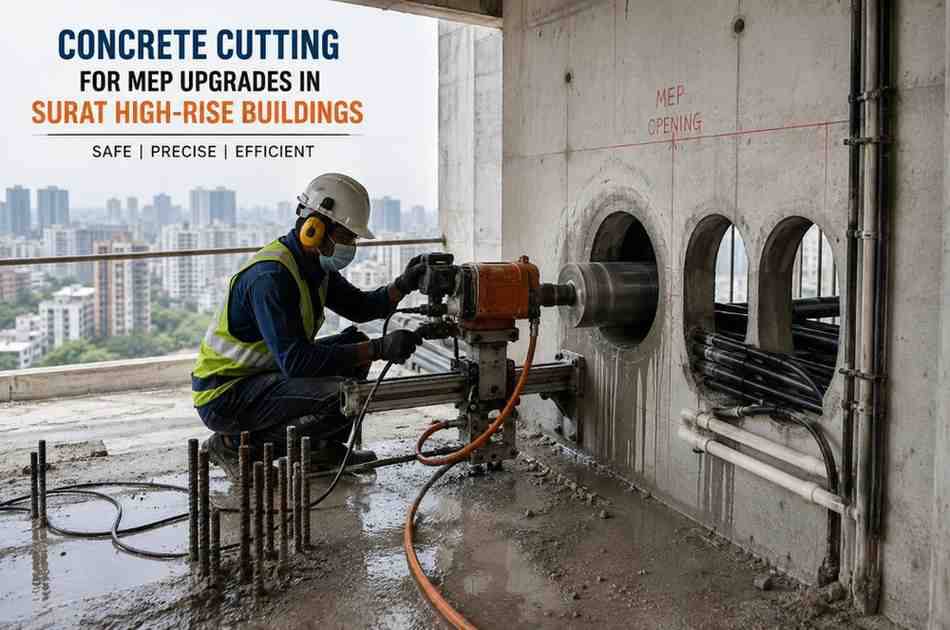
Surat's skyline has changed dramatically over the last decade. Diamond hub towers, luxury residential high-rises, and commercial complexes along the Tapi riverfront and in areas like Vesu, Adajan, and Piplod have transformed the city's construction landscape. But with every high-rise comes an ongoing need: mechanical, electrical, and plumbing (MEP) systems that must be upgraded, repaired, or expanded years after the building's original construction. This is where professional concrete cutting becomes essential, and it's a specialty that Core Cutting India has built its reputation on.
Whether it's routing new electrical conduits through a reinforced concrete slab, installing a plumbing riser for a retrofitted bathroom, or cutting an opening for a new HVAC duct, concrete cutting is the invisible backbone of every successful MEP upgrade in a multi-storey building. In this blog, we'll walk through why concrete cutting matters for Surat's high-rises, the techniques involved, the challenges unique to tall buildings, and how to choose the right contractor for the job.
Why MEP Upgrades Are Increasingly Common in Surat High-Rises
Surat is one of India's fastest-growing cities, with a booming textile and diamond trade economy fueling continuous construction and renovation. Many high-rise buildings constructed 10-20 years ago are now undergoing significant upgrades to meet modern living and business standards. Common triggers for MEP upgrades include:
- Aging infrastructure: Old plumbing and electrical systems reaching the end of their functional life
- Change of use: Residential units being converted into offices, or floors being repurposed for commercial tenants
- Energy efficiency retrofits: Installing modern HVAC systems, solar integration, or smart building technology
- Fire safety compliance: Adding sprinkler lines, fire-rated conduits, and updated ductwork to meet current fire codes
- Increased occupancy demands: Expanding water supply lines, drainage capacity, or electrical load to serve more units or higher power consumption
- Government and municipal mandates: Surat Municipal Corporation has tightened building safety and utility compliance norms in recent years, pushing many older high-rises toward mandatory upgrades
Each of these scenarios requires precise penetrations through concrete slabs, shear walls, and structural beams — work that cannot be done with a hammer drill or a jackhammer without risking serious structural damage.
Why Concrete Cutting Is Non-Negotiable for MEP Work
In a low-rise or standalone structure, contractors sometimes get away with makeshift methods for breaking through concrete. In a high-rise, that approach is simply not viable. Here's why professional concrete cutting is critical:
1. Structural Safety
High-rise buildings rely on continuous load paths through slabs, columns, and shear walls. An improperly placed or oversized cut can compromise the structural integrity of a floor, potentially affecting multiple levels above and below. Professional concrete cutting uses calculated, precise methods that avoid rebar damage and maintain the building's load-bearing capacity.
2. Precision for MEP Fit
MEP components — pipes, conduits, ducts, cable trays — are manufactured to exact dimensions. A rough or oversized opening wastes material, weakens the surrounding concrete, and creates future maintenance headaches. Diamond-tipped cutting tools create clean, accurately sized openings that match MEP specifications exactly.
3. Noise, Dust, and Vibration Control
Occupied high-rises — especially residential towers or active commercial buildings — cannot tolerate excessive noise, vibration, or airborne dust. Modern concrete cutting techniques, particularly wet cutting methods, dramatically reduce dust generation and vibration compared to traditional demolition, minimizing disruption to residents and tenants.
4. Speed and Cost Efficiency
Cutting is faster and more predictable than breaking. Contractors can plan MEP installation timelines with confidence when concrete cutting is handled by specialists who deliver clean openings on schedule, rather than dealing with unpredictable rubble removal from manual breaking.
Common Concrete Cutting Techniques Used in MEP Upgrades
Core Cutting India employs a range of specialized techniques depending on the location, size, and purpose of each cut. Here are the most common methods used in Surat high-rise MEP projects:
Core Drilling
Core drilling uses a diamond-tipped hollow bit to bore circular holes through concrete slabs and walls. This is the go-to method for:
- Plumbing riser penetrations
- Electrical and data cable routing
- HVAC pipe and refrigerant line passages
- Small utility openings between floors
Core drilling is precise, low-vibration, and can be performed at virtually any angle, making it ideal for tight utility shafts common in high-rise construction.
Wall Sawing
Wall saws are track-mounted diamond blade saws used to make straight, controlled cuts through vertical concrete walls. This technique is used for:
- Creating new door or duct openings in shear walls (with structural engineer approval)
- Widening existing openings for larger MEP equipment
- Cutting access panels for maintenance shafts
Slab Sawing (Flat Sawing)
Used for horizontal surfaces, slab sawing creates straight-line cuts in floors and ceilings. This is often used when:
- Installing floor trenches for underfloor electrical or plumbing routing
- Creating larger rectangular openings for HVAC risers or elevator-adjacent utility chases
- Removing sections of slab for staircase or shaft modifications
Diamond Wire Sawing
For thicker structural elements or heavily reinforced concrete, diamond wire sawing offers a highly controlled, low-vibration alternative. It's particularly useful in sensitive zones near existing MEP lines or structural members where precision is critical.
Handheld Diamond Cutting
For smaller, irregular, or hard-to-reach openings — such as niche electrical box installations or small conduit pass-throughs — handheld diamond saws provide flexibility without the setup time of larger equipment.
Unique Challenges of Concrete Cutting in Surat High-Rises
Cutting concrete in a high-rise is fundamentally different from ground-level work. Some of the specific challenges our teams navigate include:
Access and Logistics: Getting cutting equipment, water supply lines, and dust extraction systems up to the 10th, 20th, or 30th floor requires careful planning, often involving building elevators, hoists, or temporary scaffolding access.
Occupied Building Constraints: Many MEP upgrades happen in buildings that are still occupied. Work must be scheduled around resident or tenant routines, often requiring cutting during specific hours and using low-noise, low-dust techniques.
Water Management: Wet cutting methods control dust but generate slurry that must be captured and disposed of properly, especially critical in high-rise settings where water runoff could damage lower floors or violate building drainage rules.
Rebar and Post-Tension Cable Detection: Before any cut is made, our team uses rebar scanning and ground-penetrating radar (GPR) to identify reinforcement bars and, in some cases, post-tensioned cables that must never be severed. This step is especially critical in high-rise slabs, which often have dense reinforcement or post-tensioning systems.
Structural Approval: Any cut affecting a load-bearing wall, column, or transfer slab typically requires sign-off from a structural engineer. Reputable concrete cutting contractors work closely with the project's structural consultant to ensure every cut is safe and compliant.
Coordination with Multiple Trades: MEP upgrades usually involve electricians, plumbers, HVAC technicians, and fire safety contractors all working in sequence. Concrete cutting must be scheduled precisely to avoid delays across the entire project timeline.
Safety Standards We Follow
At Core Cutting India, safety is built into every stage of the concrete cutting process:
- Pre-cut structural surveys and rebar/cable scanning
- Use of wet-cutting diamond blades to control dust and reduce silica exposure
- Vibration monitoring near sensitive structural zones
- Proper containment and disposal of slurry and debris
- PPE compliance for all site personnel
- Adherence to local Surat Municipal Corporation guidelines and national building safety codes
- Clear communication with building management and residents about work schedules
How Concrete Cutting Fits into the Broader MEP Upgrade Timeline
A well-run MEP upgrade project generally follows this sequence:
- Assessment and design — MEP consultants determine new routing paths for electrical, plumbing, and HVAC systems
- Structural review — Engineers approve proposed penetration locations
- Scanning and marking — Concrete cutting teams scan for rebar and mark precise cut locations
- Cutting execution — Core drilling, wall sawing, or slab sawing is performed based on the scope
- Debris removal and cleanup — Slurry, dust, and concrete cores are removed from site
- MEP installation — Electricians, plumbers, and HVAC teams install their systems through the newly created openings
- Sealing and fire-stopping — Openings are sealed with fire-rated materials to restore compartmentalization and fire safety ratings
- Final inspection — Structural and safety sign-off before the space is handed back for use
Concrete cutting sits right at the foundation of this process — get it wrong, and every downstream trade is affected.
Choosing the Right Concrete Cutting Contractor in Surat
Not every contractor is equipped to handle the complexity of high-rise concrete cutting. When evaluating a concrete cutting partner for your MEP upgrade project in Surat, consider:
- Experience with high-rise and occupied buildings: Ground-floor demolition experience doesn't always translate to multi-storey precision work
- Availability of rebar scanning equipment: This is non-negotiable for structural safety
- Range of cutting techniques: Core drilling, wall sawing, slab sawing, and wire sawing capabilities under one roof
- Dust and noise control practices: Especially important for occupied residential or commercial towers
- Coordination ability: Willingness to work closely with structural engineers, MEP consultants, and other trades
- Compliance track record: Familiarity with Surat Municipal Corporation regulations and national safety codes
- Transparent quoting and scheduling: Clear timelines that respect the broader project schedule
Core Cutting India has worked on numerous high-rise projects across Surat, supporting MEP contractors, builders, and facility managers with reliable, precise, and code-compliant concrete cutting services.
Final Thoughts
As Surat's skyline continues to rise and its existing high-rises age into their next life cycle of upgrades, concrete cutting will remain one of the most critical — yet often overlooked — components of successful MEP retrofits. It's the difference between a clean, structurally sound installation and a project plagued by delays, damage, or safety risks.
If you're planning an MEP upgrade in a Surat high-rise, partnering with an experienced concrete cutting specialist isn't just a convenience — it's a necessity for protecting the building's structural integrity while keeping your project on schedule.
Contact Core Cutting India today at [email protected] to discuss your concrete cutting requirements for your next MEP upgrade project in Surat.
People Also Ask
1. What is concrete cutting used for in MEP upgrades? Concrete cutting creates precise openings in slabs, walls, and beams to allow electrical conduits, plumbing pipes, HVAC ducts, and cable trays to pass through concrete structures without compromising the building's structural integrity.
2. Is concrete cutting safe for high-rise buildings? Yes, when performed by trained professionals using rebar scanning, structural engineer approval, and proper cutting equipment, concrete cutting is a safe and standard practice in high-rise construction and renovation projects.
3. How long does concrete cutting take for a typical MEP upgrade? Duration depends on the scope — a single core drill hole may take under an hour, while extensive wall sawing or slab cutting across multiple floors can take several days, factoring in scanning, cutting, and cleanup.
4. Does concrete cutting damage the structure of a building? Not when done correctly. Professional concrete cutting avoids rebar and post-tension cables through pre-scanning and follows structural engineer-approved locations, preserving the building's load-bearing capacity.
5. What is the difference between core drilling and wall sawing? Core drilling creates circular holes using a rotating diamond bit, ideal for pipes and cables. Wall sawing uses a track-mounted blade to make straight-line cuts, typically used for larger openings like doorways or duct passages.
6. How much dust and noise does concrete cutting generate? Modern wet-cutting diamond techniques significantly reduce dust and noise compared to traditional demolition methods, making them suitable for occupied residential and commercial high-rises.
7. Do I need permission from a structural engineer before cutting concrete in a high-rise? Yes, any cutting that affects load-bearing walls, columns, or slabs typically requires review and approval from a structural engineer to ensure the building's safety is not compromised.
8. Which areas of Surat commonly require concrete cutting for MEP upgrades? High-rise residential and commercial zones such as Vesu, Adajan, Piplod, City Light, and the diamond and textile business districts frequently see MEP upgrade projects requiring professional concrete cutting services.