
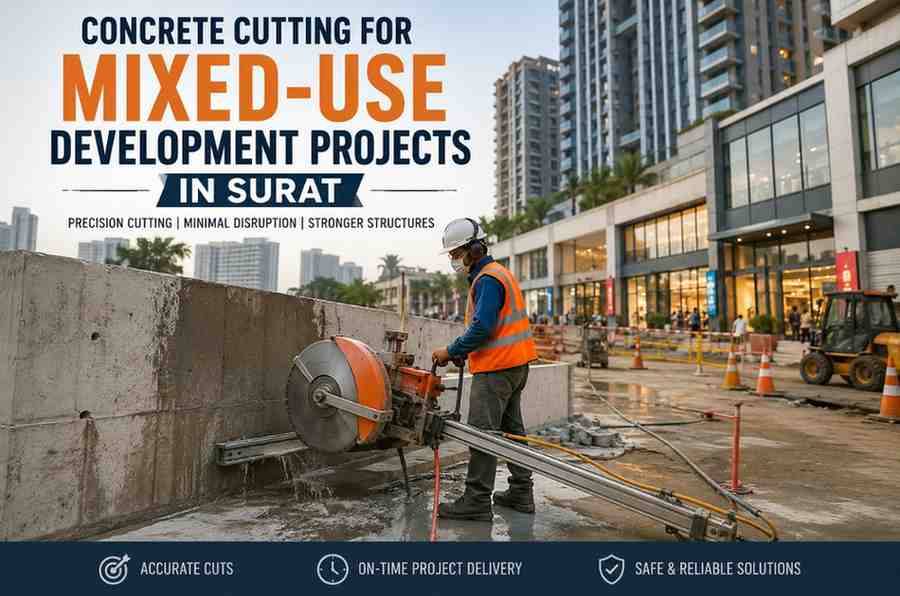
Surat's skyline is changing faster than almost any other city in Gujarat. Diamond trading hubs, textile markets, IT parks, and residential towers are increasingly being replaced or supplemented by mixed-use developments — single complexes that combine retail, office space, and residential units under one roof. These projects are complex by nature, and one of the most critical yet often overlooked services behind their successful execution is professional concrete cutting.
At Core Cutting India ([email protected]), we specialize in precision concrete cutting, core drilling, wall sawing, and demolition services tailored specifically for the demands of mixed-use construction. In this guide, we'll explore why concrete cutting matters so much in Surat's evolving urban landscape, the techniques involved, and what developers should look for when hiring a concrete cutting contractor.
Why Mixed-Use Developments Are Booming in Surat
Surat has grown from a textile and diamond trading city into one of India's fastest-expanding urban centers. With rising land costs and a growing population, developers are shifting toward vertical, multi-functional buildings that maximize land use. Areas like Vesu, Adajan, Piplod, City Light, and Dumas Road have seen a surge in mixed-use towers that combine:
- Ground-floor retail and commercial showrooms
- Mid-level office or co-working spaces
- Upper-floor residential apartments or serviced suites
- Basement parking and utility infrastructure
This layered structure means construction teams must work with dense reinforced concrete, tight timelines, and multiple stakeholders simultaneously — all factors that make precision concrete cutting indispensable.
The Role of Concrete Cutting in Mixed-Use Construction
Unlike single-purpose buildings, mixed-use developments require constant structural modification throughout the construction lifecycle. Walls need openings for utilities, floors need penetrations for plumbing and electrical risers, and structural elements often need controlled removal to accommodate design changes. Concrete cutting services are used at nearly every stage:
1. Foundation and Basement Work
Basement parking levels in mixed-use towers often require cutting for drainage channels, ramps, and utility trenches. Precise floor sawing ensures these cuts don't compromise the structural integrity of the slab above.
2. Utility Penetrations
HVAC ducts, plumbing lines, electrical conduits, and fire safety systems all need to pass through concrete walls and floors. Core drilling allows for clean, circular openings without cracking surrounding concrete — essential in buildings where multiple trades are working in parallel.
3. Structural Modifications
As design requirements evolve mid-construction (a common occurrence in large mixed-use projects), sections of concrete walls or slabs sometimes need to be removed or resized. Wall sawing and wire sawing techniques allow for controlled, vibration-free removal that protects adjacent structures.
4. Renovation and Retrofitting
Many mixed-use projects in Surat involve converting older commercial buildings into modern multi-purpose complexes. This requires selective demolition and cutting to preserve usable structural elements while removing outdated sections.
5. Expansion Joints and Movement Control
Large mixed-use buildings expand and contract with temperature changes. Saw-cut expansion joints in floors and pavements prevent uncontrolled cracking over time.
Common Concrete Cutting Techniques Used in Surat Projects
Professional contractors like Core Cutting India use a range of specialized techniques depending on the project's needs:
Diamond Core Drilling Used for creating precise circular holes in concrete for pipes, cables, and ventilation. This method is dust-controlled and minimizes vibration, making it suitable for occupied or partially completed buildings.
Wall Sawing A track-mounted diamond saw cuts straight, clean lines through vertical concrete walls. This is commonly used for creating door openings, window enlargements, and structural access points.
Floor Sawing (Flat Sawing) Ideal for horizontal surfaces such as slabs, pavements, and basement floors. Flat sawing is used for expansion joints, utility trenches, and controlled demolition sections.
Wire Sawing For thick or heavily reinforced concrete sections, wire sawing uses a diamond-embedded cable to cut through large structural elements with minimal noise and vibration — critical near occupied residential or commercial zones.
Chain Sawing and Ring Sawing Used for creating corners and openings where wall saws cannot reach, particularly useful in tight mixed-use building layouts with irregular geometry.
Hydraulic Bursting and Controlled Demolition For sections that need complete removal without traditional cutting, hydraulic bursting offers a low-vibration alternative that protects surrounding structures — especially valuable in dense urban plots common across Surat.
Why Precision Matters in Mixed-Use Projects Specifically
Mixed-use buildings present unique challenges that single-use structures don't. A retail space on the ground floor might be operational while upper floors are still under construction. Residential tenants may already be occupying finished units while commercial fit-outs continue elsewhere in the building. This layered occupancy means:
- Noise and vibration control become essential to avoid disrupting residents or businesses.
- Dust management is critical near finished retail or residential interiors.
- Structural safety must be verified before any cutting near load-bearing elements, especially in taller mixed-use towers.
- Scheduling precision is required so cutting work doesn't delay parallel trades like electrical, plumbing, or interior finishing.
This is where experienced contractors add real value. At Core Cutting India, our teams use concrete scanning technology before drilling or cutting to detect rebar, post-tension cables, and existing utility lines — preventing costly damage and ensuring compliance with structural safety standards.
Choosing the Right Concrete Cutting Contractor in Surat
With Surat's construction sector expanding rapidly, developers have more contractor options than ever. However, not all concrete cutting providers are equipped to handle the complexity of mixed-use projects. When evaluating a contractor, developers and site engineers should consider:
1. Experience with Multi-Phase Projects Mixed-use developments involve overlapping construction phases. A contractor should demonstrate experience coordinating cutting work around live occupancy and parallel trades.
2. Equipment Range Look for a provider offering core drilling, wall sawing, floor sawing, wire sawing, and hydraulic demolition — rather than a single-technique operation. This ensures one team can handle diverse requirements across the project.
3. Safety Compliance Reinforced concrete cutting near structural elements requires strict adherence to safety protocols, including pre-cut scanning and load-bearing assessments.
4. Dust and Vibration Control Systems Especially important for projects with partial occupancy, where residents or retail tenants are already present in the building.
5. Local Knowledge A contractor familiar with Surat's building codes, soil conditions, and common construction practices in areas like Vesu, Adajan, or Pal can better anticipate site-specific challenges.
6. Transparent Pricing and Timelines Given the scale of most mixed-use projects, clear cost estimates and realistic scheduling prevent budget overruns and construction delays.
The Cost Factor: What Influences Concrete Cutting Pricing in Surat
Concrete cutting costs vary based on several factors, and developers should understand these before budgeting for a project:
- Concrete thickness and reinforcement density — thicker or heavily reinforced slabs require more time and specialized blades.
- Cutting method — wire sawing and hydraulic bursting typically cost more than standard core drilling due to equipment and labor intensity.
- Site accessibility — basement levels or upper floors without direct crane access may increase labor costs.
- Occupancy status — cutting in occupied or partially finished buildings often requires additional dust and noise control measures, affecting pricing.
- Project scale — bulk utility penetrations or large-scale floor sawing typically come at a lower per-unit cost than isolated, single cuts.
Getting a detailed site assessment before committing to a project timeline is the best way to avoid unexpected costs — something Core Cutting India offers as part of our project consultation process.
Sustainability and Efficiency in Modern Concrete Cutting
As Surat's construction industry moves toward more sustainable practices, concrete cutting has evolved beyond just structural necessity. Precision cutting reduces material waste compared to traditional demolition methods, since only the required sections are removed rather than entire structural elements. This is particularly relevant for mixed-use developments, where partial renovations and phased construction are common.
Additionally, modern diamond cutting technology significantly reduces airborne dust and noise pollution compared to older jackhammer-based demolition, making it a more responsible choice for projects located near residential neighborhoods or commercial hubs — a common scenario in Surat's densely built urban core.
Why Developers in Surat Trust Core Cutting India
Mixed-use development projects demand more than just cutting equipment — they require a partner who understands the coordination, safety, and precision these complex builds involve. At Core Cutting India, we bring specialized expertise in:
- Diamond core drilling for utility and MEP installations
- Wall and floor sawing for structural modifications
- Wire sawing for heavy reinforced concrete sections
- Controlled, low-vibration demolition near occupied structures
- Pre-cut concrete scanning to protect structural integrity
Our team works closely with architects, structural engineers, and site supervisors to ensure every cut is planned, safe, and executed without disrupting the broader construction timeline.
Whether you're developing a new mixed-use tower in Vesu, retrofitting a commercial building in City Light, or managing a large-scale project along Dumas Road, precision concrete cutting is not a task to leave to chance.
Get in Touch
For a site assessment or project consultation, reach out to Core Cutting India at [email protected]. Our team is ready to support your next mixed-use development project in Surat with reliable, precise, and safety-first concrete cutting solutions.
Frequently Asked Questions (People Also Ask)
What is concrete cutting used for in construction? Concrete cutting is used to create openings for utilities, modify structural elements, remove sections during renovation, and form expansion joints in slabs and pavements. It allows precise, controlled changes to concrete structures without damaging surrounding areas.
How much does concrete cutting cost in Surat? Costs depend on concrete thickness, reinforcement level, cutting method, and site accessibility. Simple core drilling is generally more affordable than wire sawing or hydraulic demolition. A site visit is the most accurate way to get project-specific pricing.
What is the difference between core drilling and wall sawing? Core drilling creates circular holes, typically for pipes or cables, using a rotating diamond bit. Wall sawing uses a track-mounted diamond blade to make straight-line cuts through vertical concrete surfaces, often for door or window openings.
Is concrete cutting safe for occupied buildings? Yes, when performed by experienced contractors using dust control, vibration reduction, and proper structural scanning. Techniques like wire sawing and diamond core drilling are specifically chosen for their low-impact profile in occupied environments.
How long does concrete cutting take for a commercial project? Timelines vary based on project scope, but most utility penetrations take a few hours, while large-scale wall or floor sawing for structural modifications can take several days depending on complexity and reinforcement density.
What equipment is used for cutting reinforced concrete? Diamond-tipped blades, core drills, wire saws, and hydraulic bursting tools are commonly used for reinforced concrete, as standard cutting tools cannot effectively penetrate steel reinforcement bars without specialized diamond technology.