
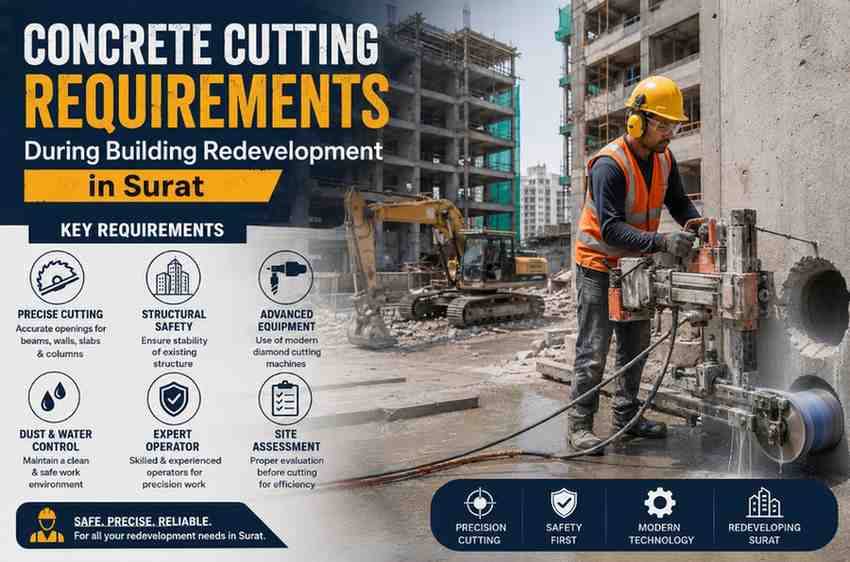
Surat's skyline is changing fast. Old textile-era buildings, ageing housing societies, and commercial complexes across areas like Adajan, Vesu, Katargam, and City Light are being torn down and rebuilt to meet the demands of a growing population and modern infrastructure standards. This wave of redevelopment has created a strong demand for one specialised trade that most people rarely think about until they need it: professional concrete cutting.
Whether it's widening a doorway, removing a damaged slab, creating space for new plumbing lines, or preparing a structure for full demolition, concrete cutting plays a foundational role in every redevelopment project. Done incorrectly, it can compromise structural integrity, delay project timelines, and even endanger workers and nearby residents. Done correctly, by an experienced team like Core Cutting India, it becomes a precise, low-vibration, and highly controlled process.
This guide walks through everything property owners, developers, architects, and contractors in Surat need to know about concrete cutting requirements during building redevelopment.
Why Concrete Cutting Matters in Redevelopment Projects
Redevelopment is different from fresh construction. You're working around existing structures, utilities, neighbouring properties, and often occupied buildings. Traditional demolition methods — sledgehammers, breakers, and manual chiseling — generate excessive noise, dust, and vibration. In dense urban pockets of Surat, where buildings are often built wall-to-wall, this approach can crack adjoining structures and invite complaints or legal disputes.
Modern diamond concrete cutting solves these problems. It allows for controlled, precise removal of concrete and masonry without disturbing the surrounding structure. This is why concrete cutting has become a non-negotiable requirement — not just a convenience — in Surat's redevelopment landscape.
Common Concrete Cutting Requirements in Building Redevelopment
Every redevelopment project has its own scope, but certain concrete cutting requirements come up repeatedly across residential, commercial, and industrial sites in Surat.
1. Structural Assessment Before Cutting
Before any cutting begins, a structural assessment is essential. This determines which walls or slabs are load-bearing, where reinforcement bars (rebar) are positioned, and how much load a section can lose without affecting the building's stability. Skipping this step is one of the most common — and dangerous — mistakes in redevelopment projects. A qualified structural engineer, working alongside the cutting contractor, should always sign off on the cutting plan.
2. Wall Sawing for Openings and Demolition
Wall sawing is used to create clean, straight cuts in vertical concrete or masonry walls. During redevelopment, this technique is commonly required for:
- Enlarging or creating new doorways and windows
- Removing entire wall sections for layout changes
- Cutting expansion joints in adjoining structures
- Preparing walls for controlled demolition in phases
Wall saws produce minimal dust and vibration compared to breakers, which is particularly important when neighbouring units remain occupied during redevelopment.
3. Floor Sawing for Slab Removal
Floor sawing (or flat sawing) is used on horizontal surfaces — slabs, floors, pavements, and rooftops. This is a frequent requirement when:
- Removing damaged or aged RCC slabs
- Creating openings for new staircases, lift shafts, or ducts
- Cutting expansion joints in large floor areas
- Preparing sections for utility trenching
4. Core Drilling for Utility and Service Openings
Core drilling creates precise circular holes through concrete, brick, or stone. In redevelopment work, core drilling is almost always required for:
- Plumbing and drainage pipe routing
- Electrical conduit and cable passage
- HVAC ductwork
- Fire-fighting pipeline installation
- Anchor bolt holes for structural retrofitting
Diamond core drilling is dust-controlled and produces smooth, accurate holes without cracking the surrounding concrete — a critical requirement when working near existing rebar and finished surfaces.
5. Track Sawing and Hand Sawing for Precision Areas
In tight spaces, stairwells, balconies, or areas with limited machine access, track saws and hand-held saws are used. These are lightweight, manoeuvrable, and ideal for finishing cuts that larger equipment cannot reach — a common necessity in Surat's older, densely packed buildings.
6. Controlled Demolition Cutting
For full or partial demolition during redevelopment, concrete cutting is often used to pre-weaken structural elements before mechanical demolition, or to remove sections in a sequence that avoids uncontrolled collapse. This is especially important for buildings adjacent to active roads, occupied neighbours, or underground utility lines — all common conditions across Surat's commercial districts.
Regulatory and Safety Requirements in Surat
Concrete cutting in a redevelopment context isn't just a technical exercise; it's also governed by local compliance requirements.
Permits and NOCs
Depending on the scale of the project, redevelopment work in Surat may require approvals from the Surat Municipal Corporation (SMC), especially where structural alterations, demolition, or work near public roads and utilities is involved. Contractors should verify permit requirements before mobilising cutting equipment on site.
Structural Safety Certification
For load-bearing wall or slab cutting, a structural stability certificate from a licensed engineer is typically required, particularly for high-rise redevelopment projects and buildings undergoing vertical extension.
Dust and Noise Control Norms
Urban redevelopment sites in Surat are increasingly held to environmental compliance standards around dust suppression and noise limits, particularly in mixed residential-commercial zones. Diamond cutting methods, which use water suppression systems, directly support compliance with these norms compared to conventional breaking methods.
Worker Safety Standards
Concrete cutting involves rotating blades, high-pressure water systems, and heavy equipment. Site safety requirements typically include:
- PPE for all operators (helmets, gloves, ear and eye protection, dust masks)
- Machine guarding and blade inspection before use
- Barricading of the cutting zone
- Trained and certified operators for wall saws, floor saws, and core drills
Choosing the Right Cutting Method for Your Redevelopment Project
Not every redevelopment project needs every cutting technique. The right method depends on several factors:
Location of the cut — Vertical walls call for wall sawing; horizontal slabs call for floor sawing; circular openings call for core drilling.
Access constraints — Tight stairwells or balconies often require hand-held or track saws rather than large stationary equipment.
Structural sensitivity — Load-bearing elements require pre-assessment and often a phased cutting approach to avoid sudden load redistribution.
Occupancy status — If the building or neighbouring units are occupied, low-vibration, low-dust methods become a strict requirement rather than a preference.
Depth and thickness of concrete — Thicker RCC slabs and walls, common in older Surat structures with generous safety margins, may require multi-pass cutting or larger-diameter blades.
An experienced concrete cutting partner will assess these factors on-site and recommend the appropriate combination of techniques, rather than applying a one-size-fits-all approach.
Benefits of Professional Concrete Cutting Over Traditional Demolition
Property owners and contractors in Surat increasingly prefer diamond concrete cutting over manual breaking for redevelopment work, and for good reason:
- Structural precision — Clean, straight cuts avoid unintended cracking or weakening of adjoining sections.
- Reduced vibration — Protects neighbouring structures, a major concern in Surat's closely built residential pockets.
- Lower dust generation — Water-cooled diamond blades suppress dust significantly compared to breakers.
- Faster turnaround — Precision cutting reduces rework and speeds up subsequent construction phases.
- Noise control — Better suited to work near occupied buildings, schools, hospitals, or commercial establishments.
- Cost efficiency over time — Reduced structural damage and rework translates into long-term savings, even though the initial equipment cost may be higher than manual labour.
Common Challenges Faced During Redevelopment Cutting Work in Surat
Redevelopment projects in Surat come with their own set of site-specific challenges:
Congested urban plots — Many buildings share walls or sit close to neighbouring structures, leaving little room for large equipment manoeuvring.
Ageing reinforcement patterns — Older buildings may not have accurate structural drawings, making rebar detection (using scanning tools before cutting) an important preparatory step.
Water and electricity access on site — Diamond cutting requires a consistent water supply for dust suppression and blade cooling, which needs to be planned for at older sites.
Monsoon scheduling — Surat's monsoon season can affect outdoor cutting schedules and water management on site, requiring contractors to plan phases around weather conditions.
Coordination with multiple trades — Cutting often needs to be sequenced carefully with plumbing, electrical, and structural teams to avoid conflicts or repeated cutting work.
Working with a cutting contractor who understands these local conditions — rather than a generic demolition team — significantly reduces delays and rework.
Why Choose Core Cutting India for Redevelopment Projects in Surat
Redevelopment demands a cutting partner who understands both the technical requirements and the on-ground realities of working in Surat's urban fabric. Core Cutting India brings specialised diamond cutting equipment, trained operators, and a safety-first approach to every project — from single-unit residential redevelopment to large commercial and industrial sites.
Services typically offered for redevelopment projects include:
- Wall sawing and floor sawing
- Core drilling for utilities and services
- Track sawing and hand sawing for restricted-access areas
- Controlled demolition cutting support
- Structural opening creation for renovations and extensions
For a site assessment or project consultation, reach out to Core Cutting India at [email protected].
Frequently Asked Questions (People Also Ask)
1. What is the difference between concrete cutting and concrete breaking? Concrete cutting uses diamond-tipped blades to create precise, controlled cuts along a defined line, while concrete breaking uses impact tools like jackhammers to fragment concrete without precision. Cutting causes less vibration and structural disturbance, making it more suitable for redevelopment near existing structures.
2. Is a permit required for concrete cutting during redevelopment in Surat? For structural alterations or demolition work, approvals from the Surat Municipal Corporation are often required, especially for load-bearing changes or work affecting shared walls and public areas. It's advisable to confirm requirements with local authorities before starting work.
3. How long does concrete cutting take for a typical redevelopment project? Timelines vary based on the scope — a single doorway opening might take a few hours, while full-floor slab removal across a multi-storey building can take several days. Project-specific assessment is the best way to get an accurate estimate.
4. Does concrete cutting damage the surrounding structure? When performed by trained professionals using diamond cutting equipment, the risk of collateral damage is minimal. The precision of the cut, combined with proper structural assessment beforehand, keeps disturbance to the surrounding area low.
5. What safety measures are followed during concrete cutting? Standard safety measures include use of PPE, barricading the work zone, rebar and utility scanning before cutting, water suppression for dust control, and certified operators handling all cutting equipment.
6. Can concrete cutting be done on occupied buildings? Yes. Diamond cutting methods are specifically preferred for occupied buildings because they generate significantly less noise, dust, and vibration compared to traditional demolition methods.
Final Thoughts
Concrete cutting is far more than a preparatory task in Surat's building redevelopment projects — it's a specialised discipline that directly affects structural safety, project timelines, and compliance with local regulations. From wall sawing and floor sawing to core drilling and controlled demolition support, each technique serves a specific purpose based on the site's structural and access conditions.
For property owners, developers, and contractors planning redevelopment work in Surat, partnering with an experienced concrete cutting company ensures the work is done safely, precisely, and in line with regulatory requirements. Core Cutting India offers the technical expertise and equipment needed to support redevelopment projects across Surat, from initial assessment through to final execution.
Get in touch with Core Cutting India at [email protected] to discuss your redevelopment project's concrete cutting requirements.
Target-Related Searches
- concrete cutting services Surat
- building redevelopment concrete cutting
- diamond wall sawing Surat
- concrete core drilling contractor Surat
- floor slab cutting services
- RCC cutting company near me
- structural demolition cutting Surat
- concrete cutting for renovation
- Surat redevelopment construction services
- controlled demolition contractor Gujarat