
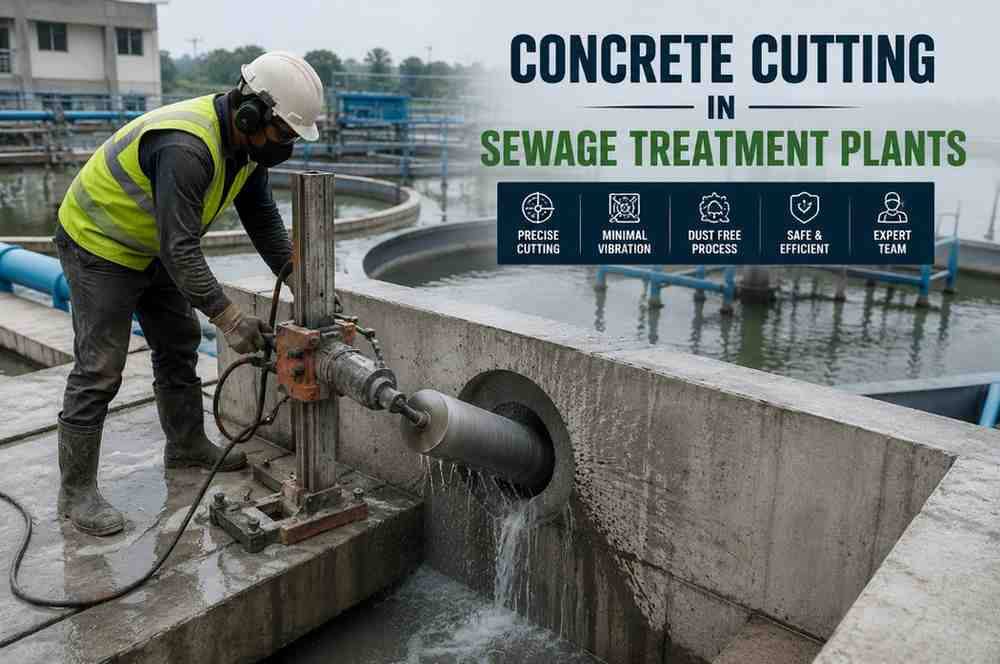
Introduction
Sewage treatment plants (STPs) are the backbone of municipal and industrial sanitation. These massive infrastructure assets process millions of gallons of wastewater daily, filtering, treating, and purifying water before it safely re-enters the ecosystem or is repurposed for industrial applications. However, like any heavy industrial facility, STPs are subject to mechanical wear, shifting ground conditions, environmental corrosion, and the ongoing demand for capacity upgrades.
When modifications, expansions, or repairs are required, facility managers invariably face a formidable obstacle: massive, heavily reinforced concrete structures.
Unlike standard commercial buildings, modifying an operational wastewater facility requires an exceptional level of precision, specialized machinery, strict environmental containment, and rigorous safety protocols. This comprehensive guide explores the complexities of concrete cutting in sewage treatment plants, the techniques required, the challenges faced by engineering teams, and why partnering with specialized professionals is vital for success.
The Critical Need for Concrete Modifications in STPs
Sewage treatment plants are rarely static. Over decades of operation, municipal growth and evolving environmental regulations necessitate structural interventions. Common scenarios requiring concrete cutting and core drilling within an STP include:
-
Capacity Expansion: Adding new aeration basins, secondary clarifiers, or biological filtration units often requires cutting into existing concrete walls to tie in new piping, channels, or structural extensions.
-
Piping and Infrastructure Upgrades: Modernizing a plant frequently involves routing larger-diameter inlet and outlet pipes through thick, reinforced concrete retaining walls or foundation slabs.
-
Equipment Replacement: Replacing aging pumps, heavy blowers, or massive slide gates often demands precision openings in concrete floors, machine pads, or wet wells.
-
Structural Remediation: Concrete exposed to hydrogen sulfide gas and moisture undergoes accelerated degradation over time. Repairing or replacing spalled, cracked, or structurally compromised concrete requires surgically removing damaged sections without destabilizing the rest of the facility.
-
Flow Diversion and Channel Modification: Rerouting wastewater streams during maintenance requires cutting new channels, weir openings, or sluice gate slots in existing concrete channels.
Unique Challenges of Concrete Cutting in Wastewater Facilities
Working inside or adjacent to a sewage treatment plant presents hazards and obstacles not found in typical construction or demolition environments. Contractors must navigate several critical challenges:
1. Hazardous Gases and Confined Spaces
STPs are notorious for hazardous atmospheres. Hydrogen sulfide (H2S), methane (CH4), carbon dioxide (CO2), and depleted oxygen levels are common hazards, particularly in subterranean structures, wet wells, grit chambers, and influent channels. Concrete cutting operations—especially those utilizing combustion engines or generating heavy friction—can introduce ignition sources or disrupt settled sludge, releasing trapped gases.
2. Live Operations and Continuous Flow
Most sewage treatment plants cannot simply shut down for a renovation. Plant operators must maintain continuous wastewater processing to prevent environmental disasters or regulatory violations. Consequently, concrete cutting must often be executed adjacent to live flows, active electrical feeds, and pressurized lines, requiring meticulous staging and containment.
3. Aggressive Chemical Environments
The constant presence of moisture, organic acids, and corrosive gases means that concrete within an STP is often severely degraded or structurally altered. Reinforcing steel (rebar) may be heavily oxidized and structurally compromised, making predictable breakage or stress distribution difficult during mechanical interventions.
4. Heavy Steel Reinforcement
STPs are engineered to withstand immense hydraulic pressures from millions of gallons of water and heavy equipment loads. Consequently, structural walls, slabs, and basins feature dense, multi-layered networks of heavy-gauge steel rebar and structural beams, demanding high-performance cutting equipment capable of slicing through concrete and steel simultaneously.
Advanced Concrete Cutting Techniques for STPs
Standard demolition hammers or excavators with hydraulic breakers are entirely inadequate for wastewater plant modifications. Heavy impact demolition causes micro-fractures in surrounding concrete, damages internal rebar integrity, compromises water-tight seals, and generates uncontrollable dust and debris. Instead, specialized non-percussive diamond cutting technologies are employed:
+---------------------------------------------------------------------------------+
|                        PRIMARY CONCRETE CUTTING METHODS                         |
+---------------------------+-----------------------------------------------------+
| Diamond Wire Sawing       | Ideal for massive structures, thick walls, and deep |
|                           | submerged foundations with complex geometries.      |
+---------------------------+-----------------------------------------------------+
| Core Drilling             | Perfect for creating clean, circular penetrations   |
|                           | for piping, conduits, and anchor bolts.             |
+---------------------------+-----------------------------------------------------+
| Wall Sawing               | Utilized for creating precise rectangular openings  |
|                           | for doors, hatches, and weir gates in vertical walls.|
+---------------------------+-----------------------------------------------------+
| Flat / Slab Sawing        | Applied on horizontal surfaces like tank floors,    |
|                           | walkways, and access roads.                         |
+---------------------------+-----------------------------------------------------+
1. Diamond Wire Sawing
For massive concrete structures such as thick secondary clarifier walls, thick bio-reactor basins, or submerged foundations, diamond wire sawing is the gold standard. A continuous steel cable threaded with industrial diamond beads is looped through pre-drilled holes and driven by a hydraulic or electric pulley system. It can slice through infinite thicknesses of heavily reinforced concrete quickly, smoothly, and without vibration.
2. Core Drilling
Core drilling utilizes diamond-impregnated cylindrical core barrels to extract precise circular cores from concrete structures. In STPs, core drilling is essential for installing new core-drilled pipe penetrations, taking material samples for compressive strength testing, or installing chemical-resistant anchoring systems for heavy mounting brackets.
3. Wall Sawing
When facility engineers need to cut precise rectangular openings in vertical concrete walls—such as installing new access hatches, viewing windows, or flow-control gates—track-mounted wall saws are employed. These saws utilize circular diamond blades driven along rigid tracks, ensuring laser-straight cuts with smooth finishes.
4. Slab / Flat Sawing
Slab sawing is used on horizontal surfaces, including access roads, equipment pads, and the concrete floors of treatment buildings or basins. Walk-behind saws powered by electric or low-emission hydraulic motors deliver rapid cutting depths while maintaining strict control over slurry containment.
Environmental and Safety Protocols
Given the sensitive nature of wastewater treatment facilities, safety and environmental protection are paramount during any concrete cutting operation.
-
Slurry Containment and Management: Concrete cutting generates a slurry mixture of water, concrete dust, and aggregate. In an STP, allowing slurry to enter wastewater streams, storm drains, or biological treatment basins can disrupt bacterial cultures, clog filtration systems, or violate environmental discharge permits. Contractors must use industrial wet-vacuums, containment berms, and filtration systems to capture and properly dispose of all slurry.
-
Strict Confined Space Compliance: Technicians operating in wet wells, vaults, or below-grade channels must adhere to OSHA and local safety regulations regarding confined space entry, continuous atmospheric monitoring, harness systems, and standby rescue personnel.
-
Vibration Monitoring: Excessive vibration from heavy equipment can compromise the structural integrity of adjacent, aging concrete structures or disrupt sensitive instrumentation and telemetry equipment. Precision diamond cutting eliminates percussive shock, safeguarding neighboring infrastructure.
-
Electrical and Utility Safety: STPs house high-voltage transformers, switchgears, and complex SCADA control systems. Comprehensive ground-penetrating radar (GPR) and utility locating must precede any cutting or drilling to avoid catastrophic utility strikes.
Best Practices for Facility Managers and Project Engineers
To ensure a seamless concrete modification project within a sewage treatment plant, facility managers and project planners should follow these essential best practices:
-
Conduct Thorough Structural and Material Assessments: Before breaking ground, perform non-destructive testing (such as GPR, ultrasonic pulse velocity, and core sampling) to understand rebar density, concrete thickness, and internal degradation levels.
-
Develop a Comprehensive Phasing Plan: Coordinate closely with plant operators to determine optimal operational windows, flow diversion strategies, and temporary bypassing requirements to maintain facility compliance.
-
Specify Electric or Hydraulic Equipment: To minimize toxic exhaust emissions inside enclosed spaces or underground basins, specify electric-powered or emission-controlled hydraulic cutting equipment.
-
Partner with Certified Industrial Specialists: Concrete cutting in a high-risk industrial environment like an STP requires specialized expertise. Always work with licensed, experienced professionals who understand wastewater infrastructure constraints.
Conclusion
Modifying and maintaining sewage treatment plants is a complex engineering challenge that requires precision, technical expertise, and rigorous adherence to safety and environmental standards. When structural changes demand cutting through massive, heavily reinforced concrete, traditional demolition methods simply will not suffice. Utilizing advanced non-percussive techniques such as diamond wire sawing and core drilling ensures structural stability, protects surrounding infrastructure, and keeps critical municipal sanitation operations running smoothly.
For expert consultation, project planning, and professional execution on your next wastewater facility modification, reach out to the specialists at [email protected].