
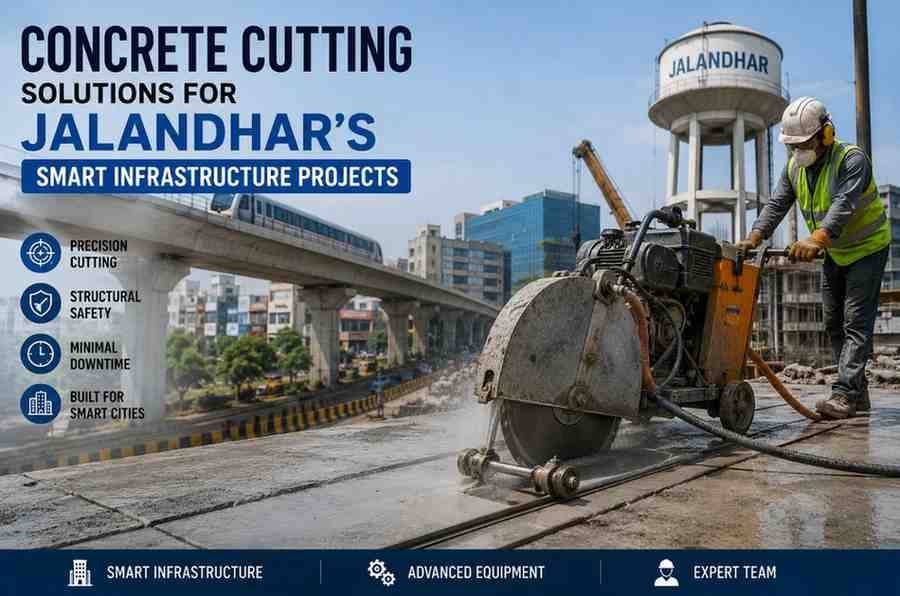
Jalandhar is changing fast. As one of Punjab's three cities selected under the central government's Smart City Mission, it has seen investment flow into smart roads, storm-water drainage networks, junction improvements, sports infrastructure, water treatment plants, and modern civic amenities. Behind almost every one of these visible transformations sits a less glamorous but essential trade: concrete cutting.
Whether it is laying a new drainage line beneath an already-built road, installing fibre optic cable ducts for smart traffic signals, retrofitting a decades-old building with modern utility access, or demolishing a section of ageing pavement to make way for a redesigned junction, none of it can happen without precise, controlled concrete cutting. This blog looks at how professional concrete cutting solutions are directly enabling Jalandhar's smart infrastructure push, the techniques involved, and why choosing the right contractor matters for a city under this much construction pressure.
Why Concrete Cutting Matters More Than Ever in Jalandhar
Jalandhar's smart city programme has touched dozens of projects across the city — junction redesigns, green area development, a large water treatment plant near Adampur, new reservoirs, upgraded storm drainage in the core urban area, and smart road development. Much of this work does not happen on empty land. It happens inside a living, functioning city, often beneath roads that are already in daily use, next to buildings that are already occupied, and around utility networks that already exist.
That is exactly the kind of environment where concrete cutting becomes indispensable. Unlike traditional breaking methods that rely on jackhammers and brute force, modern concrete cutting is engineered to be precise, low-vibration, and dust-controlled. It allows contractors to:
- Open trenches for new drainage or cabling without destabilising the surrounding road structure
- Create clean openings in existing walls and slabs for retrofitted utility connections
- Remove only the exact section of concrete that needs to go, leaving the rest of the structure untouched
- Work close to occupied buildings, live traffic, and existing underground services without the risk that comes with impact-based demolition
For a city trying to modernise its infrastructure while staying functional day to day, this precision is not a luxury. It is what keeps roads passable, buildings safe, and project timelines realistic.
Core Concrete Cutting Techniques Used in Smart City Work
Diamond Wall Sawing
Wall sawing uses a diamond-tipped circular blade mounted on a track system to make straight, controlled cuts through concrete walls, slabs, bridge decks, and pavements. It is the go-to method when a project needs a clean, straight-edged opening — for example, cutting a doorway into an existing structure, creating an opening for a new utility duct, or slicing through a section of road slab that needs to be lifted out intact. The track-guided system means the cut stays perfectly straight even through reinforced concrete, which matters a great deal when a road or structural wall cannot afford an uneven edge.
Concrete Core Drilling
Core drilling uses a hollow diamond bit to bore precise circular holes through concrete, brick, or masonry. This technique is central to smart infrastructure work because so much of it involves passing something through existing concrete — water pipes, electrical conduits, fibre optic cables for smart traffic and surveillance systems, HVAC lines, or anchor bolts for new fixtures. Core drilling can produce holes ranging from a few centimetres to well over a metre in diameter, and because the bit rotates rather than hammers, it does not create the micro-cracking that impact drilling can cause in surrounding concrete.
Road and Slab Sawing (Flat Sawing)
Flat sawing is used on horizontal surfaces — roads, pavements, footpaths, and floor slabs. A walk-behind or ride-on saw with a diamond blade cuts straight control joints or removal lines into the concrete. This is the technique most visible to the public, since it is what precedes almost every road-cutting operation for drainage, cabling, or utility repair work across Jalandhar's smart road corridors. Precise flat sawing means the surrounding pavement stays intact, and the reinstated patch sits flush once the trench is backfilled.
Wire Sawing
For thicker, heavily reinforced concrete sections — bridge piers, large structural elements, or sections too big for a standard blade — wire sawing uses a diamond-embedded cable looped around the structure and drawn through under tension. It can cut through concrete of virtually any thickness and is often used where conventional blades cannot reach, such as irregularly shaped structural elements in flyovers and junction improvement works.
Trench and Chain Sawing
Where a straight-line cut through concrete or masonry needs to go deeper than a flat saw can reach — for example, cutting through a thick culvert wall or an old masonry structure — chain saws fitted with diamond segments can plunge-cut in a single pass, which speeds up work on drainage and storm-water projects considerably.
Controlled Demolition and Selective Removal
Beyond cutting, many smart infrastructure projects require selective demolition — removing a defined section of an old structure (a redundant culvert, an obsolete road island, part of an ageing building) without disturbing what is meant to stay standing. Combining core drilling, wall sawing, and wire sawing allows a contractor to demolish selectively rather than knocking an entire structure down, which is critical when a project sits beside heritage structures, active roads, or nearby residential buildings.
How These Solutions Directly Support Jalandhar's Smart City Goals
Jalandhar's smart city investment has gone into storm-water drainage systems, smart road development in the core urban area, junction improvements, a large water treatment plant, new reservoirs, and upgraded public infrastructure. Each of these categories relies on concrete cutting in a specific way:
Storm-water drainage upgrades. Building a trunk storm drainage system through an already-developed part of the city means cutting through existing roads and pavements to lay new pipelines, then reinstating the surface cleanly. Precision flat sawing and trenching keep disruption to traffic and nearby properties to a minimum.
Smart road development. Roads built or resurfaced under the smart roads programme need control joints, utility access points, and periodic maintenance cuts. Clean sawing keeps the new road surface from cracking unpredictably and gives utility crews defined access points for future maintenance instead of ad hoc breaking.
Water treatment and reservoir infrastructure. Large-scale projects like the water treatment plant works around Jalandhar and the planned reservoirs across the city require core drilling for pipe penetrations through thick concrete tanks and walls, along with precision cutting for equipment installation and structural modifications.
Junction and public infrastructure improvements. Redesigning junctions, adding footpaths, or upgrading public spaces frequently means removing old concrete kerbs, islands, or slabs while protecting adjacent structures — work suited to selective demolition rather than blanket breaking.
Utility and smart-tech retrofits. Smart city infrastructure depends on cabling — for traffic signal systems, surveillance, and connectivity. Getting that cabling underground or through existing structures without damaging roads or buildings depends entirely on core drilling and controlled trenching.
What to Look for in a Concrete Cutting Contractor
Given how much of Jalandhar's development now runs through occupied, functioning parts of the city, the contractor handling the cutting work matters as much as the technique itself. A few things worth checking before hiring:
Experience with reinforced and structural concrete. Smart city works often involve older reinforced structures, culverts, and slabs of unknown thickness. A contractor should be able to assess reinforcement and structural load before cutting, not just start sawing.
Equipment range. A single project might need wall saws, core drills, flat saws, and wire saws depending on where the work moves. Contractors who carry a full equipment range avoid delays caused by switching vendors mid-project.
Dust and vibration control. Cutting near occupied buildings, live traffic, or sensitive utilities calls for wet-cutting methods and vibration-controlled techniques that limit disruption and protect nearby structures.
Safety compliance and trained operators. Concrete cutting equipment is powerful and, handled poorly, can be dangerous on a live construction or public site. Trained, certified operators and proper site safety protocols are non-negotiable, especially on projects near roads and pedestrians.
Track record on municipal and infrastructure work. Government and municipal infrastructure projects come with strict timelines and inspection requirements. A contractor familiar with that pace and documentation standard tends to cause fewer delays.
Core Cutting India: Built for Jalandhar's Infrastructure Push
At Core Cutting India, we work directly with the kind of precision concrete cutting that Jalandhar's smart infrastructure projects demand — diamond wall sawing, core drilling, flat sawing, wire sawing, and controlled selective demolition, all carried out with dust and vibration control suited to occupied, live sites. Our teams are equipped to handle everything from small utility core-drilling jobs to large-scale trenching and structural cutting on public infrastructure works.
As Jalandhar continues to build out its drainage systems, smart roads, water infrastructure, and public spaces, having a cutting partner who understands both the technical demands of reinforced concrete and the practical realities of working inside a busy, growing city makes a measurable difference to project timelines and safety outcomes.
For queries, project consultations, or to discuss a concrete cutting requirement anywhere in Jalandhar or across Punjab, reach out to Core Cutting India at [email protected].
Frequently Asked Questions
What is concrete cutting and why is it used in construction? Concrete cutting is the process of using diamond-tipped saws, drills, or wires to precisely cut, drill, or remove sections of concrete without damaging surrounding structures. It is used instead of manual breaking wherever accuracy, minimal disruption, or structural safety matters — which is most of the time on modern infrastructure and retrofit projects.
How much does concrete cutting cost in Jalandhar? Cost depends on the technique required, the thickness and reinforcement of the concrete, the volume of work, and site accessibility. Road sawing, core drilling, and wire sawing are priced differently, so it's best to get a site assessment and quote for an accurate figure.
What is the difference between core drilling and wall sawing? Core drilling creates round holes through concrete or masonry, typically for pipes, cables, or bolts. Wall sawing creates straight-line cuts through walls or slabs, usually to remove a defined section or create an opening. Many projects use both together.
Is concrete cutting safe for existing buildings and roads? Yes, when done by trained professionals using the right technique for the structure. Diamond cutting is far less disruptive than impact-based breaking, and methods like wet-cutting reduce dust and vibration, protecting nearby structures, utilities, and occupants.
How long does a concrete cutting project take? Timelines vary with scope — a single core-drilled utility opening might take hours, while a large drainage trenching project across a road stretch can take days. Working with a contractor that has the right equipment on hand keeps projects moving without avoidable delays.
Which company provides the best concrete cutting services in Punjab? Look for a contractor with a full range of cutting equipment, experience on reinforced and municipal infrastructure, and a track record of working safely on live sites. Core Cutting India ([email protected]) has been supporting infrastructure and construction projects across Punjab, including Jalandhar's ongoing smart city works, with this exact profile.