
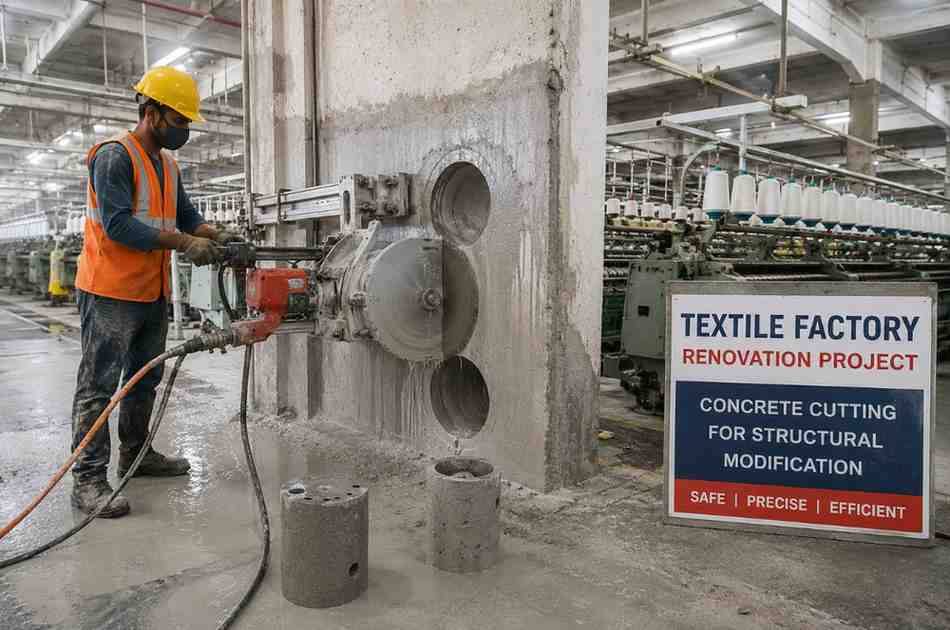
Surat has long been known as the textile hub of India, home to hundreds of power loom units, processing houses, dyeing mills, and garment manufacturing facilities. Many of these structures were built decades ago, and as the industry modernizes with new machinery, automated systems, and expanded floor space requirements, factory owners across the city are turning to renovation instead of rebuilding from scratch. At the center of almost every successful textile factory renovation project lies one critical, often overlooked process: concrete cutting.
Whether it's creating openings for new ventilation ducts, installing heavy machinery foundations, laying underground cabling, or expanding a loading bay, concrete cutting determines how smoothly a renovation project moves forward. This blog explores why concrete cutting has become an essential part of textile factory upgrades in Surat, the techniques involved, common challenges, and how to choose the right concrete cutting partner for your next project.
Why Textile Factories in Surat Are Renovating
Surat's textile sector has seen massive growth over the past two decades, but growth also means older infrastructure needs to catch up with modern demands. Several factors are driving renovation activity across the city's industrial belts, including Sachin, Pandesara, Udhna, and Katargam.
Aging Infrastructure: Many mills built in the 1980s and 1990s were designed for older machinery with lighter load requirements. Today's power looms, air-jet machines, and processing equipment are heavier and require reinforced foundations.
Automation and New Machinery: As factories adopt automated dyeing lines, computerized looms, and material handling systems, new pits, trenches, and equipment bases must be cut into existing concrete floors.
Compliance and Safety Upgrades: Fire safety norms, ventilation requirements, and effluent treatment regulations have tightened. Factories often need new openings for exhaust systems, fire escape routes, and drainage channels.
Space Optimization: With real estate in industrial zones becoming expensive, many mill owners prefer to renovate and expand vertically or reconfigure existing space rather than acquire new land.
Utility and Infrastructure Upgrades: Electrical conduits, water lines, and HVAC ducting often need to be routed through existing concrete slabs and walls, which cannot be done without precision cutting.
In every one of these scenarios, concrete cutting is the enabling process that makes structural modification possible without compromising the integrity of the building.
What Is Concrete Cutting and Why It Matters in Industrial Renovation
Concrete cutting refers to the controlled removal or shaping of concrete using specialized diamond-tipped tools and equipment. Unlike traditional demolition methods that rely on breakers and jackhammers, modern concrete cutting is precise, low-vibration, and far less disruptive to surrounding structures. This makes it particularly valuable in occupied or partially operational textile factories, where uncontrolled demolition could damage adjacent machinery, disrupt production schedules, or weaken load-bearing elements.
For a textile mill undergoing renovation, precision matters enormously. A slightly miscalculated cut in a load-bearing wall could compromise the structural stability of the entire building. Dust and vibration from poorly managed cutting work can also damage sensitive textile machinery, raw materials, or finished fabric stored nearby. This is why factory owners increasingly rely on professional concrete cutting contractors rather than general demolition crews.
Common Concrete Cutting Techniques Used in Textile Factory Renovations
1. Core Drilling
Core drilling creates precise, round holes through concrete floors, walls, or ceilings. In textile factory renovations, core drilling is commonly used for:
- Installing plumbing and drainage lines for dyeing and processing units
- Creating openings for electrical conduits and cable routing
- Fitting anchor bolts for new heavy machinery foundations
- HVAC and ventilation duct penetrations
Core drilling machines can cut through reinforced concrete with minimal noise and dust, making them ideal for use in factories that remain partially operational during renovation.
2. Wall Sawing
Wall sawing uses a track-mounted circular saw to make straight, controlled cuts through vertical concrete walls. This technique is often used when factories need to:
- Create new doorways or expand existing entry points for machinery movement
- Cut openings for large windows to improve natural ventilation
- Remove sections of walls to merge adjoining units or halls
Wall saws can cut to significant depths with high accuracy, ensuring clean edges that require minimal finishing work afterward.
3. Floor Sawing (Flat Sawing)
Floor sawing is used to cut horizontal concrete surfaces such as factory floors and slabs. This is particularly relevant when:
- Trenches need to be cut for underground utility lines
- Old, damaged flooring sections need to be removed and replaced
- Expansion joints need to be introduced to prevent future cracking
4. Diamond Wire Sawing
For thicker structural elements such as large columns, foundations, or heavily reinforced slabs, diamond wire sawing offers a flexible and powerful cutting solution. A diamond-embedded wire loop is used to cut through concrete and even steel reinforcement with precision, making it suitable for complex renovation work in older mill buildings with dense rebar structures.
5. Slab Cutting and Removal
When entire sections of flooring need replacement due to wear, chemical damage from dyeing processes, or structural upgrades, slab cutting allows contractors to remove large concrete sections in manageable pieces without damaging the surrounding floor area.
Challenges Specific to Textile Factory Renovation in Surat
Textile mills present a unique set of challenges compared to standard commercial or residential concrete cutting projects.
Chemical Exposure and Weakened Concrete: Dyeing and processing units often expose floors and walls to chemicals over years of operation, which can weaken concrete and make it more prone to unpredictable cracking during cutting. Experienced contractors assess concrete condition before beginning work to adjust their approach accordingly.
Operational Continuity: Many textile factory owners cannot afford extended production shutdowns. Concrete cutting work must often be scheduled around production hours, using low-noise and low-dust techniques to minimize disruption to ongoing operations.
Dust Control: Textile manufacturing is highly sensitive to dust contamination, which can affect fabric quality and machinery performance. Wet-cutting methods and dust extraction systems are essential to keep work areas clean and prevent contamination of nearby production zones.
Structural Uncertainty in Older Buildings: Many Surat textile mills are decades old, and original construction drawings may be incomplete or unavailable. Professional contractors use concrete scanning technology such as ground-penetrating radar (GPR) to detect embedded rebar, electrical conduits, and utility lines before cutting begins, reducing the risk of accidental damage.
Space Constraints: Dense machinery layouts and narrow aisles in many mills mean cutting equipment must be compact and maneuverable, requiring contractors experienced in tight industrial environments.
The Renovation Process: Where Concrete Cutting Fits In
A typical textile factory renovation project involving concrete cutting follows these broad stages:
- Site Assessment and Planning: Engineers evaluate the existing structure, identify load-bearing elements, and determine which walls, floors, or slabs need modification.
- Concrete Scanning: Before any cutting begins, scanning technology maps out rebar, cables, and pipes embedded within the concrete to avoid accidental damage.
- Method Selection: Based on the required openings and structural considerations, contractors select the appropriate combination of core drilling, wall sawing, floor sawing, or diamond wire sawing.
- Cutting Execution: Work is carried out using dust and noise control measures, often scheduled to minimize disruption to ongoing textile operations.
- Debris Removal and Finishing: Cut concrete sections are removed, and edges are finished to prepare the area for the next phase of renovation, such as machinery installation or utility fitting.
- Structural Reinforcement (if required): In some cases, new support structures are added around cut openings to maintain load distribution and structural integrity.
Choosing the Right Concrete Cutting Contractor in Surat
Given the specialized nature of textile factory renovation, choosing an experienced concrete cutting contractor is critical. Here are key factors factory owners in Surat should consider:
Industrial Experience: Look for contractors who have specifically worked on textile mills, processing units, or similar industrial facilities, not just residential or commercial projects.
Equipment and Technology: Modern diamond cutting equipment, dust suppression systems, and concrete scanning tools indicate a contractor's commitment to precision and safety.
Safety Compliance: Factory renovation work involves inherent risks. Contractors should follow strict safety protocols, including proper PPE, structural assessments, and adherence to local safety regulations.
Minimal Disruption Approach: A good contractor understands the operational realities of a working textile mill and plans cutting schedules to reduce downtime.
Transparent Estimates: Reliable contractors provide clear scope of work, timelines, and cost estimates before beginning any cutting activity, helping factory owners budget renovation projects accurately.
Track Record and References: Reviewing past projects, especially in similar industrial settings around Surat's textile clusters, gives factory owners confidence in a contractor's capability.
Frequently Asked Questions
What is concrete cutting used for in factory renovation? Concrete cutting is used to create openings for utilities, machinery foundations, doorways, ventilation systems, and structural modifications during factory upgrades, without the extensive damage caused by traditional demolition.
How much does concrete cutting cost in Surat? Costs vary based on the thickness of concrete, type of cutting method required, accessibility of the site, and the extent of reinforcement present. Getting a site assessment from a professional contractor is the most reliable way to obtain an accurate estimate.
Is concrete cutting safe for old textile mill structures? Yes, when performed by experienced contractors using proper scanning and assessment techniques. Precision cutting is generally safer for older structures than traditional breaking methods, as it reduces vibration and unpredictable stress on the surrounding structure.
How long does concrete cutting take for a factory floor? Timelines depend on the size of the area, concrete thickness, and reinforcement density. Small openings may take a few hours, while larger floor sections or extensive trenching work can take several days.
What is the difference between core drilling and wall sawing? Core drilling creates round holes typically used for pipes, cables, or bolts, while wall sawing makes straight, larger cuts through vertical surfaces, commonly used for doorways, windows, or wall removal.
Conclusion
As Surat's textile industry continues to modernize, concrete cutting has become an indispensable part of factory renovation projects across the city. From core drilling for new utility lines to wall sawing for expanded machinery access, precise and professional concrete cutting allows mill owners to upgrade their facilities safely, efficiently, and with minimal disruption to ongoing operations.
Choosing an experienced concrete cutting partner who understands the specific challenges of industrial textile environments makes all the difference between a smooth renovation and a costly, delayed project. For factory owners in Surat planning an upgrade, working with specialists who bring the right equipment, technical knowledge, and industrial experience ensures the renovation is completed safely and on schedule.
For professional concrete cutting services tailored to textile factory renovation projects in Surat, reach out to Core Cutting India at [email protected] to discuss your project requirements and get a detailed site assessment.