
Introduction
Beneath every modern city lies a hidden network of cables, pipelines, ducts, and drainage systems that keep urban life running smoothly. Building and maintaining this underground infrastructure requires more than heavy excavation — it demands precision. This is where concrete cutting for underground service corridors becomes essential. Whether it's laying fiber-optic cables, installing stormwater drains, or creating access points for gas and water lines, controlled concrete cutting ensures the work is done safely, cleanly, and with minimal disruption to surrounding structures.
At Core Cutting India (info@corecuttingindia.com), we specialize in delivering accurate, vibration-free concrete cutting solutions tailored for underground service corridor projects. In this blog, we'll explore why concrete cutting is critical for underground infrastructure, the techniques and equipment involved, safety considerations, and how to choose the right concrete cutting partner for your next project.
What Are Underground Service Corridors?
Underground service corridors are dedicated pathways built beneath roads, footpaths, buildings, or open ground to house essential utility lines. These corridors typically carry:
- Electrical and power transmission cables
- Telecommunication and fiber-optic networks
- Water supply and sewage pipelines
- Gas distribution lines
- Stormwater drainage systems
- District cooling or heating pipes in large urban developments
Rather than digging up land repeatedly every time a new utility needs to be installed or repaired, planners create structured corridors that consolidate multiple services in one accessible route. Concrete cutting plays a foundational role in creating, expanding, and maintaining these corridors — especially in areas where concrete slabs, pavements, or structural elements already exist.
Why Concrete Cutting Is Essential for Underground Corridors
Unlike traditional demolition, which relies on breaking or jackhammering concrete, professional concrete cutting uses diamond-tipped tools to create clean, controlled cuts. This precision is particularly important for underground service work for several reasons:
1. Protecting Existing Infrastructure
Underground corridors are rarely built on empty land. Cutting through existing concrete slabs, roads, or basement floors near live cables or pipelines requires exact depth and width control to avoid accidental damage — something that percussive breaking methods simply cannot guarantee.
2. Minimizing Structural Vibration
Buildings, retaining walls, and nearby foundations can be sensitive to vibration. Diamond-based cutting techniques generate significantly less vibration than jackhammers or impact breakers, reducing the risk of cracks or structural stress in adjacent structures.
3. Reducing Noise and Dust Pollution
Modern concrete cutting methods, especially wet cutting techniques, suppress dust and reduce noise levels considerably. This is critical when work is being carried out in populated areas, near hospitals, schools, or commercial zones where underground utility corridors often need to be installed or repaired.
4. Enabling Precise Trenching
Service corridors need to follow exact alignments to accommodate multiple utility lines running parallel to each other. Concrete cutting allows contractors to create straight, uniform trenches and openings that match engineering drawings precisely.
5. Faster Project Turnaround
Clean cuts mean faster removal of concrete sections, quicker access to the corridor area, and reduced rework — all of which shorten project timelines and reduce costs.
Common Concrete Cutting Techniques Used for Underground Service Corridors
Different sections of a service corridor project may require different cutting approaches. Here are the most widely used techniques:
Road and Floor Sawing
Used for cutting straight lines across roads, pavements, or industrial floors, road sawing machines use large diamond blades mounted on a self-propelled unit. This method is ideal for opening long trench lines for cable or pipe corridors running under streets or parking areas.
Wall Sawing
When a corridor needs to pass through vertical concrete structures — such as basement walls, retaining walls, or utility vaults — wall saws are used. These track-mounted diamond saws deliver precise, straight vertical or angled cuts, often needed where corridors connect to manholes or service chambers.
Core Drilling
Core drilling creates circular holes through concrete, commonly used for:
- Cable and pipe entry/exit points
- Vertical shafts connecting surface access points to underground corridors
- Utility duct penetrations through slabs and walls
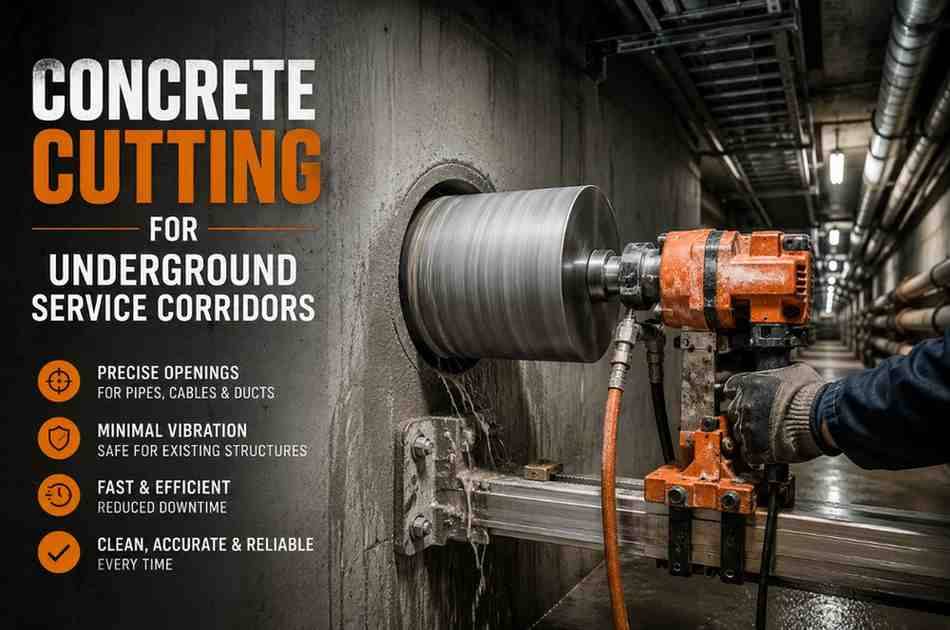
Core drilling is especially valuable because it's low-vibration and can be performed in tight spaces where larger machinery cannot operate.
Diamond Wire Sawing
For thicker concrete sections, reinforced structures, or areas with limited access, diamond wire sawing is the go-to method. A diamond-embedded wire loop moves at high speed to slice through concrete of virtually any thickness, making it ideal for large-scale corridor openings or removing bulky concrete sections near existing utilities.
Hydraulic and Chain Sawing
For confined underground spaces such as service tunnels or narrow trenches, hydraulic saws and chain saws offer maneuverability that larger equipment cannot match, allowing precise cuts in tight, low-headroom environments.
Step-by-Step Process for Cutting Underground Service Corridors
- Site Survey and Utility Mapping — Before any cutting begins, existing underground utilities are mapped using ground-penetrating radar (GPR) and utility detection tools to avoid damaging live cables or pipes.
- Engineering and Cut Planning — Based on corridor design drawings, cutting lines, depths, and access points are marked out with precision.
- Selecting the Right Cutting Method — Depending on concrete thickness, reinforcement, and location (road, wall, or slab), the appropriate technique (wall sawing, core drilling, wire sawing, etc.) is selected.
- Wet or Dry Cutting Execution — Most professional jobs use wet cutting to control dust and cool the diamond blades, ensuring cleaner cuts and longer tool life.
- Concrete Removal — Cut sections are carefully lifted and removed without disturbing the surrounding soil or nearby utility lines.
- Trench/Corridor Preparation — The exposed area is prepared for utility installation, including bedding material, conduit placement, and protective sleeves.
- Reinstatement — Once utilities are installed and inspected, the corridor is backfilled and the concrete surface is restored to match the original structure.
Safety Considerations for Underground Concrete Cutting
Working near live utilities and below ground level introduces unique risks. Professional concrete cutting teams follow strict safety protocols, including:
- Utility Locating Before Cutting — Using GPR, electromagnetic locators, and existing service drawings to identify buried cables and pipes.
- Controlled Cutting Depth — Setting precise blade depth limits to prevent accidental strikes on utilities just beneath the surface.
- Dust and Slurry Management — Using wet-cutting techniques and vacuum slurry collection to maintain a safe, clean worksite.
- Confined Space Protocols — When cutting within underground vaults, tunnels, or chambers, proper ventilation, gas monitoring, and emergency access plans are essential.
- Structural Assessment — Evaluating load-bearing elements before cutting to avoid compromising structural integrity of roads, buildings, or retaining walls.
- PPE and Trained Operators — Ensuring all personnel use appropriate protective equipment and are trained specifically in diamond cutting techniques.
Challenges in Underground Service Corridor Cutting
While concrete cutting technology has advanced significantly, underground corridor projects still present unique challenges:
- Congested Utility Zones — Multiple existing services running close together increase the risk of accidental damage and require extremely precise cutting.
- Variable Concrete Composition — Older infrastructure may contain unpredictable reinforcement patterns, requiring adaptable cutting approaches.
- Limited Access — Tunnels, basements, and narrow trenches often restrict the size of equipment that can be used.
- Traffic and Public Disruption — Road-based corridor projects must be carefully scheduled and managed to minimize disruption to traffic and pedestrians.
- Environmental Regulations — Dust, noise, and slurry disposal must comply with local environmental guidelines, especially in urban or residential zones.
An experienced concrete cutting contractor anticipates these challenges and adapts equipment and techniques accordingly, ensuring the project stays on schedule and within budget.
Why Choose Core Cutting India for Your Underground Corridor Project
At Core Cutting India, we bring specialized expertise, modern diamond cutting equipment, and a safety-first approach to every underground service corridor project. Our capabilities include:
- Advanced GPR-based utility scanning before any cutting begins
- Wall sawing, road sawing, core drilling, and diamond wire sawing services
- Low-vibration, low-noise, and dust-controlled cutting methods
- Experienced operators trained for confined and underground environments
- Fast turnaround to minimize disruption to roads, buildings, and public spaces
- Full compliance with safety and environmental regulations
Whether you're a utility company, government contractor, or private developer, our team ensures your underground service corridor is cut with precision and completed on time.
Conclusion
Underground service corridors form the backbone of modern infrastructure, and the success of these projects depends heavily on the quality of concrete cutting work performed. From protecting existing utilities to reducing structural risk and speeding up construction timelines, professional concrete cutting is not just a construction step — it's a critical enabler of safe, reliable underground infrastructure.
If you're planning a utility corridor, cable duct installation, or pipeline trenching project, partner with experts who understand the precision this work demands.
Get in touch with Core Cutting India today at info@corecuttingindia.com to discuss your underground service corridor cutting requirements.
Frequently Asked Questions (People Also Ask)
1. What is concrete cutting used for in underground utility work? Concrete cutting is used to create precise openings, trenches, and access points in existing concrete structures so that cables, pipes, and ducts can be installed or accessed without unnecessary damage to surrounding infrastructure.
2. How deep can concrete cutting machines cut? Depending on the equipment used, road saws and wall saws can typically cut up to 24-30 inches deep, while diamond wire saws can cut through concrete of virtually unlimited thickness, making them suitable for large structural sections.
3. What is the difference between core drilling and wall sawing? Core drilling creates circular holes through concrete, typically used for cable or pipe penetrations, while wall sawing creates straight-line cuts through vertical concrete surfaces, often used to open larger sections for corridor access.
4. How much does concrete cutting cost per square foot in India? Costs vary based on concrete thickness, reinforcement, cutting method, and site accessibility. It's best to request a site-specific quote from a professional contractor like Core Cutting India for an accurate estimate.
5. Is concrete cutting safe near existing underground cables and pipes? Yes, when performed by trained professionals using utility detection tools like ground-penetrating radar and controlled-depth cutting equipment, concrete cutting can be done safely even in close proximity to live utilities.
6. How long does it take to cut a concrete service corridor? Project duration depends on corridor length, concrete thickness, and site conditions. Small sections may take a few hours, while larger corridor projects can take several days to complete safely and accurately.
Core Cutting India | info@corecuttingindia.com