
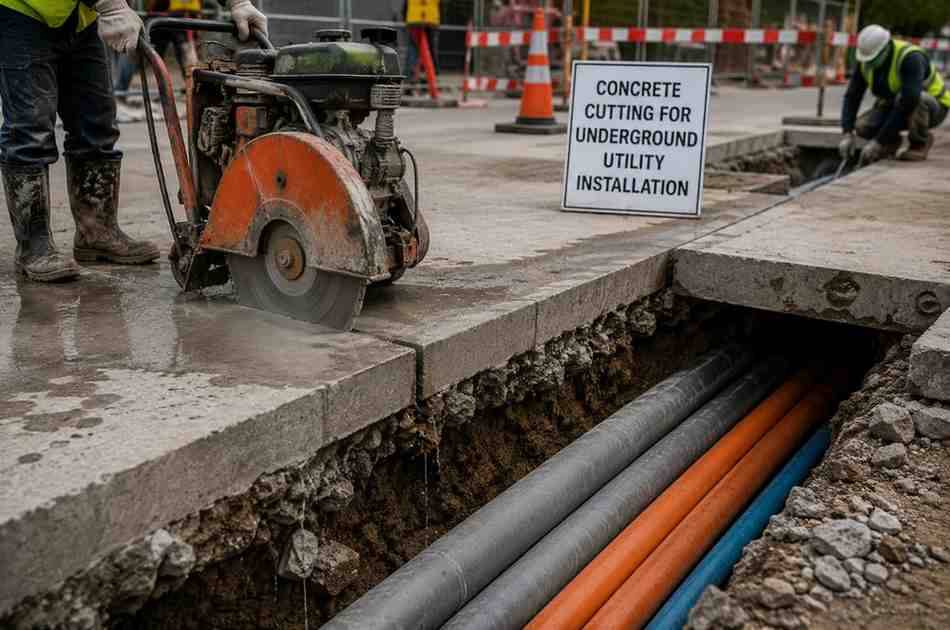
Modern infrastructure relies heavily on what lies beneath the surface. From municipal water lines and high-voltage electrical grids to telecommunication fiber optics and gas mains, a complex web of underground utilities keeps modern cities moving. However, laying down or repairing these vital lifelines in densely populated urban zones or established industrial parks rarely happens on untouched earth.
Instead, contractors routinely encounter thick layers of reinforced concrete, roadways, foundation slabs, and structural barriers. This is where specialized concrete cutting steps in as a non-negotiable foundational phase of underground utility construction.
At [email protected], we understand that precision, structural safety, and minimal disruption are the ultimate benchmarks of a successful project. In this comprehensive guide, we will explore the intricate relationship between concrete cutting and underground utility installation, the techniques used, safety protocols, and how to choose the right methodology for your next job.
The Critical Intersection of Concrete Cutting and Utility Work
When planning an underground utility installation, project managers must account for existing surface structures. Whether you are retrofitting a downtown metropolitan street or expanding an industrial manufacturing plant, the ground is frequently armored in concrete.
Attempting to excavate or trench without precise concrete cutting leads to uncontrolled cracking, structural damage to adjacent slabs, expensive project delays, and severe safety hazards.
Concrete cutting acts as the surgical mechanism for civil engineering. By creating clean, predetermined boundary lines, cutting allows heavy machinery and hand crews to remove only the exact volume of material required for the utility trench. This preserves the integrity of the surrounding pavement or foundation, drastically reducing overall restoration time and material costs.
Target-Related Searches & People Also Ask (PAA)
Target-Related Searches
-
Concrete cutting methods for utility trenches
-
Best diamond blades for road sawing
-
Sub-surface utility engineering and concrete cutting
-
Utility cut restoration procedures
-
Heavy-duty core drilling for underground pipes
People Also Ask (PAA) Questions
-
How deep can you cut concrete for a utility trench?
-
What is the difference between flat sawing and wall sawing in utility projects?
-
Why is Ground Penetrating Radar (GPR) necessary before cutting concrete?
-
How do contractors restore concrete after a utility cut?
Phase 1: Pre-Planning and Sub-Surface Investigation
Before a single diamond blade touches the pavement, thorough site evaluation and scanning must take place. Cutting blindly into concrete where historical utilities might already exist is a recipe for disaster.
1. Utility Mapping and GPR Scanning
Modern underground utility installation begins with Ground Penetrating Radar (GPR) and electromagnetic locators. At [email protected], we emphasize non-destructive testing to map out existing conduits, rebar, post-tension cables, and active utility lines. This step ensures that the planned cuts do not accidentally sever live power or water lines, safeguarding both workers and the community.
2. Layout and Marking
Once the path of the new utility corridor is approved by civil engineers, the exact perimeter of the trench is marked on the concrete surface using chalk, high-visibility paint, or snap lines. Precision during this layout phase dictates the accuracy of the final excavation.
Core Concrete Cutting Techniques Used in Utility Projects
Different job sites require different approaches. Depending on whether you are cutting horizontal roadways, vertical barriers, or boring entry points, various specialized techniques are deployed.
+-----------------------------------------------------------------+
|               PRIMARY CONCRETE CUTTING TECHNIQUES               |
+--------------------------+--------------------------------------+
| Technique                | Primary Utility Application          |
+--------------------------+--------------------------------------+
| Flat / Slab Sawing       | Roads, highways, warehouse floors    |
| Core Drilling            | Entry/exit ports for pipes & cables  |
| Wall / Track Sawing      | Vertical foundations, basement entry |
| Wire Sawing              | Massive mass concrete, bridge piers  |
+--------------------------+--------------------------------------+
Flat Sawing (Slab Sawing)
Flat saws—often referred to as walk-behind saws—are powered by gasoline, diesel, electricity, or hydraulics. They are outfitted with diamond blades and are engineered to make straight, horizontal cuts across roads, bridge decks, runways, and factory floors.
-
Application in Utilities: Ideal for cutting the rectangular perimeters of utility trenches on streets or concrete pavements prior to backhoe excavation.
Core Drilling
When utility lines must transition from the exterior underground network into a building through a thick foundation wall or floor slab, core drilling is utilized.
-
Application in Utilities: Creates perfectly round, clean apertures ranging from an inch to several feet in diameter, allowing pipes, electrical conduits, and communication sleeves to pass through seamlessly.
Wall Sawing
Utilizing a track-mounted cutting head equipped with a diamond blade, wall sawing allows for precise cuts on vertical surfaces or steep inclines.
-
Application in Utilities: Used when utility vaults, subterranean chambers, or basement access panels require structured openings cut into reinforced concrete walls.
Wire Sawing
For massive, ultra-thick concrete structures—such as heavy industrial foundations, thick dams, or subterranean concrete bulkheads that standard saws cannot clear—wire sawing is deployed. A multi-strand steel cable embedded with diamond beads is pulled through and around the concrete in a continuous loop, slicing cleanly through heavy reinforcement.
Step-by-Step Execution of a Utility Trench Cut
Executing a clean utility cut requires a methodical sequence to ensure structural safety and efficient debris extraction.
-
Relief Cuts: For thick slabs (typically over 7 inches), contractors often make buffer cuts or pressure relief cuts inside the main trench boundary. This relieves internal stresses in the concrete and prevents the blade from pinching or binding during full-depth sawing.
-
Full-Depth or Perimeter Sawing: The diamond blade cuts down to the required depth or fully through the slab. Clean, vertical, or slightly inward-tapered edges are preferred as they provide superior mechanical interlock during future patch restorations.
-
Controlled Breakout: Once the perimeter is severed, hydraulic breakers, concrete crushers, or pneumatic jackhammers with reduced impact energy are used to break up the interior concrete block without fracturing the surrounding slab edge.
-
Trench Excavation & Utility Laying: Debris is cleared away, and earth excavation commences to reach the proper engineering depth. Bedding material is laid, and the utility pipes or conduits are installed.
Safety and Environmental Management
Concrete cutting is high-impact work that involves heavy machinery, high-voltage or fuel-powered equipment, and crystalline silica dust. Managing these factors is critical for project compliance.
-
Dust Suppression (Wet Cutting): Inhalation of silica dust generated during dry concrete cutting poses severe health hazards. Professional contractors exclusively use wet cutting techniques, continuously feeding water onto the blade to suppress dust particles, cool the diamond segments, and extend blade life.
-
Slurry Management: Wet cutting produces a muddy byproduct known as concrete slurry. Environmental controls, including vacuum attachments and settling tanks, must be utilized to prevent slurry from entering storm drains or contaminating local ecosystems.
-
Personal Protective Equipment (PPE): Operators and crew members must wear high-decibel ear protection, eye protection, heavy-duty gloves, steel-toed boots, and respiratory protection compliant with local safety standards.
Utility Cut Restoration: Putting It Back Together
Once the utility lines have been successfully placed, tested, and inspected, the trench must be backfilled and the surface restored. Proper restoration ensures that the pavement does not sink, settle, or cause hazards for future traffic.
-
Flowable Fill or Aggregate Backfill: Trenches are systematically backfilled in compacted layers or filled with flowable fly-ash/soil mixtures that solidify rapidly, providing a stable sub-base.
-
High-Early-Strength Concrete: To minimize traffic downtime in urban centers, fast-setting concrete mixtures or precast concrete panels are often specified, allowing roads to be reopened to traffic within hours of the pour.
Why Choose Professional Concrete Cutting Services?
Partnering with experienced specialists for your underground utility projects eliminates guesswork. Attempting utility cuts with makeshift tools or inexperienced labor frequently results in jagged edges, structural compromise, damaged internal utilities, and inflated project costs.
At [email protected], we bring advanced diamond-cutting technology, certified operators, and a safety-first mindset to every job site. Whether you are managing a municipal expansion, an industrial plant upgrade, or a commercial site development, professional concrete cutting ensures your utility installation starts on solid, precise ground.
Conclusion
Concrete cutting for underground utility installation is far more than just a preliminary demolition task—it is an exercise in precision engineering. By integrating advanced scanning, modern diamond-sawing techniques, strict environmental controls, and structured restoration methods, civil contractors can successfully weave essential infrastructure beneath our cities safely and efficiently.
For expert advice, project consultations, and professional cutting services tailored to your upcoming utility projects, reach out to the experts today at [email protected].