
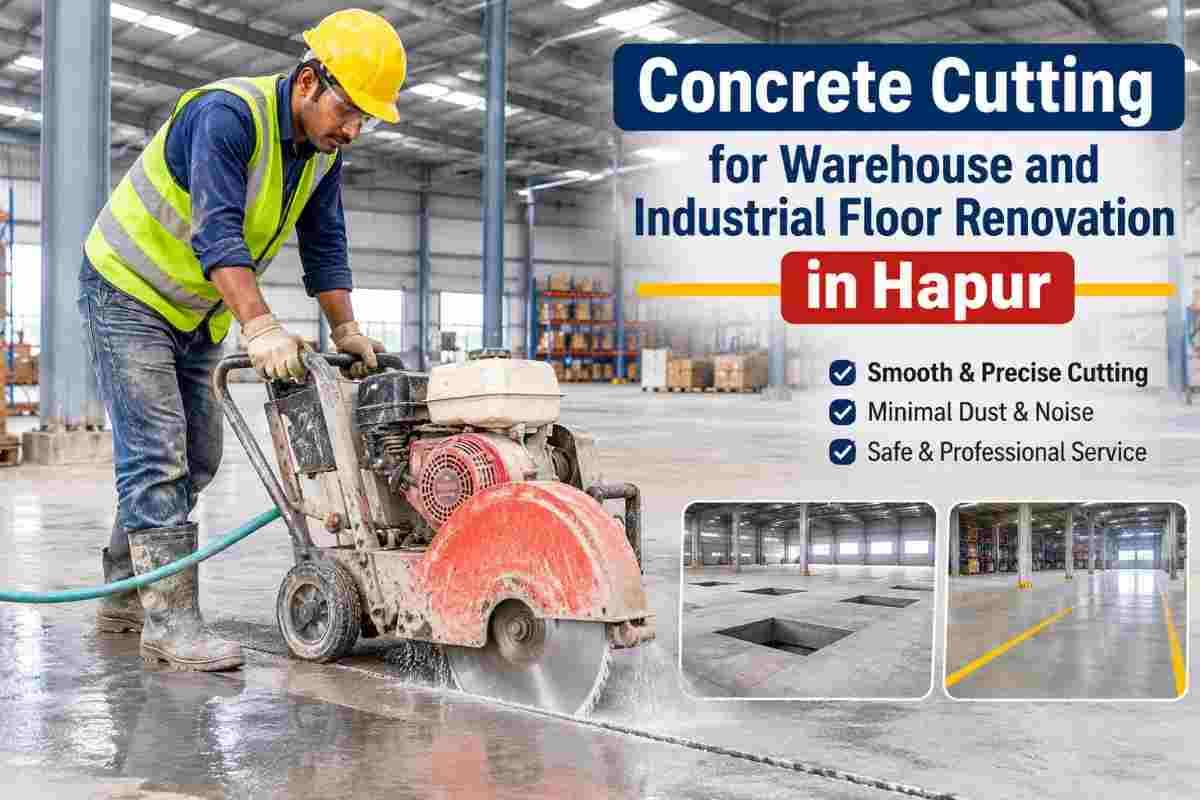
Hapur has become one of the busiest industrial and logistics hubs in western Uttar Pradesh. Its position on NH-9, close to Delhi, Ghaziabad and Meerut, has drawn warehouses, packaging units, cold storage facilities, paper mills, pharma plants and manufacturing sheds to the area. As these facilities age or expand, their floors are often the first thing that needs attention.
Industrial floors carry forklifts, pallet jacks, heavy racking and vibrating machinery every day. Sooner or later they crack, settle, or no longer fit a new layout. Renovating them without disturbing the rest of the structure takes precision, and that is where professional concrete cutting comes in.
At Core Cutting India (https://corecuttingindia.com/), we provide controlled, accurate concrete cutting for warehouses and industrial floors in Hapur and nearby areas. This guide covers how the process works, where it is used, what affects cost, and how to choose the right contractor.
What Is Concrete Cutting?
Concrete cutting is the process of cutting, drilling or removing sections of concrete using diamond-tipped tools. Unlike breaking concrete with hydraulic breakers or jackhammers, which causes vibration and uncontrolled cracking, diamond cutting follows a marked line. The result is clean edges, limited vibration, and far less damage to the surrounding structure.
The main techniques include:
- Slab and floor sawing, which cuts straight lines through floors
- Core drilling, which makes round holes for pipes, ducts and cables
- Wall sawing, which cuts openings in concrete walls
- Wire sawing, which handles very thick or large structures
- Hand sawing, which reaches corners and confined spaces
Why Warehouse and Industrial Floors in Hapur Need Concrete Cutting
Hapur’s industrial belt is constantly evolving. Businesses expand, change tenants, install new machinery and upgrade their logistics. Each of these changes can require alterations to an existing concrete floor.
Common reasons include:
- Layout changes. New racking, conveyors or production lines may need trenches or openings the original floor never had.
- Damaged sections. Heavy loads, chemical exposure and poor sub-base compaction cause cracking, spalling and settlement.
- Utility upgrades. New drainage, electrical conduits, compressed air lines and fire safety pipework often need cuts through the slab.
- Machine foundations. Installing heavy machinery means removing part of the old floor and casting a proper foundation.
- Expansion and joints. Control joints and expansion joints must be cut at the right depth and spacing to prevent random cracking.
- Dock and ramp modifications. Loading bays and ramps are frequently reconfigured as traffic patterns change.
Demolishing and rebuilding an entire floor is slow and costly. Targeted concrete cutting lets you renovate only what is necessary and keep the rest of the facility running.
Concrete Cutting Methods Used in Floor Renovation
Floor Saw (Slab Saw) Cutting
A floor saw is a walk-behind machine fitted with a diamond blade. It is the primary tool for industrial floor renovation. It cuts straight, accurate lines to a set depth, which makes it ideal for:
- Removing damaged panels
- Cutting trenches for drainage or services
- Creating expansion and contraction joints
- Cutting openings for machine pits
Depth control matters here. Cutting too deep risks damaging reinforcement, embedded conduits or underground services. Cutting too shallow leaves concrete that is hard to remove cleanly.
Core Drilling
Core drilling uses a hollow diamond bit to remove a cylinder of concrete. Industrial sites use it for plumbing, HVAC, cable routing, anchor holes, sprinkler lines and ventilation. The holes are clean and accurately sized, and the method creates very little vibration. That is important in facilities where sensitive equipment or stored goods are nearby.
Wall Sawing
When a renovation involves new doorways, windows, or openings for machinery and ducts in concrete walls, wall sawing is the safest approach. The saw runs on a rail and cuts large, precise openings without weakening the adjacent wall.
Wire Sawing
Wire sawing is used for very thick concrete, heavy foundations, columns or sections that standard saws cannot reach. A diamond wire loops around the section and cuts through it, which suits large industrial demolition and modification work.
Hand Sawing and Detail Work
Corners, edges near walls and tight spaces need smaller tools such as hand saws, which can finish cuts that larger machines cannot reach.
Typical Applications in Warehouse and Industrial Renovation
Trench cutting for drainage and utilities. Food processing units, pharma plants and wash bays need drainage channels. Floor sawing creates trenches with clean edges that make pipe laying and re-concreting easier.
Removal of damaged floor sections. Instead of replacing the entire floor, damaged panels are cut out along joint lines and replaced with new concrete, which saves time and material.
Machine pit and foundation openings. Large equipment needs vibration-isolated foundations. Cutting a precise opening in the old slab keeps the surrounding floor intact.
Floor leveling and re-surfacing preparation. Where floors need grinding, topping or coating, cutting out failed sections first gives the new surface a sound base.
Opening for lifts, stairs and mezzanines. Adding a mezzanine or lift in an existing warehouse often means cutting through slabs and walls to exact dimensions.
Cold storage modifications. Cold rooms have insulated floors and strict structural limits. Precision cutting avoids damaging insulation layers and vapour barriers.
Step-by-Step Concrete Cutting Process
A well-run project follows a clear sequence:
1. Site inspection and survey. The team checks the slab thickness, reinforcement layout and the location of utilities. Where possible, scanning tools identify rebar, conduits and post-tension cables before cutting begins.
2. Planning and marking. Cut lines are marked according to drawings or the client’s requirements. Planning also covers debris handling, access routes and shutdown windows.
3. Safety setup. Work areas are cordoned off, and water supply, slurry collection and dust control measures are arranged.
4. Cutting. Floor saws, core drills or wall saws are used to make the cuts to the specified depth and dimensions.
5. Removal of concrete. Cut sections are lifted out in manageable pieces, usually with small equipment suited to indoor work.
6. Cleanup. Slurry, dust and debris are removed, leaving the site ready for the next trade, whether that is re-concreting, flooring or machinery installation.
Benefits of Professional Concrete Cutting
Precision. Diamond cutting follows exact lines, so openings match drawings and new work fits properly.
Minimal vibration. Unlike breakers, cutting does not shake the building. This protects neighbouring structures, racking and equipment.
Less damage to existing structure. Clean cuts prevent micro-cracking in the concrete you intend to keep.
Faster completion. Controlled cutting reduces rework and lets follow-up trades start sooner, which shortens downtime.
Reduced noise and dust. Wet cutting and slurry control keep dust down, which matters in food, pharma and packaging facilities.
Cost efficiency. You pay to modify only what is needed instead of rebuilding entire floors.
Safety and Environmental Considerations
Concrete cutting in an operating industrial facility must be planned carefully. Good practice includes:
- Wet cutting to suppress silica dust, which is harmful when inhaled
- Slurry collection so water and concrete residue do not spread across the site or enter drains
- Utility scanning to avoid striking live cables, gas lines or water pipes
- Proper PPE, including respirators, ear protection, gloves and safety footwear
- Barricading to keep unauthorised people away from the cutting zone
- Structural assessment to confirm that cuts will not compromise load paths
A professional contractor treats these steps as standard, not optional.
What Affects the Cost of Concrete Cutting in Hapur?
Pricing varies from project to project. The main factors are:
- Slab thickness and depth of cut. Deeper cuts take longer and wear blades faster.
- Amount of reinforcement. Heavily reinforced concrete is harder and slower to cut.
- Total running length or number of holes. Costs are usually calculated per running metre for sawing and per hole (by diameter and depth) for core drilling.
- Site access. Tight or elevated locations may need special equipment.
- Working hours. Night or weekend shifts, often needed to avoid disrupting operations, can affect pricing.
- Debris removal and disposal. Some quotes include hauling away broken concrete, others do not.
- Project size and scheduling. Larger or multi-phase jobs may be priced more favourably.
The most reliable way to get an accurate figure is a site visit and written quotation.
How to Choose the Right Concrete Cutting Contractor in Hapur
Because a mistake in an industrial floor can be expensive, choose carefully. Look for:
- Relevant experience. Ask about previous warehouse, factory or cold storage projects.
- Modern equipment. Well-maintained diamond tools produce cleaner cuts and faster results.
- Trained operators. Skill matters as much as machinery, especially around reinforcement and services.
- Clear safety practices. Ask how they handle dust, slurry and site safety.
- Transparent quotations. The scope, rates and exclusions should be spelled out clearly.
- Timely delivery. Warehouses and factories lose money when work overruns, so reliability counts.
- Responsive communication. A contractor who answers questions promptly is easier to coordinate with.
Why Choose Core Cutting India for Concrete Cutting in Hapur?
Core Cutting India specialises in concrete cutting, core drilling and related services for industrial, commercial and infrastructure projects. For warehouse and factory owners in Hapur, we offer:
- Floor saw cutting for trenches, joints and panel removal
- Core drilling for utilities, ducts and anchor points
- Wall sawing for new openings in concrete walls
- Wire sawing for heavy or thick structures
- Dust-controlled, vibration-free methods suited to working facilities
- Practical planning that fits around your operations
We focus on accurate cutting, safe working methods and keeping your downtime short. Visit https://corecuttingindia.com/ to learn more about our services.
Frequently Asked Questions
What is concrete cutting and how is it different from demolition?
Concrete cutting uses diamond tools to cut precise sections of concrete, while demolition typically breaks concrete in bulk with breakers or heavy machinery. Cutting is controlled, causes less vibration and protects the surrounding structure.
Can concrete floors be cut without stopping warehouse operations?
In many cases, yes. Work can be done in phases, in specific zones, or during off-hours. Wet cutting and slurry control reduce dust, and cutting causes far less vibration than breaking. The exact approach depends on your layout and the work involved.
How deep can a floor saw cut?
Depth depends on the blade size and the machine. Industrial floor saws can cut to considerable depths, and deeper or thicker slabs can be handled with wall saws or wire saws. A site inspection will confirm what is suitable for your slab.
Is core drilling safe for reinforced concrete?
Yes, when done correctly. Diamond core bits can cut through rebar. However, scanning before drilling is good practice so that critical reinforcement, conduits and utilities are avoided wherever possible.
How long does an industrial floor cutting project take?
Small jobs such as a few core holes can finish in hours. Larger projects involving trenches, panel removal or multiple openings may take several days. The timeline depends on cut length, thickness, reinforcement and site access.
Does concrete cutting create a lot of dust?
Dry cutting creates significant dust, which is why wet cutting is preferred. Water suppresses dust at the source, and slurry is collected and removed afterward.
How do I get a quote for concrete cutting in Hapur?
Share your requirements, such as the type of work, approximate dimensions and location, and request a site visit. You can call Core Cutting India on +91 70096 79903 or visit https://corecuttingindia.com/ to get started.
Conclusion
Renovating a warehouse or industrial floor does not have to mean tearing everything up. With the right method, whether floor sawing, core drilling, wall sawing or wire sawing, you can modify existing concrete accurately and with minimal disruption. This approach protects your structure, speeds up the project, and keeps costs under control.
If you are planning a floor renovation, utility upgrade, machine foundation or layout change in Hapur, working with an experienced concrete cutting team makes the difference between a smooth project and an expensive one.
Contact Core Cutting India today:
📞 +91 70096 79903
🌐 https://corecuttingindia.com/