
Introduction
Metro rail networks have become the backbone of urban transportation in India's fast-growing cities. Behind every functional metro station lies a complex web of utilities — electrical cabling, water supply lines, drainage systems, fire-fighting networks, HVAC ducts, and communication conduits — all of which must pass through thick reinforced concrete (RCC) walls, floors, and slabs. This is where concrete drilling becomes an indispensable part of metro station construction.
At Core Cutting India ([email protected]), we specialize in precision concrete drilling and core cutting services tailored for large-scale infrastructure projects, including metro rail stations, underground tunnels, and elevated corridors. In this blog, we take a detailed look at why concrete drilling matters for metro utility installations, the techniques and equipment involved, the challenges unique to metro environments, and the best practices that ensure safety, accuracy, and structural integrity.
Why Concrete Drilling Is Critical for Metro Station Projects
Metro stations are engineering marvels built with dense, high-strength concrete designed to withstand heavy structural loads, vibration, and decades of continuous use. Unlike residential or commercial buildings, metro stations must accommodate an extensive network of utilities within a confined footprint — often below ground level or within elevated concrete box structures.
Concrete drilling allows contractors to:
- Create precise openings for electrical conduits and cable trays
- Install plumbing and drainage pipelines without compromising structural strength
- Route HVAC and ventilation ducts through walls and slabs
- Lay fire suppression and sprinkler system pipework
- Install signal, telecom, and SCADA cabling conduits
- Create access points for maintenance shafts and inspection chambers
Because metro structures are reinforced with dense rebar and pre-stressed concrete elements, drilling must be executed with extreme precision. Any error can compromise structural integrity, delay project timelines, or create safety hazards for future station operations.
Types of Concrete Drilling Used in Metro Utility Installations
1. Diamond Core Drilling
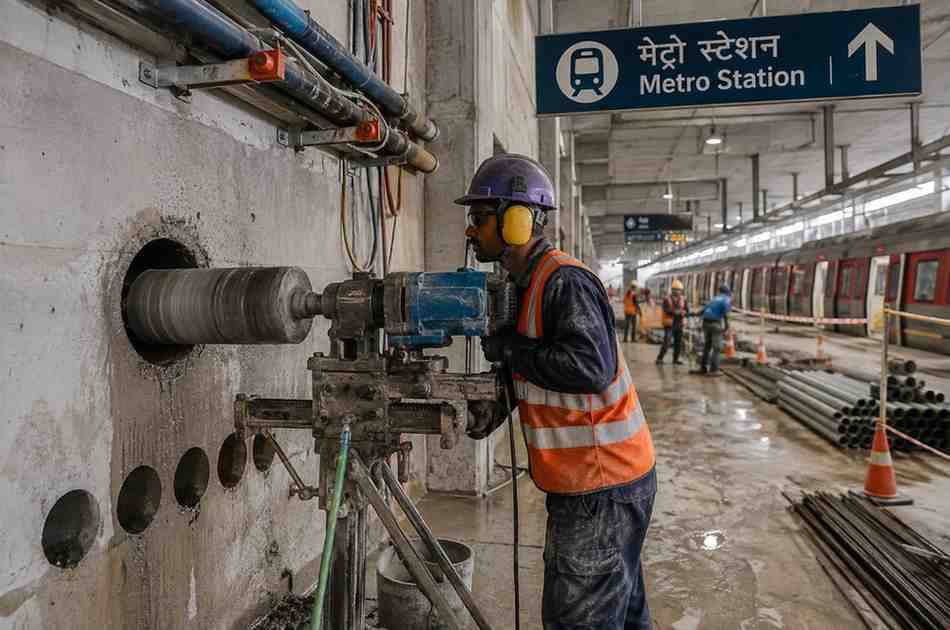
Diamond core drilling is the most widely used method for metro utility installations. It uses a hollow diamond-tipped bit to cut clean, circular holes through concrete, including reinforced sections. This method is preferred because it:
- Produces smooth, precise holes with minimal vibration
- Works effectively on heavily reinforced concrete
- Minimizes dust and noise compared to traditional methods
- Allows for accurate hole diameters ranging from small cable openings to large duct penetrations
2. Wall and Slab Drilling
Metro stations require both vertical (slab) and horizontal (wall) drilling to accommodate utility routing across multiple levels — concourse, platform, and underground service floors. Specialized rigs are used to maintain drilling accuracy even in tight, confined underground spaces.
3. Wet Drilling vs. Dry Drilling
- Wet drilling uses water to cool the diamond bit and suppress dust, making it ideal for large-diameter holes and continuous operation in enclosed metro environments.
- Dry drilling is used for smaller holes or areas where water usage is restricted, such as near live electrical installations.
4. Hand-Held vs. Rig-Mounted Drilling
For smaller utility penetrations, hand-held core drills offer flexibility in confined spaces. For larger or high-precision holes, rig-mounted drilling machines anchored to the concrete surface ensure stability and accuracy.
The Concrete Drilling Process for Metro Utility Installations
- Site Survey and Utility Mapping – Before any drilling begins, structural drawings and utility layout plans are reviewed to identify rebar locations, existing services, and safe drilling zones. Ground Penetrating Radar (GPR) or rebar scanning is often used to avoid cutting through critical reinforcement or embedded cables.
- Marking and Layout – Precise markings are made on walls, slabs, or floors according to the approved MEP (Mechanical, Electrical, Plumbing) drawings.
- Machine Setup and Anchoring – Core drilling rigs are securely anchored to prevent movement during operation, ensuring hole accuracy and operator safety.
- Drilling Operation – Diamond core bits cut through the concrete at controlled speeds, with continuous water cooling (if wet drilling) to reduce heat and dust.
- Debris Removal and Cleaning – Concrete slurry or dust is removed, and the hole is cleaned to prepare for utility installation.
- Quality Inspection – Each drilled opening is checked for diameter accuracy, alignment, and structural safety before utilities are installed.
- Utility Installation and Sealing – Once the utility line is installed, the surrounding gap is sealed using fire-rated or waterproof sealants, especially critical in underground metro stations to prevent water ingress and maintain fire compartmentalization.
Challenges Unique to Metro Station Drilling
Metro construction sites present a distinct set of challenges compared to standard building projects:
- Dense Reinforcement: Metro structures use heavy rebar and pre-stressed concrete, requiring specialized bits and careful scanning before drilling.
- Confined Underground Spaces: Working within underground concourses and platform levels limits equipment mobility and requires compact, maneuverable drilling rigs.
- Live Construction Environments: Drilling often occurs alongside ongoing structural, electrical, and finishing works, demanding strict coordination and safety protocols.
- Noise and Vibration Control: Since metro stations are often located near residential and commercial areas, drilling operations must comply with noise and vibration regulations.
- Dust and Debris Management: Enclosed underground environments require efficient dust suppression and slurry management systems to maintain air quality and cleanliness.
- Strict Safety Standards: Metro rail authorities enforce rigorous safety codes, requiring trained operators, certified equipment, and adherence to structural safety guidelines.
Safety Considerations in Metro Concrete Drilling
Given the scale and complexity of metro infrastructure, safety is non-negotiable. Key safety practices include:
- Conducting rebar detection scans before every drilling operation
- Using PPE such as safety goggles, gloves, ear protection, and dust masks
- Ensuring proper ventilation in underground drilling zones
- Following lockout/tagout procedures near live utilities
- Using anchored, stable drilling rigs to prevent kickback or slippage
- Regular equipment maintenance and calibration checks
- Employing trained and certified drilling technicians
At Core Cutting India, our teams follow strict safety protocols aligned with metro rail authority guidelines to ensure zero-incident project execution.
Benefits of Professional Concrete Drilling Services for Metro Projects
Partnering with an experienced concrete drilling contractor like Core Cutting India offers several advantages:
- Precision Accuracy: Clean, accurately sized holes that match MEP design specifications
- Structural Safety: Careful rebar avoidance and load-bearing assessment to protect structural integrity
- Time Efficiency: Faster project turnaround with modern diamond drilling equipment
- Reduced Noise and Dust: Advanced wet drilling and vacuum dust extraction systems
- Cost Savings: Minimized rework and material wastage through precise execution
- Compliance: Adherence to metro rail safety and quality standards
Applications Beyond Utility Installation
While utility installation is a primary use case, concrete drilling in metro stations also supports:
- Escalator and elevator shaft openings
- Expansion joint installations
- Anchor bolt holes for structural steel and signage
- Sampling and testing cores for quality assurance
- Retrofitting and renovation of existing metro infrastructure
Why Choose Core Cutting India for Metro Station Drilling
Core Cutting India brings specialized expertise in diamond core drilling, wall sawing, and concrete cutting services for large-scale infrastructure projects, including metro rail networks. Our team combines modern equipment, skilled technicians, and strict safety compliance to deliver precise, reliable, and efficient drilling solutions tailored to the demanding requirements of metro construction.
Whether you need utility duct openings, cable routing holes, or structural core sampling, our experienced crew ensures minimal disruption to ongoing construction activities while maintaining the highest standards of accuracy and safety.
For inquiries or project consultations, reach out to us at [email protected].
Conclusion
Concrete drilling plays a foundational role in bringing metro stations to life — enabling the seamless integration of electrical, plumbing, HVAC, fire safety, and communication systems within dense reinforced concrete structures. Given the scale, safety requirements, and precision demanded by metro rail projects, partnering with an experienced concrete drilling contractor is essential.
Core Cutting India remains committed to supporting India's metro infrastructure growth through reliable, precise, and safety-first concrete drilling and core cutting solutions. Connect with us at [email protected] to discuss your next metro station or infrastructure project.
People Also Ask
1. What is concrete core drilling used for in metro construction? Concrete core drilling is used to create precise openings in walls, floors, and slabs for installing utilities such as electrical conduits, plumbing lines, HVAC ducts, and fire safety systems in metro stations.
2. How is rebar avoided during concrete drilling in metro stations? Rebar detection tools like Ground Penetrating Radar (GPR) or rebar scanners are used before drilling to map reinforcement locations and avoid damaging structural steel.
3. What equipment is used for concrete drilling in metro projects? Diamond core drilling rigs, both hand-held and rig-mounted, along with wet and dry drilling systems, are commonly used for metro utility installation drilling.
4. Is wet drilling or dry drilling better for metro station projects? Wet drilling is generally preferred for larger holes as it reduces dust and cools the drill bit, while dry drilling is used for smaller holes or areas near live electrical systems.
5. How thick can concrete drilling machines cut through in metro structures? Modern diamond core drilling machines can cut through several feet of reinforced concrete, depending on the bit size, machine power, and structural density.
6. Why is precision important in metro station concrete drilling? Precision prevents structural damage, avoids cutting critical reinforcement, ensures utilities fit correctly, and maintains the long-term safety and durability of the metro structure.