
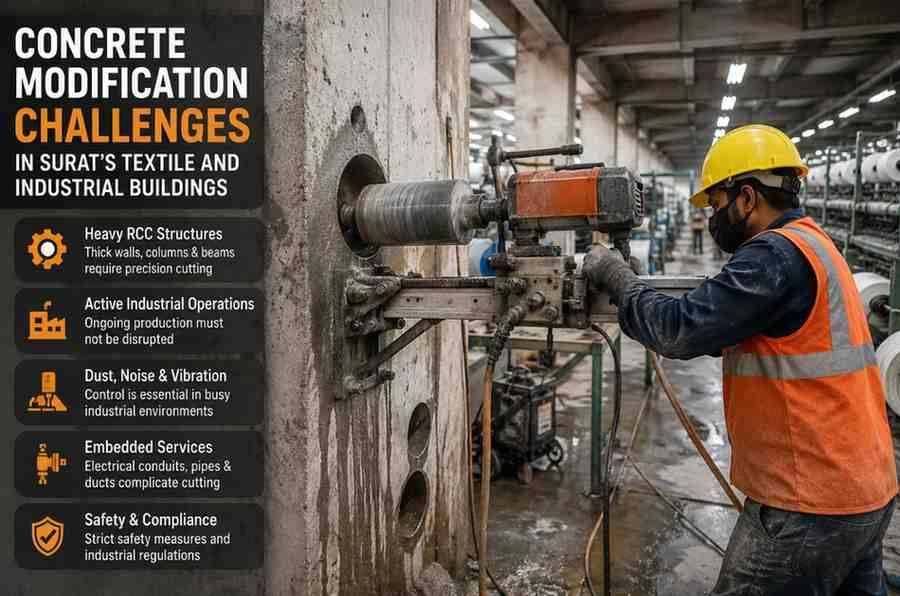
Surat has long been recognized as the textile and diamond capital of India, home to thousands of power loom units, textile processing mills, dyeing houses, and heavy industrial facilities. Behind this thriving industrial landscape lies a less visible but equally important story — the constant need to modify, retrofit, and adapt the concrete structures that house these operations. As machinery upgrades, expansion plans, and modernization projects accelerate across Surat's industrial belts like Sachin, Pandesara, Udhna, and Katargam, concrete modification has become an essential part of keeping these facilities safe, compliant, and production-ready.
At Core Cutting India ([email protected]), we work closely with textile mill owners, factory engineers, and industrial contractors across Surat, and we've seen firsthand how demanding and technically complex concrete modification projects in this region can be. This blog explores the unique challenges involved in modifying concrete structures in Surat's textile and industrial buildings, and how professional core cutting and concrete cutting services help overcome them.
Why Concrete Modification Is So Common in Surat's Industrial Sector
Surat's textile industry is one of the most dynamic in the country, with mills constantly upgrading machinery, adding new production lines, or converting old warehouse spaces into modern processing units. Every such change usually requires some form of structural intervention — cutting openings for new ducting, installing heavy machinery foundations, creating access points for pipelines, or reinforcing aging concrete that was never designed for today's loads.
Unlike new construction, where structural elements are planned from scratch, modification work happens on buildings that are often decades old, already under heavy use, and sometimes operating 24/7. This is where the real challenges begin.
Key Concrete Modification Challenges in Surat's Textile and Industrial Buildings
1. Aging Infrastructure and Unknown Structural History
Many textile mills and industrial sheds in Surat were constructed 20 to 40 years ago, often without complete structural drawings or updated documentation. When contractors are asked to cut an opening for a new duct or drill through a slab for utility routing, they frequently don't know the exact position of embedded reinforcement, post-tensioned cables, or load-bearing elements underneath the surface.
Cutting into concrete without this knowledge risks weakening the structure, damaging rebar, or compromising the integrity of load-bearing walls and columns. This is why any responsible concrete modification project begins with structural assessment and, wherever possible, scanning the concrete using GPR (Ground Penetrating Radar) or rebar detectors before any cutting or coring begins.
2. Operating Amidst Continuous Production
A major challenge unique to Surat's textile belt is that most units cannot afford to shut down production for modification work. Power looms, dyeing units, and processing machines often run in three shifts, and halting operations even for a day can mean significant financial loss.
This forces contractors to plan concrete cutting, core drilling, or demolition work around tight operational windows — sometimes late at night or during scheduled maintenance breaks. It also demands the use of low-vibration, low-noise, and dust-controlled cutting techniques so that nearby machinery, yarn, and fabric stock aren't damaged or contaminated during the process.
3. Vibration Sensitivity Near Precision Machinery
Textile processing involves highly calibrated machinery — from power looms to dyeing and finishing equipment — that is sensitive to vibration. Traditional concrete breaking methods like jackhammering can transmit vibrations through the floor slab, potentially misaligning nearby machines or affecting product quality during a production run.
This is precisely why diamond core drilling and diamond wall sawing have become the preferred methods for concrete modification in occupied industrial buildings. These techniques use diamond-tipped blades and bits that cut cleanly through concrete with minimal vibration, protecting adjacent equipment and structural elements.
4. Dust and Contamination Control in Textile Environments
In a textile mill, airborne dust is not just a nuisance — it can directly compromise fabric quality, clog machinery filters, and create fire hazards near flammable materials. Conventional concrete cutting generates large amounts of fine silica dust, which is unacceptable in these environments.
Professional concrete modification teams address this using wet-cutting techniques, where water is continuously fed to the blade during cutting to suppress dust at the source. Vacuum extraction systems are also used for indoor coring work to capture slurry and debris before it spreads across the shop floor.
5. Creating Openings for MEP and Utility Upgrades
As Surat's industrial units modernize, there's growing demand for new HVAC ducting, effluent treatment plant (ETP) piping, electrical conduit routing, and fire safety installations. Each of these requires precise openings to be cut through existing concrete walls, slabs, and beams.
The challenge lies in achieving clean, accurately sized openings without over-cutting or under-cutting, since both create problems — oversized openings weaken structural elements, while undersized ones require rework. Diamond core drilling allows contractors to cut circular openings of exact diameters (from small conduit holes to large duct penetrations) with millimeter-level precision.
6. Structural Reinforcement and Load-Bearing Modifications
Textile and industrial buildings often need modification to support new, heavier machinery than what the original structure was designed for. This might involve strengthening existing columns, adding new foundations, or modifying slab thickness to handle increased point loads.
Every such intervention requires careful sequencing: sections of concrete may need to be cut and removed to expose reinforcement, new steel or concrete is added, and the modified section is finished to match the original structural performance. Any error in sequencing or method can compromise the entire structural system, making experienced concrete cutting contractors essential for such work.
7. Working Within Tight and Congested Spaces
Surat's older industrial buildings, particularly in areas like Pandesara and Udhna, were often built with narrow bays, low ceiling heights, and dense machinery layouts. This leaves very little room for large cutting equipment to maneuver.
Modification contractors frequently need compact, wire saw or hand-held core drilling equipment that can operate in confined spaces without disturbing adjacent machinery, pipework, or storage racks. Planning access routes for equipment and debris removal becomes as important as the cutting work itself.
8. Compliance With Fire and Safety Norms
Following increased regulatory scrutiny on fire safety in Gujarat's industrial units after past incidents in the textile sector, many mills are now required to retrofit fire exits, create additional emergency openings, install fire-rated doors, or modify walls to meet updated fire NOC requirements.
These modifications must be executed without weakening surrounding structural elements, and often need to be completed within compliance deadlines set by local authorities. This adds time pressure to what is already technically demanding work.
9. Weather and Seasonal Considerations
Surat experiences a humid subtropical climate with intense monsoons between June and September. Concrete cutting and coring work involving water-based cooling systems must account for site drainage, especially in ground-floor units where water accumulation can affect ongoing production or damage stored raw materials like yarn and fabric rolls.
Contractors need to plan wet-cutting slurry management carefully during monsoon months to prevent water damage and ensure worker safety on potentially slippery surfaces.
10. Balancing Cost and Precision
Industrial and textile unit owners in Surat are naturally cost-conscious, and there can be pressure to choose cheaper, faster methods over precision cutting techniques. However, poorly executed concrete modification — using improper tools or unqualified labor — often leads to structural cracks, uneven openings, or damage that costs far more to repair later.
Experienced concrete cutting companies help balance this by recommending the right technique for each specific job: diamond core drilling for clean circular openings, wall sawing for larger rectangular openings, wire sawing for thick structural elements, and controlled demolition for larger-scale modifications — ensuring the job is done right the first time.
How Core Cutting India Addresses These Challenges
At Core Cutting India, our approach to concrete modification in Surat's textile and industrial buildings is built around precision, safety, and minimal disruption to ongoing operations. Our services typically include:
- Diamond core drilling for clean, accurately sized openings in walls, slabs, and beams
- Diamond wall sawing for larger openings such as doorways, windows, and machine access points
- Wire sawing for cutting through thick or heavily reinforced structural sections
- Dust and vibration-controlled cutting to protect sensitive textile machinery and stock
- Structural assessment support before modification to identify reinforcement and load paths
- Flexible scheduling, including night and off-peak shift work, to avoid production downtime
We understand that every textile mill, dyeing unit, or industrial shed in Surat has its own layout, operational rhythm, and structural quirks. That's why our teams assess each site individually before recommending a cutting or modification method, rather than applying a one-size-fits-all approach.
Best Practices for Planning a Concrete Modification Project
For factory owners and contractors planning a concrete modification project in Surat, a few best practices can significantly reduce risk and cost:
- Get a structural assessment first. Understand what's inside the concrete before cutting begins.
- Choose the right cutting method for the material thickness, reinforcement, and location.
- Plan around production schedules to minimize operational disruption.
- Prioritize dust and vibration control, especially near sensitive machinery or fabric storage.
- Work with experienced, insured contractors who understand local building norms and fire safety compliance requirements.
- Document the modification with as-built drawings for future reference and compliance audits.
Conclusion
Concrete modification in Surat's textile and industrial buildings is far more complex than it may appear on the surface. Between aging infrastructure, continuous production demands, vibration-sensitive machinery, dust control needs, and evolving compliance requirements, every project requires careful planning and specialized execution.
Whether you're upgrading machinery foundations, creating new utility openings, reinforcing load-bearing elements, or retrofitting fire safety exits, working with an experienced concrete cutting and core drilling partner makes the difference between a smooth modification and costly structural setbacks.
Core Cutting India brings the technical expertise, equipment, and local industry understanding needed to handle concrete modification projects across Surat's textile and industrial sector safely and efficiently. To discuss your next concrete cutting or modification project, reach out to us at [email protected].
Target-Related Searches
- concrete cutting services in Surat
- core drilling contractors Surat
- textile mill structural retrofitting
- industrial concrete demolition Surat
- diamond core drilling company
- RCC wall cutting Surat
- concrete coring for MEP openings
- wire sawing concrete Surat
- factory shed modification services
- concrete cutting company near Pandesara Udhna
People Also Ask
- What is concrete modification in industrial buildings?
- How is concrete cutting done in occupied factories without stopping production?
- What is the difference between core drilling and wall sawing?
- Why is diamond cutting preferred over jackhammering for concrete?
- How do you cut concrete without damaging reinforcement bars?
- What precautions are needed for concrete cutting in textile mills?
- How much does concrete core drilling cost in Surat?
- Is a structural engineer needed before modifying concrete slabs or walls?
- How is dust controlled during indoor concrete cutting work?
- What is the best method for creating openings in RCC slabs for ducting?