
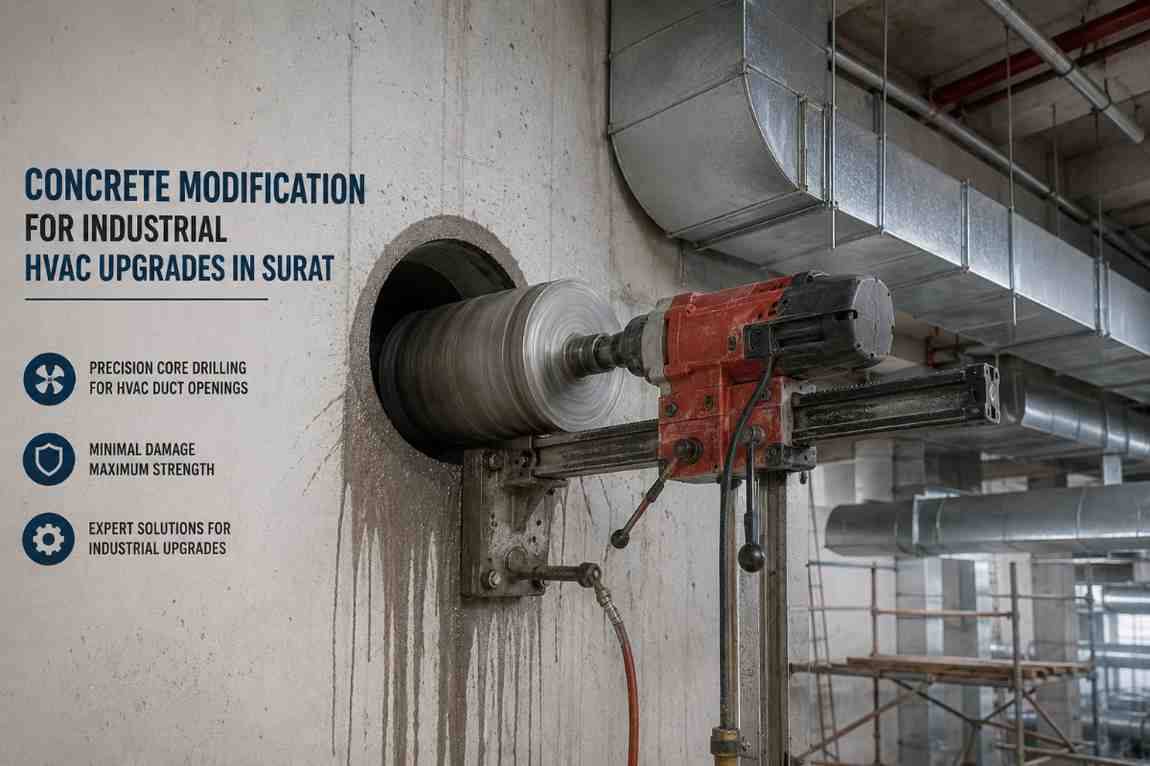
Surat's industrial landscape is expanding faster than almost any other city in Gujarat. Textile processing units, chemical plants, diamond polishing units, and manufacturing facilities across GIDC Sachin, Pandesara, Sarigam, and Hazira are constantly modernizing their infrastructure to keep pace with production demands and stricter environmental norms. One upgrade that almost every growing facility eventually faces is a heating, ventilation, and air conditioning (HVAC) overhaul. But before a single duct or air handling unit can be installed, there's a critical, often underestimated step: concrete modification.
At Core Cutting India, we work with factory owners, mechanical contractors, and project engineers across Surat to make this step fast, safe, and structurally sound. This blog explains why concrete modification matters for industrial HVAC upgrades, the techniques involved, and what to keep in mind before you start your next project.
Why HVAC Upgrades Almost Always Require Concrete Work
Industrial buildings are built with dense reinforced concrete floors, load-bearing walls, and shear walls designed to support heavy machinery and multiple floors of operation. Unlike a residential renovation where ducts can often be routed through false ceilings or lightweight partitions, industrial HVAC systems typically need to pass through solid concrete slabs and walls at several points:
- Vertical duct risers running between floors
- Horizontal duct runs through fire-rated or load-bearing walls
- Roof or terrace openings for exhaust and intake shafts
- Floor openings for chiller pipework and refrigerant lines
- Equipment plinths and anchor points for new air handling units (AHUs) and rooftop package units
Without proper concrete modification, none of this equipment can be positioned correctly, and worse, unplanned breakthroughs can compromise the structural integrity of the building. This is why HVAC contractors in Surat increasingly bring in specialist concrete cutting teams early in the project rather than treating it as an afterthought.
Common Concrete Modification Techniques Used in HVAC Projects
1. Diamond Core Drilling
Core drilling is the go-to method whenever a clean, circular opening is needed, which is most of the time in HVAC work. A diamond-tipped core bit rotates through the concrete, cutting a precise cylindrical hole without hammering, cracking, or disturbing the surrounding structure. This makes it ideal for:
- Refrigerant pipe penetrations
- Condensate drain lines
- Round duct sleeves
- Cable and control wiring pass-throughs for BMS (Building Management Systems)
Core drilling produces very little vibration, which matters in occupied factories where production lines are running nearby and cannot tolerate disruption.
2. Wall Sawing
For larger, rectangular duct openings that need to pass through masonry or concrete walls, wall sawing is typically used. A track-mounted diamond blade makes controlled, straight cuts, allowing large sections of wall to be removed cleanly for supply and return air ducts. This is especially common when connecting a new AHU room to the main production floor.
3. Floor Sawing and Slab Cutting
When HVAC risers or large vertical shafts need to travel through multiple floors, floor sawing is used to cut precise openings in the slab. This method is common in multi-storey industrial buildings and warehouses being converted for cleaner, climate-controlled operations, such as pharmaceutical packaging units or food processing plants.
4. Chain Saw and Ring Saw Cutting
In tight spaces or corners where a track saw cannot maneuver, handheld chain saws or ring saws cut through concrete for smaller, irregularly shaped openings. This is often needed around existing pipework, cable trays, or structural columns that cannot be relocated.
5. Wire Sawing for Thick or Reinforced Sections
For very thick concrete sections, heavily reinforced walls, or unusual angles, diamond wire sawing offers flexibility that standard blades cannot match. It's slower but extremely precise, and it's often specified for critical structural areas where minimal disturbance is non-negotiable.
Why Precision Matters in Industrial Settings
Industrial HVAC upgrades in Surat are rarely simple, standalone jobs. They usually happen inside live factories where:
- Production cannot stop for extended periods
- Existing electrical conduits, fire sprinkler lines, and structural rebar are already embedded in the concrete
- Dust and noise need to be tightly controlled to protect workers and sensitive equipment
- Any structural miscalculation can lead to costly downtime or safety hazards
This is where experienced concrete cutting contractors add real value. Before any cutting begins, a professional team scans the concrete using rebar detection and ground-penetrating radar to map out embedded reinforcement, electrical lines, and existing utilities. This step alone prevents the two most expensive mistakes in industrial retrofits: cutting through live cables and weakening load-bearing elements.
Step-by-Step: How Concrete Modification Fits into an HVAC Upgrade Project
- Site Survey and Structural Assessment An engineer or experienced contractor evaluates the building's structural drawings (where available) and conducts a physical inspection to identify load-bearing walls, slab thickness, and existing services.
- Scanning and Marking Rebar and utility scanning is carried out at every proposed cutting location to avoid damaging embedded steel, electrical conduits, or plumbing lines.
- Method Selection Based on the opening size, shape, and location, the right technique, core drilling, wall sawing, floor sawing, or wire sawing, is selected.
- Cutting and Coring Work is carried out using diamond-tipped tools with water-cooled or dust-extraction systems to minimize airborne dust, a particularly important consideration for textile and food-grade facilities in Surat where cleanliness standards are strict.
- Debris Removal and Edge Finishing Cut edges are cleaned and, where required, reinforced or sealed to maintain structural strength and prepare the opening for duct or equipment installation.
- Handover to HVAC Installation Team Once the concrete modification is complete, mechanical contractors move in to install ductwork, AHUs, chillers, or rooftop units through the prepared openings.
Industries in Surat Benefiting from This Work
Surat's industrial economy is diverse, and HVAC-driven concrete modification work spans several sectors:
- Textile and dyeing units upgrading to controlled humidity and temperature environments for better fabric quality
- Diamond processing houses requiring dust-free, climate-controlled cutting and polishing floors
- Chemical and pharmaceutical manufacturers needing cleanroom-grade ventilation with precise duct routing
- Warehousing and logistics parks installing modern climate control for temperature-sensitive storage
- Food processing plants requiring hygienic, code-compliant ventilation systems
Each of these industries has its own regulatory and operational constraints, and the concrete modification approach has to be tailored accordingly. A dyeing unit's humid, corrosive environment calls for different cutting sequencing than a diamond polishing unit that cannot tolerate dust contamination.
Common Challenges in Surat's Industrial Buildings
Many of Surat's industrial sheds and factory buildings were constructed in phases over the years, often without complete as-built documentation. This creates a few recurring challenges during HVAC-related concrete work:
- Undocumented rebar placement, making scanning essential rather than optional
- Congested service routes, where multiple utilities already share limited wall or floor space
- Tight production schedules, requiring cutting work to be done in shifts or during planned downtime
- Variable concrete quality in older structures, which can affect cutting speed and tool selection
A contractor familiar with Surat's industrial building stock, rather than a generic construction crew, is far better positioned to anticipate and manage these issues without delaying the overall HVAC project timeline.
Safety and Compliance Considerations
Concrete modification for HVAC systems isn't just a technical exercise, it's also a safety-critical one. Reputable contractors follow strict protocols including:
- Structural sign-off before cutting into any load-bearing element
- Dust suppression and extraction to protect worker health, particularly relevant under India's evolving industrial safety norms
- Noise and vibration control to avoid disturbing nearby operations
- Proper disposal of concrete debris in line with local municipal regulations
- Fire-stopping and sealing of penetrations after duct installation, to maintain the building's fire rating
Cutting corners on any of these steps can lead to compliance issues during factory inspections or, worse, genuine safety incidents down the line.
Choosing the Right Concrete Cutting Partner for Your HVAC Project
When evaluating contractors for concrete modification work tied to an HVAC upgrade in Surat, consider the following:
- Experience with industrial and factory environments, not just residential or small commercial jobs
- Availability of scanning equipment to detect rebar and utilities before cutting
- Range of cutting methods (core drilling, wall sawing, floor sawing, wire sawing) so the right tool is used for each opening
- Dust and noise management practices suited to live production environments
- Coordination ability with your HVAC installation team to avoid scheduling conflicts and rework
At Core Cutting India, our teams specialize in exactly this kind of coordinated, industrial-grade concrete cutting and coring work across Surat and the wider Gujarat industrial belt. From a single core hole for a refrigerant line to a full floor-to-roof duct riser through multiple slabs, we plan every cut around your building's structure and your production schedule.
Final Thoughts
Industrial HVAC upgrades are ultimately about improving working conditions, product quality, and energy efficiency, but none of that is possible without accurate, safe concrete modification at the foundation of the project. Whether you're retrofitting an old textile shed in Pandesara or fitting out a new pharmaceutical facility near Hazira, getting the concrete cutting and coring right the first time saves both time and money.
If you're planning an HVAC upgrade in Surat and need a concrete cutting partner who understands industrial structures, reach out to Core Cutting India at [email protected]. Our team can assess your site, recommend the right cutting method, and execute the work with minimal disruption to your operations.