
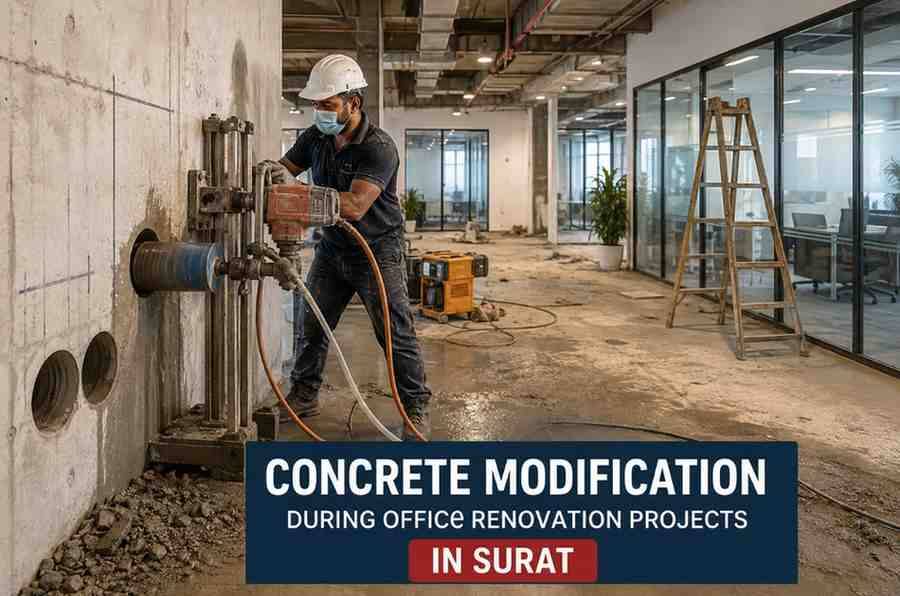
Surat has grown into one of western India's busiest commercial and industrial hubs, home to diamond trading houses, textile enterprises, IT parks, and a rapidly expanding corporate landscape. As businesses scale up, relocate, or simply modernize their workspaces, office renovation has become a routine part of running a company in the city. But behind every sleek, modern office redesign lies a less glamorous but absolutely critical process: concrete modification.
Whether it's cutting an opening for a new HVAC duct, coring holes for electrical conduits, widening a doorway, or removing a section of slab to install a staircase, concrete modification is the technical backbone of almost every serious office renovation project. Done incorrectly, it can compromise a building's structural integrity, delay timelines, and inflate costs. Done correctly, by experienced professionals, it enables architects and interior designers to bring ambitious renovation plans to life safely and efficiently.
In this guide, we'll walk through what concrete modification actually involves, why it matters so much in Surat's commercial buildings, the techniques used by specialists like Core Cutting India, and what business owners should keep in mind before starting a renovation project.
What Is Concrete Modification?
Concrete modification refers to the process of altering existing concrete structures — walls, floors, slabs, beams, or columns — to accommodate new design requirements. During office renovations, this typically includes:
- Cutting openings in walls or slabs for doors, windows, or ventilation
- Core drilling for electrical, plumbing, or data cabling routes
- Removing sections of flooring to install elevators, staircases, or sunken areas
- Widening existing openings to meet updated building codes or accessibility standards
- Creating expansion joints or control joints in large floor slabs
- Partial demolition of non-load-bearing walls to open up floor plans
Unlike raw demolition, concrete modification is a precision-driven process. It requires an understanding of structural loads, rebar placement, and the specific properties of the concrete being worked on, so that the building's integrity is preserved even as its layout changes.
Why Concrete Modification Matters in Surat's Office Buildings
Surat's commercial real estate has its own set of characteristics that make concrete modification an especially important consideration.
1. Rapid Commercial Growth
Areas like Ring Road, Adajan, Vesu, Piplod, and the diamond and textile business districts have seen a surge in new commercial towers over the past decade. Many companies now occupy spaces originally built for a different purpose or a different tenant, meaning the existing concrete layout often doesn't match current operational needs.
2. Mixed-Use and High-Density Buildings
Many office buildings in Surat share space with retail outlets, warehouses, or residential units. Concrete cutting and coring in these buildings must be handled with extra caution to avoid disturbing neighboring tenants, damaging shared structural elements, or violating fire safety norms.
3. Climate and Material Considerations
Surat's hot and humid climate, along with the quality and age variation of concrete used across different construction eras, means every renovation site can behave differently. Older buildings may have weaker or more brittle concrete, while newer structures may use high-strength mixes that require different cutting equipment altogether.
4. Regulatory Compliance
Local municipal authorities and the Surat Municipal Corporation require certain structural modifications to be reviewed or approved, particularly when load-bearing elements are involved. Professional concrete modification contractors are familiar with these requirements and can help business owners avoid compliance issues during renovation.
Common Concrete Modification Techniques Used in Office Renovations
Diamond Concrete Cutting
Diamond blade cutting is the industry standard for creating clean, precise openings in concrete walls and floors. It generates minimal vibration and dust compared to traditional demolition methods, which is especially valuable in occupied office buildings where noise and debris need to be tightly controlled.
Core Drilling
Core drilling uses a cylindrical diamond-tipped bit to bore precise round holes through concrete, commonly used for routing electrical cables, plumbing lines, HVAC ducts, and structured cabling for IT infrastructure. Core drilling is fast, accurate, and produces far less structural disturbance than manual breaking.
Wall Sawing
For larger openings — such as new doorways, pass-through counters, or window installations — wall sawing offers straight, controlled cuts along a guided track. This method is particularly useful when precision and a clean finish are priorities, such as in reception areas or client-facing spaces.
Floor Sawing
When modifying flooring for elevator shafts, sunken flooring, or utility trenches, floor saws cut horizontal sections of slab with consistent depth control, reducing the risk of over-cutting into structural reinforcement.
Controlled Demolition and Chipping
In areas where partial removal rather than a clean cut is required, controlled chipping and breaking techniques are used, always with attention to nearby rebar and structural connections.
Step-by-Step: How Concrete Modification Fits Into an Office Renovation
- Site Assessment and Structural Survey – Before any cutting begins, a professional team inspects the site to identify load-bearing walls, existing rebar layout, utility lines, and potential hazards.
- Design Coordination – Concrete modification specialists work alongside architects and interior designers to confirm exactly where cuts, core holes, or openings are needed.
- Permissions and Approvals – For structural changes, approvals from a structural engineer or local authority may be required, especially in multi-tenant commercial buildings.
- Dust and Noise Control Planning – Since most renovations happen in active commercial buildings, a plan for containment barriers, dust extraction, and scheduled work hours is put in place.
- Execution – Using diamond cutting, core drilling, or wall/floor sawing equipment, the modification is carried out with continuous monitoring for structural stability.
- Finishing and Handover – Cut edges are cleaned, reinforced if necessary, and prepared for the next phase of renovation, such as electrical fitting, flooring, or partition work.
Benefits of Hiring Professional Concrete Modification Contractors
Office renovations run on tight timelines, and concrete work sits at the critical path of nearly every other trade — electrical, plumbing, flooring, and interior fit-out all depend on it being done correctly and on schedule. Professional contractors bring several advantages:
- Precision – Reduces the risk of over-cutting, which can weaken structural elements or require costly repairs.
- Safety – Trained crews follow safety protocols to protect workers, occupants, and neighboring tenants.
- Speed – Modern diamond cutting and coring equipment completes work significantly faster than manual demolition.
- Reduced Disruption – Techniques like diamond cutting minimize dust, vibration, and noise, which matters when a business needs to stay operational during renovation.
- Code Compliance – Experienced contractors understand local building regulations and structural safety norms specific to Surat.
Things to Consider Before Starting Concrete Modification Work
If you're planning an office renovation in Surat that involves concrete cutting or coring, keep the following in mind:
- Identify load-bearing elements early. Never assume a wall or slab is non-structural without professional verification.
- Factor in dust and noise restrictions if your building shares space with other tenants or is located in a residential-adjacent area.
- Plan utility rerouting in advance, since core drilling for cables and pipes often needs to be coordinated with electricians and plumbers.
- Get a written scope of work from your contractor, including cutting locations, depths, and expected timelines.
- Ask about equipment used. Diamond cutting and core drilling tend to be cleaner and more precise than older, high-impact demolition methods.
- Confirm post-cutting reinforcement, if any openings are near structural columns or beams, to ensure the modification doesn't affect long-term stability.
Frequently Asked Questions
What is concrete modification and why is it needed during renovation? Concrete modification involves altering existing walls, floors, or slabs to fit a new office layout — such as creating openings for doors, ducts, or cabling. It's needed because most renovated spaces require structural changes that go beyond simple interior finishing.
Is it safe to cut concrete walls or slabs in an occupied office building? Yes, when handled by experienced professionals using low-vibration methods like diamond cutting and core drilling, along with proper containment for dust and noise. A pre-work structural assessment further reduces risk to occupants and the building itself.
How much does concrete cutting cost for office renovation in Surat? Costs vary depending on the thickness of the concrete, the type of cut (core drilling, wall sawing, or floor sawing), and the complexity of the site. It's best to request a site visit and written quote from a contractor for an accurate estimate.
What tools are used for concrete cutting and coring? Common tools include diamond blade wall saws, floor saws, core drilling rigs, and hand-held cutting equipment, chosen based on the location, thickness, and reinforcement of the concrete being modified.
How long does concrete modification take during a renovation project? Timelines depend on the scope of work, but most cutting and coring tasks for a standard office renovation can be completed within a few days, especially when planned in coordination with other renovation trades.
Do I need a structural engineer's approval before cutting concrete? If the modification involves load-bearing walls, columns, or beams, structural engineer approval is strongly recommended and, in many cases, required by local building regulations.
Final Thoughts
Concrete modification may not be the most visible part of an office renovation, but it's one of the most important. It determines how smoothly the rest of the project unfolds, how safe the finished space is, and how well the renovation holds up over time. For businesses in Surat undertaking a renovation — whether it's a small interior refresh or a full structural overhaul — working with experienced concrete cutting and modification specialists is essential to getting the job done right.
At Core Cutting India, we specialize in precision concrete cutting, core drilling, wall sawing, and structural modification services for commercial and office renovation projects across Surat. Our team works closely with architects, contractors, and business owners to ensure every cut is safe, accurate, and code-compliant.
For a site assessment or project consultation, reach out to us at [email protected].