
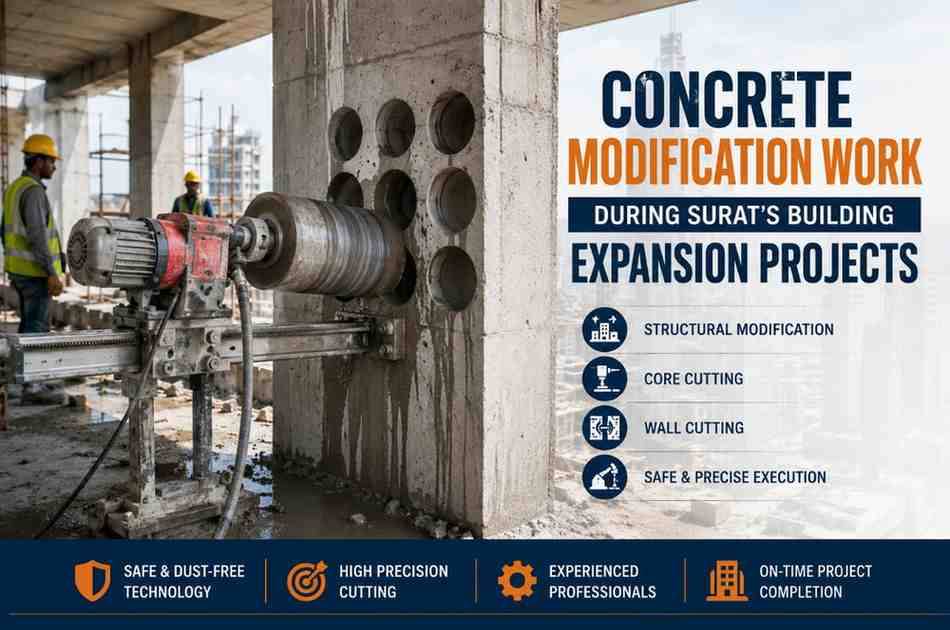
Surat has become one of the fastest-growing urban centers in Gujarat, driven by its booming textile, diamond, and manufacturing industries. As the city expands outward and upward, property owners, industrial units, and commercial developers are constantly upgrading their existing structures to meet new operational demands. Whether it's a factory adding a new production line, a commercial complex creating additional floors, or a residential society retrofitting utility infrastructure, one process sits at the heart of nearly every expansion project: concrete modification work.
Concrete modification is not simply about breaking walls or drilling holes. It is a precise, engineering-driven discipline that determines whether a building expansion proceeds safely, on schedule, and without compromising the structural integrity of the original construction. In this blog, we take a detailed look at what concrete modification work involves, why it has become indispensable to Surat's building expansion boom, and how professional contractors like Core Cutting India ([email protected]) are helping developers execute these projects with precision and safety.
Understanding Concrete Modification Work
Concrete modification refers to the controlled cutting, drilling, coring, chiseling, and partial demolition of existing concrete structures to accommodate new construction requirements. Unlike fresh concrete pouring, modification work deals with structures that are already load-bearing, aged, or integrated with other building systems such as plumbing, electrical conduits, and HVAC ducts.
This makes the process significantly more delicate. A single miscalculated cut into a beam or column can compromise the load path of an entire structure. That's why concrete modification is typically handled by specialized teams using diamond-tipped tools, precision measuring equipment, and structural assessments rather than conventional demolition crews.
In the context of Surat's building expansion projects, concrete modification work commonly includes:
- Creating new openings for doors, windows, and staircases
- Cutting slots for elevator shafts or escalators
- Coring holes for plumbing, electrical, and HVAC routing
- Widening or extending existing floor slabs
- Cutting expansion joints to accommodate new wings
- Selective demolition of walls or partitions for floor plan reconfiguration
- Surface modification such as grinding, leveling, and polishing
Why Surat's Expansion Boom Depends on Concrete Modification
Surat's rapid industrial and commercial growth has created a unique construction dynamic. Unlike greenfield projects where builders start from scratch, a large share of Surat's expansion activity happens on existing plots — factories extending production floors, textile markets adding vertical levels, and commercial buildings retrofitting for modern tenant requirements.
This "build on what exists" approach makes concrete modification work a critical enabler of urban growth for several reasons.
1. Space Constraints in Dense Commercial Zones
Areas like Ring Road, Udhna, Sachin GIDC, and the diamond and textile markets are already densely built. New land is scarce and expensive, so businesses prefer expanding vertically or modifying existing floor plates rather than acquiring new plots. This directly increases demand for precision cutting and structural alteration services.
2. Industrial Retrofitting
Surat's textile and diamond processing units frequently need to modify existing concrete flooring and walls to install new machinery, conveyor systems, or utility lines. These retrofits require accurate, vibration-free cutting to avoid damaging surrounding equipment or structural elements.
3. Regulatory and Safety Upgrades
Post-2019 fire safety regulations reshaped how commercial and industrial buildings in Gujarat approach structural compliance. Many older buildings in Surat have had to modify concrete walls and slabs to install fire exits, ventilation shafts, and emergency staircases — all of which require controlled concrete cutting rather than manual breaking.
4. Infrastructure and Utility Upgrades
As buildings expand, they often need upgraded plumbing, electrical, and data cabling systems. This means cutting precise openings through existing concrete floors and walls without disturbing the surrounding structure — a task that demands specialized coring equipment.
Core Techniques Used in Concrete Modification Work
Professional concrete modification relies on a range of specialized techniques, each suited to different structural requirements.
Diamond Core Drilling
Core drilling uses diamond-tipped hollow bits to cut clean, circular holes through concrete, masonry, or reinforced structures. It's the preferred method for creating openings for pipes, cables, HVAC ducts, and anchor bolts because it produces minimal vibration and dust compared to traditional drilling.
Wall Sawing
Wall saws are track-mounted diamond blade systems used to make precise, straight cuts through vertical concrete surfaces. This technique is commonly used to create new door openings, window bays, or to remove entire wall sections during floor plan reconfiguration.
Floor Sawing
Similar to wall sawing but applied horizontally, floor sawing is used to cut concrete slabs for staircases, elevator pits, expansion joints, or utility trenches. It allows contractors to remove precise slab sections without cracking the surrounding floor.
Wire Sawing
For thicker structural elements like large columns, beams, or foundations, wire sawing uses a diamond-embedded cable to cut through dense reinforced concrete. This method is especially useful in Surat's industrial buildings where structural members are heavily reinforced.
Chiseling and Controlled Demolition
For smaller modifications or where cutting equipment cannot access tight spaces, hydraulic chiseling and controlled hand demolition are used. This method requires experienced operators to avoid unintended structural stress.
Concrete Grinding and Surface Preparation
After cutting or demolition, surfaces are often ground and leveled to prepare for new flooring, waterproofing, or finishing work — an essential step in seamlessly blending old and new construction.
Key Challenges in Surat's Urban Construction Environment
Concrete modification work in a city like Surat comes with its own set of practical challenges that contractors must navigate carefully.
Working around live operations: Many modification projects happen in factories or commercial spaces that continue operating during construction. This requires low-noise, low-dust cutting methods and strict scheduling to avoid disrupting business activity.
Congested utility networks: Older buildings often have undocumented electrical wiring, plumbing lines, or structural reinforcement hidden within walls and slabs. Contractors must use scanning tools like ground-penetrating radar or rebar detectors before cutting to avoid damaging hidden utilities.
Structural sensitivity: Many buildings in Surat's older commercial districts were constructed decades ago, often without complete structural drawings. Before any cutting begins, a structural assessment is essential to identify load-bearing elements that cannot be modified without additional reinforcement.
Monsoon and humidity factors: Surat's monsoon season and high humidity levels can affect curing times for any repair or reinforcement work done after modification, requiring contractors to plan schedules around weather conditions.
Space limitations: Dense urban plots often leave little room for heavy equipment. Contractors need compact, precision tools that can operate in confined spaces without compromising cutting accuracy.
Safety and Compliance in Concrete Modification Projects
Because concrete modification directly affects structural elements, safety protocols are non-negotiable. Reputable contractors follow a structured process:
- Structural assessment — Engineers evaluate load-bearing walls, columns, and slabs before any cutting plan is finalized.
- Utility scanning — Non-destructive scanning identifies embedded rebar, electrical conduits, and plumbing lines.
- Method selection — The appropriate cutting technique (core drilling, wall sawing, wire sawing, etc.) is chosen based on the structural element and location.
- Dust and vibration control — Wet-cutting techniques and vacuum dust extraction systems minimize environmental impact, especially in occupied buildings.
- Temporary shoring — Where structural elements are being modified, temporary support systems are installed to maintain stability during the cutting process.
- Post-modification reinforcement — Openings and cut sections are often reinforced with steel plates, epoxy injections, or additional concrete to restore structural strength.
For expansion projects in Surat, compliance with the Gujarat Fire Prevention and Life Safety Measures Act and local municipal building codes is also essential, particularly when modifications involve fire exits, ventilation shafts, or structural alterations to existing approved building plans.
Choosing the Right Concrete Modification Contractor in Surat
Given the technical and safety complexities involved, selecting an experienced concrete cutting and modification contractor is critical for any building expansion project. Key factors to evaluate include:
- Equipment quality — Diamond core drills, wall saws, and wire saws should be well-maintained and suited to the project's scale.
- Experience with structural work — Contractors should have a track record of working alongside structural engineers, not just performing generic demolition.
- Dust and noise management — Especially important for occupied commercial or industrial buildings.
- Safety certifications and insurance — Protects both the contractor's team and the client's property.
- Local knowledge — Familiarity with Surat's building codes, soil conditions, and common structural practices in the region adds significant value.
Companies like Core Cutting India specialize in precision concrete cutting, core drilling, and structural modification services tailored to Surat's industrial and commercial construction landscape. With the right combination of trained operators, calibrated equipment, and engineering coordination, such contractors help ensure that expansion projects proceed smoothly without compromising the safety of the existing structure.
A Practical Example: Factory Expansion in Sachin GIDC
Consider a mid-sized textile processing unit in Sachin GIDC planning to add a new production line. The expansion requires:
- Cutting new floor openings for machine foundations and cabling
- Creating a wider doorway for equipment movement
- Installing additional ventilation ducts through existing walls
- Cutting an expansion joint to connect the new structure to the existing building
A professional concrete modification team would begin with a structural survey, scan for embedded utilities, then use core drilling for the cable and duct openings, wall sawing for the doorway, and floor sawing for the expansion joint — all while the rest of the factory continues normal operations. This kind of coordinated, phased execution is what separates professional concrete modification from ad-hoc demolition work.
Conclusion
As Surat continues to grow as a hub for textiles, diamonds, and manufacturing, building expansion projects will remain a constant feature of the city's development. Concrete modification work — precise, engineered, and safety-focused — is the foundation that makes these expansions possible without putting existing structures at risk.
From core drilling and wall sawing to controlled demolition and structural reinforcement, the techniques involved require specialized expertise that goes far beyond conventional construction labor. For property owners, industrial units, and developers planning an expansion, partnering with an experienced concrete cutting and modification contractor is one of the most important decisions in the entire project.
For expert concrete cutting, core drilling, and structural modification services across Surat, reach out to Core Cutting India at [email protected].
People Also Ask
What is concrete modification work in construction? Concrete modification work refers to the controlled cutting, drilling, coring, or partial demolition of existing concrete structures to accommodate new openings, utilities, or structural changes — typically performed using diamond cutting tools rather than manual breaking.
How is concrete cutting different from concrete demolition? Concrete cutting is a precise, controlled process that removes specific sections of concrete without damaging surrounding structures, while demolition typically involves the broader, less precise breakdown of a structure or large sections of it.
Is core cutting safe for load-bearing walls? Core cutting can be done safely on load-bearing walls, but only after a structural engineer assesses the wall and specifies where cuts can be made, along with any reinforcement needed afterward to maintain structural integrity.
How much does concrete cutting cost in Surat? Costs vary depending on the thickness of the concrete, the type of cutting method required (core drilling, wall sawing, or wire sawing), the presence of reinforcement, and site accessibility. It's best to get a site-specific quote from a local contractor.
How long does concrete modification work take during a building expansion? Timelines depend on the scope of work, but small openings or coring tasks can often be completed within a day, while larger wall or slab modifications on active industrial sites may take several days to allow for phased, safe execution.
Do concrete cutting companies need permits in Surat? For structural alterations, especially those affecting load-bearing elements, approvals from the local municipal authority and coordination with a structural engineer are typically required to ensure compliance with building safety regulations.